Ex-Qantas boss behind plans for Ryanair of Australia
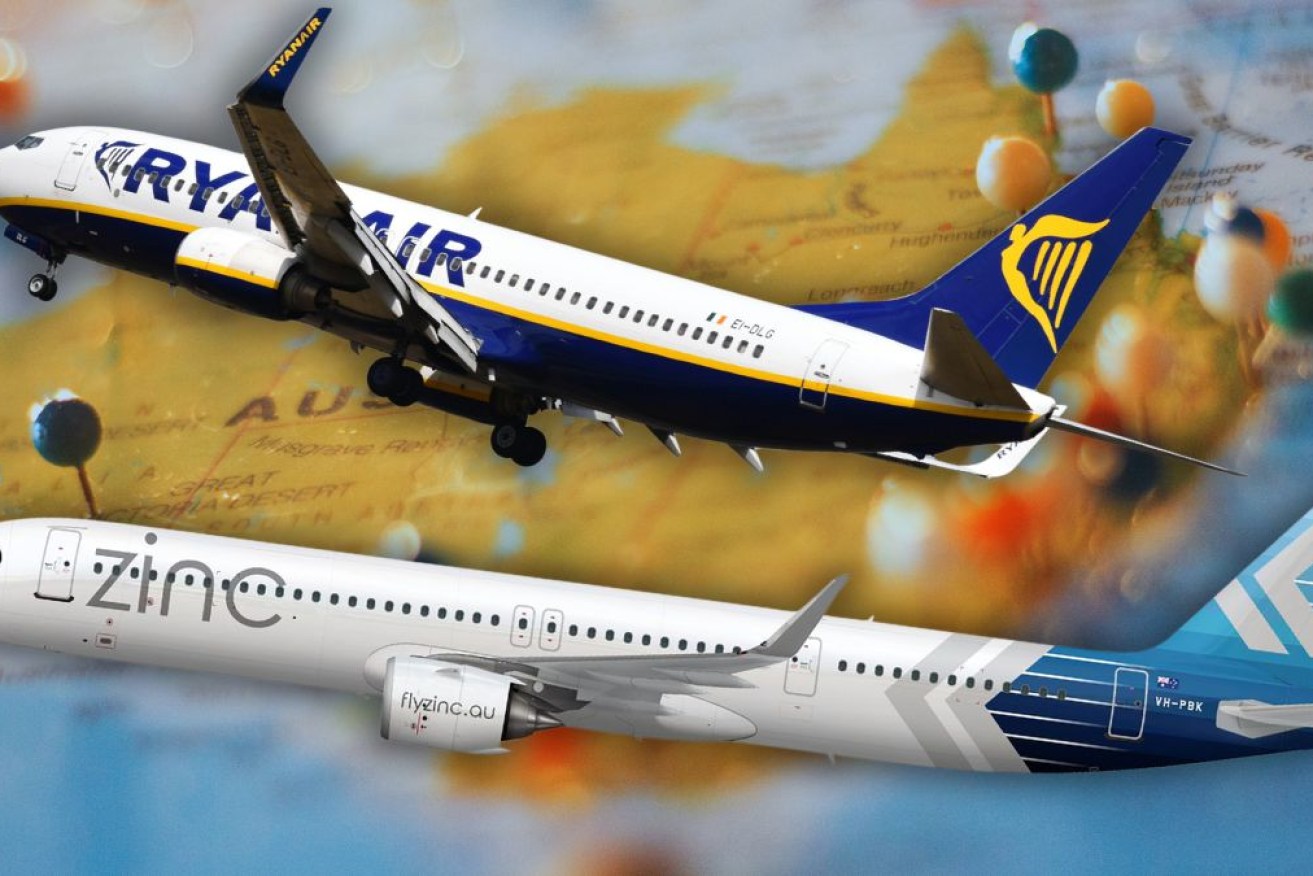
The new Australian airline will be modelled on successful ultra low-budget carrier Ryanair. Photos: AAP/Pexels/Canva/TND
A former Qantas boss is driving plans for a new low-budget airline modelled on British budget carrier Ryanair in the latest challenge to Australia’s aviation duopoly.
Peter Kelly – who ran Ansett’s Golden Wing Club before taking over Qantas’ frequent flyer program – has revealed a grand plan for a new airline, Zinc.
It proposes to offer the cheapest domestic tickets, initially only between the “golden triangle” of Sydney, Melbourne and Brisbane. Adelaide and the Gold Coast would be added later.
Zinc will have a fleet of Airbus A320neo aircraft and target highly price-sensitive travellers. It promises ultra-cheap base fares, and additional charges for add-ons such as checked baggage, seat selection and onboard food.
According to its website, Zinc intends to “exploit a once-in-a-generation structural shift in Australian domestic aviation – the opening of Western Sydney International Airport”.
The airport’s first cargo flights take off in July, followed by the first passenger flights in October. The list of airlines already signed up to operate from Western Sydney includes Qantas, Jetstar, Singapore Airlines and Air New Zealand.
Kelly, an aviation consultant since leaving Qantas, is banking on the new airport changing the economics of flying in Australia – offering Zinc a chance to succeed where so many other names have failed.
“One of the main features of an ultra-low-cost carrier model is its efficiency,” he told The Australian Financial Review.
“Some think it’s about not paying staff and low costs; it’s not. Our model is about sweating the assets and running the planes for 12 hours a day minimum.”

Zinc will operate a fleet of Airbus A320neo aircraft. Photo: AAP
Kelly, who also helped to set up Qantas’s budget carrier Jetstar, said it operated a larger model than his plans for Zinc – with more planes and destinations. He said the new Western Sydney airport presented the opportunity for a high enough volume of flights to be viable.
The Australian domestic market has been impeded by the limited number of landing “slots” available at Sydney’s existing Kingsford Smith Airport, which Kelly said were largely taken up by incumbent airlines.
Aviation experts think the plans might be a winner for travellers – at least in part.
Professor Rico Merkert, an industry expert from Sydney University, said an ultra-low budget airline like Zinc had the potential to bring down ticket prices across the board.
“For customers it would be great. More competition means lower prices,” he said.
But he said Jetstar would push back against another competitor in the market, particularly on its most profitable routes.
“They will do everything they can to make this a failure in my view,” he said.

Flights begin from the new airport later this year. Photo: Western Sydney International Airport
Merkert pointed out that Rex also chose to “poke the bear” by expanding from its regional roots to offering flights in the “golden triangle” and ultimately collapsed.
Rex is Australia’s largest independent regional airline, flying to 53 destinations across the nation. It fell into administration in 2024 with about $500 million in debt and was later snapped up by US aviation group Air T.
The federal government extended Rex an $80 million lifeline in late 2024, and bought $50 million of its debt from a major creditor to keep regional routes afloat.
Other upstart names to come and go in recent years include Bonza. It launched a low-cost service in 2023, largely between regional destinations, but collapsed after 15 months when its small fleet of Boeing 737 Max8s was abruptly repossessed.
Then there was Tigerair, which was brought undone by pandemic restrictions. Its owner, Virgin Australia, permanently grounded it in mid-2020.
In 2024, Koala Airlines announced plans for a domestic expansion. Chief executive Bill Astling said it had secured three Boeing 737s and an operating certificate.
Further back, there are even more aviation scalps: Compass Airlines in the early 1990s and Impulse Airlines, which was absorbed into QantasLink in 2001.
But Kelly said there was an appetite for more competition in Australia, not least from the Australian Competition and Consumer Commission.
“I don’t think [Qantas chief executive] Vanessa Hudson wants to see Qantas up on the front page of the newspapers with the ACCC filing [against] them for predatory practices,” he said.
Merkert also questioned the timing of the Zinc announcement, coinciding with a global fuel crisis, and just last week American ultra low-cost airline, Spirit, going bust.
“It’s an absolute crazy environment to set up an airline right now, when most other airlines are just trying to understand how they can survive,” he said.
RMIT aviation expert Chrystal Zhang agreed timing was critical, saying Zinc’s lead-up prior to its launch could potentially make for better conditions in the future.
“New airlines entering the market would face significant and very head on competition from the incumbent airlines,” she said.
“In theory, we need more airlines but in reality, perhaps it’s a different story.”
-with AAP
Want to see more stories from The New Daily in your Google search results?
- Click here to set The New Daily as a preferred source.
- Tick the box next to "The New Daily". That's it.