Boeing, FAA defend plane safety amid Air India crash questions

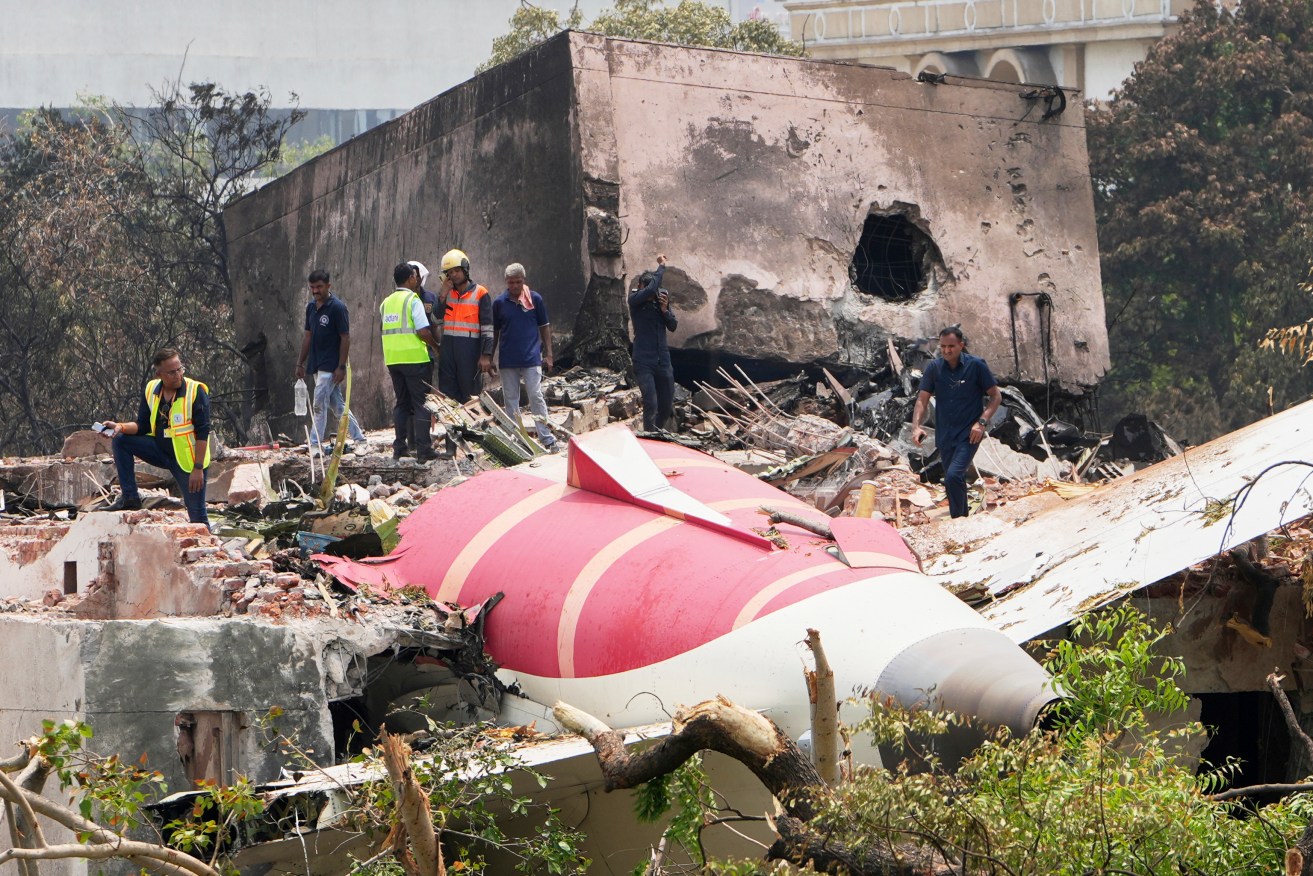
A preliminary report into the crash found both fuel control switches on the plane were cut off.
American aviation authorities and Boeing have privately issued notifications about the safety of the company’s planes, as preliminary reports into the Air India crash that killed 260 people last month raise fresh questions.
The US Federal Aviation Administration issued a Continued Airworthiness Notification on July 11 following a preliminary report into the Boeing 787-8 crash, which highlighted concerns about engine fuel cutoff switches.
“Although the fuel-control switch design, including the locking feature, is similar on various Boeing airplane models, the FAA does not consider this issue to be an unsafe condition that would warrant an Airworthiness Directive on any Boeing airplane models, including the Model 787,” the FAA’s notification to Civil Aviation Authorities, seen by Reuters, said.
The FAA said it had nothing to add.
Boeing also referred to the FAA notification in a Multi-Operator-Message sent to airlines in recent days. It said Boeing was not recommending any action, two sources with direct knowledge said.
Boeing referred Reuters’ questions to the FAA.
It follows the preliminary investigation report by India’s Aircraft Accident Investigation finding that immediately after the plane lifted off the ground, closed-circuit TV footage showed a backup energy source called a ram air turbine had deployed, indicating a loss of power from the engines.
In flight 171’s final moments, one pilot was heard on the cockpit voice recorder asking the other why he cut off the fuel.
“The other pilot responded that he did not do so,” the report said.
It did not identify which remarks were made by the flight’s captain and which by the first officer, nor which pilot transmitted “Mayday, Mayday, Mayday” just before the crash.
The commanding pilot of the Air India plane was Sumeet Sabharwal, 56, who had a total flying experience of 15,638 hours. The Indian government said he was also an Air India instructor.
His co-pilot was Clive Kunder, 32, who had 3403 hours of total experience.
The fuel switches had almost simultaneously flipped from run to cutoff just after takeoff. The preliminary report did not say how the switches could have flipped to the cutoff position during the flight.
The Gatwick-bound flight crashed into a medical college only minutes after takeoff from Ahmedabad, in western India, killing 241 of the 242 people on board. Another 19 people died on the ground and 67 were seriously injured.
The preliminary findings have sparked concerns among grieving families of those who died. Ameen Siddiqui, whose bother-in-law and niece died in the crash, said there had been a cover-up.
“It’s a cover-up to protect Air India and the government,” he told Britain’s Telegraph newspaper.
“They want to blame dead pilots who can’t defend themselves.
“How can the fuel switches end up turning off at a critical moment, either through pilot error or a mechanical fault?”
In a letter posted to X, ALPA India – which represents Indian pilots at the Montreal-based International Federation of Air Line Pilots’ Associations – said the report referred to the 2018 FAA advisory “concerning the fuel control switch gates, which indicates a potential equipment malfunction”.
The preliminary investigation report recommended, but did not mandate, operators of several Boeing models, including the 787, to inspect the locking feature of the fuel cutoff switches to ensure it couldn’t be moved accidentally.
It said Air India had said it had not carried out the FAA’s suggested inspections as the 2018 advisory was not a mandate.
But it also said maintenance records showed that the throttle control module, which includes the fuel switches, on the plane involved in the crash was replaced in 2019 and 2023.
The report noted “all applicable airworthiness directives and alert service bulletins were complied on the aircraft as well as engines”.
On Saturday, ALPA India rejected the presumption of pilot error and called for a “fair, fact-based inquiry”.
“The pilots body must now be made part of the probe, at least as observers,” president Sam Thomas told Reuters.
-with AAP
Want to see more stories from The New Daily in your Google search results?
- Click here to set The New Daily as a preferred source.
- Tick the box next to "The New Daily". That's it.