Would half of Australians really prefer One Nation to Labor?

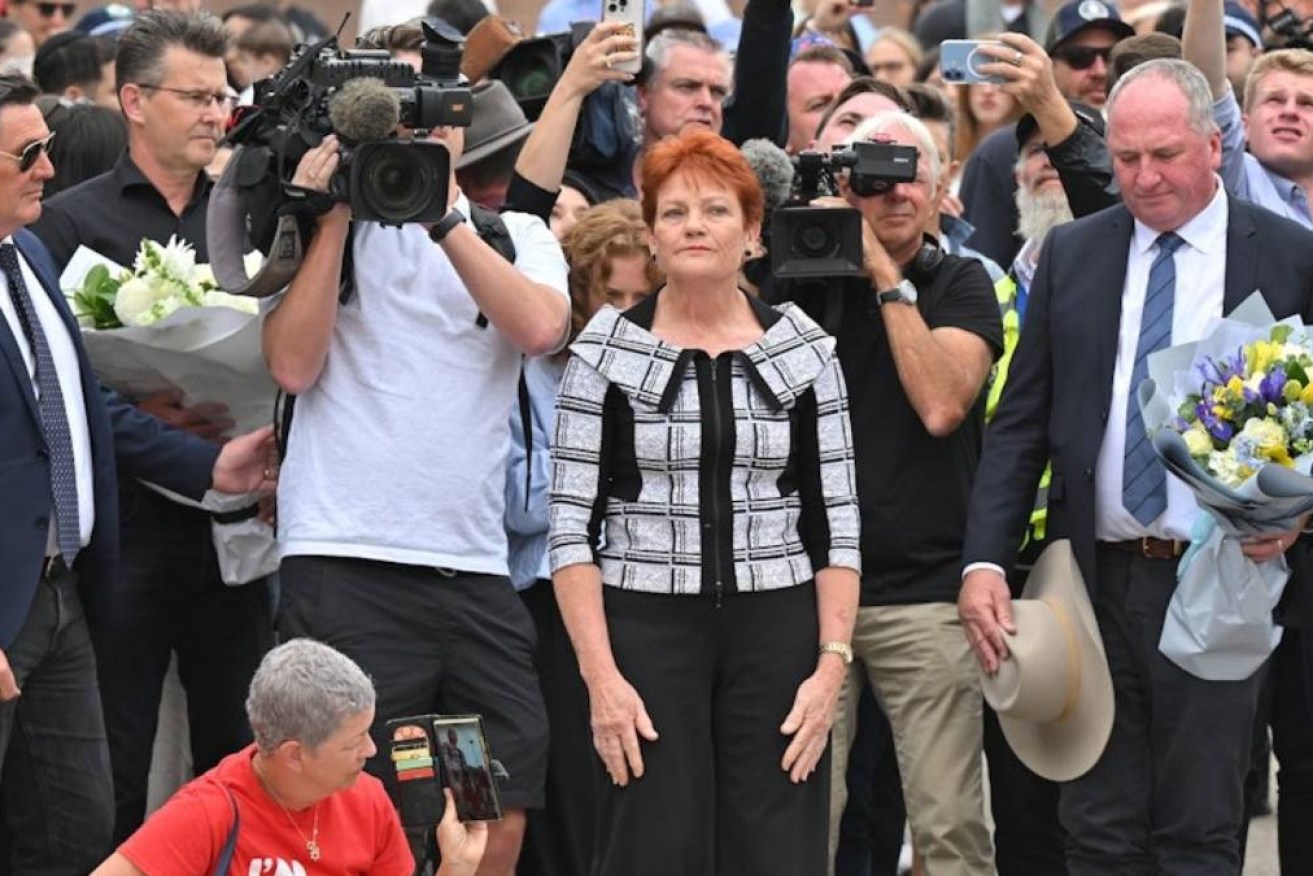
Support for One Nation has surged. Photo: AAP
Fresh political polling from Newspoll and Resolve confirm the growing support for One Nation.
Newspoll figures released Sunday night show One Nation with a bigger share of the primary vote than the Coalition, at 22 versus 21 per cent.
And while Resolve still had One Nation 10 points behind the Coalition, at 18 to 28 per cent, the two indicators follow sensational opinion polling by DemosAU released last week.
The DemosAU polling not only showed One Nation tied with the Coalition on “first-preference votes”, but also level with Labor on “two-party preferred”.
According to that polling research, if an election were held tomorrow, Labor would win 29 per cent of first-preference votes, One Nation and the Coalition would be tied on 23 per cent each, Greens would win 12 per cent and other 13 per cent.
One Nation won only 6 per cent of the vote at last year’s federal election. To put it another way, just under one million Australians voted “1” for a One Nation candidate in 2025, and this polling suggests over 3.5 million would do so today.
Whereas first-preference measures your most preferred party, the two-party preferred measures who Australians would vote for if they had only two options.
Last May, 55 per cent preferred their Labor candidate to the Liberal/National and 45 per cent preferred their Liberal/National candidate to Labor’s.
DemosAU compared Labor and One Nation. According to their calculations, exactly 50 per cent of Australians would prefer a One Nation MP to represent them over a Labor MP.
Polling is famously murky, but what do we know about One Nation’s rise in popularity?
One Nation is polling much higher, at the expense of the Coalition
Other pollsters have not shown as dramatic an increase for One Nation as DemosAU, but they do show an increase.
Here’s the Poll Bludger average for January 13, and how it compares to each party’s election result:

Two-party preferred is an uncertain measure
In each of Australia’s 150 lower house seats, a “two-candidate preferred” count between the last two candidates decides who wins the seat.
That’s usually Labor vs Liberal/National, but a growing number of seats are “non-classic” races like Liberal versus independent and Greens versus Labor.
The “national two-party preferred” count applies the two-candidate preferred logic to the national vote.
But while two-candidate preferred decides who wins each seat, national two-party preferred doesn’t decide anything.
A party can win government without winning the two-party preferred vote. John Howard did it in 1998: His Coalition government won 200,000 fewer two-party preferred votes than Labor, but Howard’s votes were in the right places. He won the most seats and therefore the election.
The national two-party preferred is useful for describing the popular will. It tells us that in 2025, 55 per cent of Australians preferred Labor to the Coalition, even though Labor was the first preference for only 35 per cent of Australians (the Coalition was the first preference for even less, just 32 per cent).
Here’s what the two-party preferred vote looked like in 2025, split by first-preference votes. Most of the almost two million Greens voters preferred Labor and most of the almost one million One Nation voters preferred the Coalition.

There is no good data for how a Labor/One Nation contest would go
DemosAU has useful polling data showing the Liberal–National Coalition and One Nation are neck-and-neck on first preferences.
But DemosAU also calculated that half of Australians prefer One Nation over Labor. It warns that this figure should be “treated with caution”, but I would argue the calculation is worse than useless.
How did DemosAU calculate a Labor/One Nation two-party preferred?
- Labor’s 29 per cent and One Nation’s 23 per cent were allocated to their respective parties.
- The Liberal/Nationals’ 23 per cent was split 17:83 Labor:One Nation, because that’s how the National voters split in the electorate of Hunter in 2025.
- The Greens’ 12 per cent was split 88:12 Labor:One Nation, because Greens voters split 88:12 Labor:Coalition in 2025.
- Other’s 13 per cent was split 50:50 Labor:One Nation, on the basis that their “composition” is unknown.
Three different approaches, none of which is grounded in how most of the country actually voted.
To get 50:50 Labor:One Nation, DemosAU made three major assumptions:
- Liberal/National voters all around Australia have the same voting habits as 20,000 Nationals voters in one of Australia’s 150 electorates.
- Greens voters who prefer the Coalition to Labor would also prefer One Nation to Labor.
- Because we know nothing about other voters, they’d split 50:50.
Since One Nation emerged in the late 1990s, there’s only been a scattering of other races across the country where the final count was between Labor and One Nation. We couldn’t find another example of One Nation doing as well on Coalition preferences as it did in Hunter in 2025.
Conclusion
Whether One Nation can turn polling into actual votes remains to be seen. Nor is One Nation’s dream polling run guaranteed to continue. The next election isn’t due for another two years.
We can accept the legitimacy and usefulness of the polling, while being sceptical of the conclusions drawn from it. One Nation’s first-preference vote polling is remarkable by itself, without a dubious two-party preferred figure to go along with it.
This article first appeared in The Point. Read the original here.
Want to see more stories from The New Daily in your Google search results?
- Click here to set The New Daily as a preferred source.
- Tick the box next to "The New Daily". That's it.


Pork barrel rolls out again – it's time for a change

Long-awaited migrant plan reflects needs and fears