War with China lurks beneath AUKUS, US-Australia talks

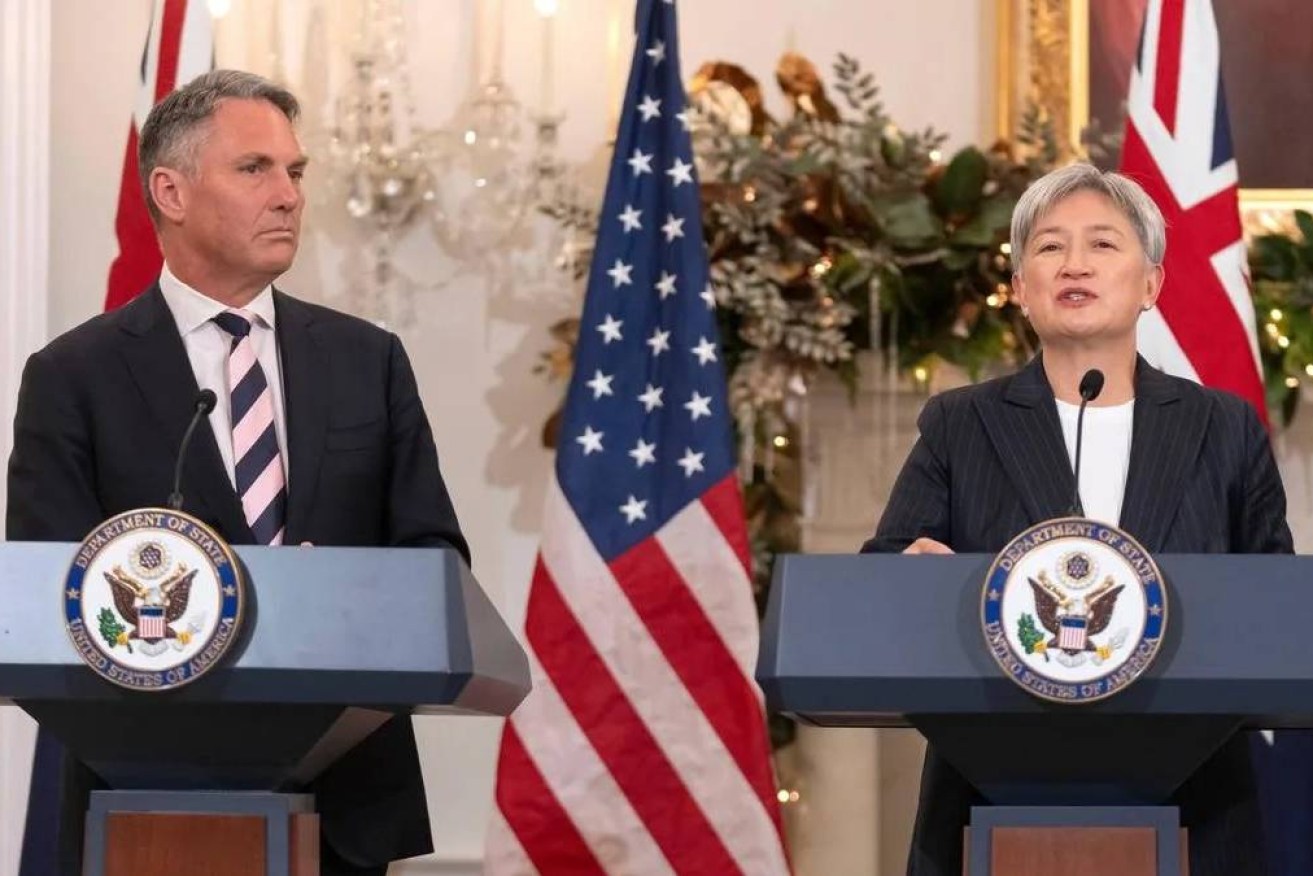
The US-Australia military partnership is no longer simply deepening, it is fusing. Photo: AAP
When US officials gathered in Washington this week for the 40th annual Australia-United States Ministerial Consultations (AUSMIN), the message was unmistakable.
The US-Australia military partnership is no longer simply deepening, it is fusing.
US Secretary of State Marco Rubio opened the meeting by emphasising that Australia is “our only ally that has fought with us in every war” in recent decades.
The subtext was clear – Canberra is not just a regional partner, it’s becoming a frontline state in Washington’s long-haul competition with China.
This year’s consultations landed at a moment when AUKUS – the trilateral pact binding Australia, the US, and the UK in a decades-long nuclear-submarine and advanced weapons partnership – is shifting from paperwork to production.
Both Rubio and Secretary of War Pete Hegseth reaffirmed President Donald Trump’s late-October declaration that the US would push “full steam ahead” on AUKUS, before outlining the plans for an Indo-Pacific security architecture dictated by deterrence, denial, and industrialised militarisation.
Hegseth used this year’s AUSMIN meeting to detail a sweeping list of joint initiatives: Upgrades to Australian air bases to accommodate expanded US bomber rotations; co-production of guided weapons, precision-strike missiles, and hypersonic systems; enhanced cooperation on Mark 54 torpedoes; and the integration of rare-earth and critical-mineral supply chains.
“These are practical, realistic ways that our two countries can come together to ensure that we provide peace through strength,” Hegseth said.
“The stronger we are together the more we can deter the kinds of conflicts neither of us want to see.”
But while Hegseth insists these measures stabilise the region, the construction of a shared war-making ecosystem across “land, air, and sea” risks accelerating the very trajectory toward war they are meant to prevent.
Crucially, this investment in military might is unfolding alongside an equally consequential economic deal that underpins it – rare-earth minerals.
During Prime Minister Anthony Albanese’s visit to Washington in October, the US and Australia committed to jointly invest more than US$2 billion (A$3 billion) in critical-mineral projects over the coming six months, with Washington signalling total investments could reach $3 billion.
The Export-Import Bank of the United States also issued statements of intent to provide $2.2 billion in financing, while the Pentagon will fund an advanced gallium refinery in Western Australia.

Albanese and Trump agreed to a massive rare-earth minerals deal. Photo: AAP
Canberra is matching that investment to support a rare-earth mining project in WA’s north.
This broader critical-minerals framework establishes what the White House called “a model for supply chain cooperation globally”.
The declared strategy is straightforward – counter China’s dominance over a sector it controls at staggering levels – roughly 70 per cent of rare-earth mining and 90 per cent of processing – a chokepoint central to the global “rare-earth” supply chain.
Australia and the US thus appear to be constructing not simply an alliance, but an integrated strategic economy with AUKUS at the centre.
The minerals, submarines, missiles and aircraft are not parallel tracks, but interlocking gears reflective of a military strategy that depends upon a flow of critical minerals immune to rising geopolitical tensions and China’s processing monopoly.
In tandem, Australia is preparing to contribute an additional US$1 billion to help expand US submarine-production capacity, part of a plan that involves Canberra purchasing at least three Virginia-class submarines in the 2030s, followed by development of the next-generation SSN-AUKUS submarine for the UK and Australia.
This investment underwrites the industrial hardware of the military buildup, while the rare-earth agreements secure the strategic fuel that makes it operational.
While the Trump administration’s stated rationale is straightforward – maintain regional stability by ensuring US and allied dominance beneath the waves – the deeper logic mirrors a longstanding pattern of US strategy in Asia and the Pacific.
Since China began modernising its navy and asserting vast, legally dubious claims in the South China Sea, Washington has responded with a strategy it claims is designed hold the line at the first island chain – from Japan through Taiwan to the Philippines – and now down to northern Australia.
However, nuclear-powered attack submarines are the not-so-quiet backbone of this containment architecture, and their mission profile is not defensive.
In any hypothetical crisis in Taiwan, allied submarine superiority is seen as key to breaking a Chinese blockade.
AUKUS is meant to ensure Australia is not simply a supporting actor but an operational partner in such a catastrophic scenario.
This is precisely why Beijing frames AUKUS as part of an “all-round containment“ effort.
Expanding submarine cooperation, missile co-production, and forward basing increases the risk of miscalculation in an already crowded maritime space where overlapping territorial claims and constant military activity leave little room for error.
Beyond operational strategy, the AUKUS ecosystem is fortifying the defence industrial bases of all three countries.
That includes creating vertically integrated supply chains for the critical minerals and rare earths essential for advanced weapons systems, a move Hegseth called “a huge part” of enabling joint force operations.

AUKUS is fortifying the defence industrial bases of all three countries. Photo: AAP
Supporters argue that AUKUS shields democracies from Chinese supply coercion, while critics contend it binds Australia’s economy ever tighter to US military priorities, leaving ultimate control over production and deployment in Washington’s hands.
Regardless of perspective, the pact underscores an uncomfortable reality – the more nations co-develop advanced weapons, the stronger the political incentives to justify their use.
The deal potentially marks another shift of momentum in a securitisation spiral in which defensive preparations by the US and its allies are read as offensive by China, hardening narratives, constricting diplomatic space and raising the stakes of every regional flare-up.
AUKUS was launched in 2021 amid already-heightened rivalry.
Three years later, it has evolved into a comprehensive fusion of strategy, force posture and weapons manufacturing.
The new AUSMIN announcements make clear that Washington and Canberra view the next decade as decisive, and that their stated strategy is to deter China by preparing – materially and psychologically – for war.
But deterrence is a fragile pretext.
As two nuclear-armed powers view the same waters – the South China Sea, Taiwan and the broader Indo-Pacific – through irreconcilable lenses, the US and Australia’s multibillion-dollar investments in bases, missiles, submarines and critical-mineral supply chains become more than technical decisions.
They are declarations of power, linking economic leverage directly to military capability and signalling a posture that extends far beyond nuclear submarines alone.
Want to see more stories from The New Daily in your Google search results?
- Click here to set The New Daily as a preferred source.
- Tick the box next to "The New Daily". That's it.


Pork barrel rolls out again – it's time for a change
Long-awaited migrant plan reflects needs and fears