The debate about net zero ignores the evidence

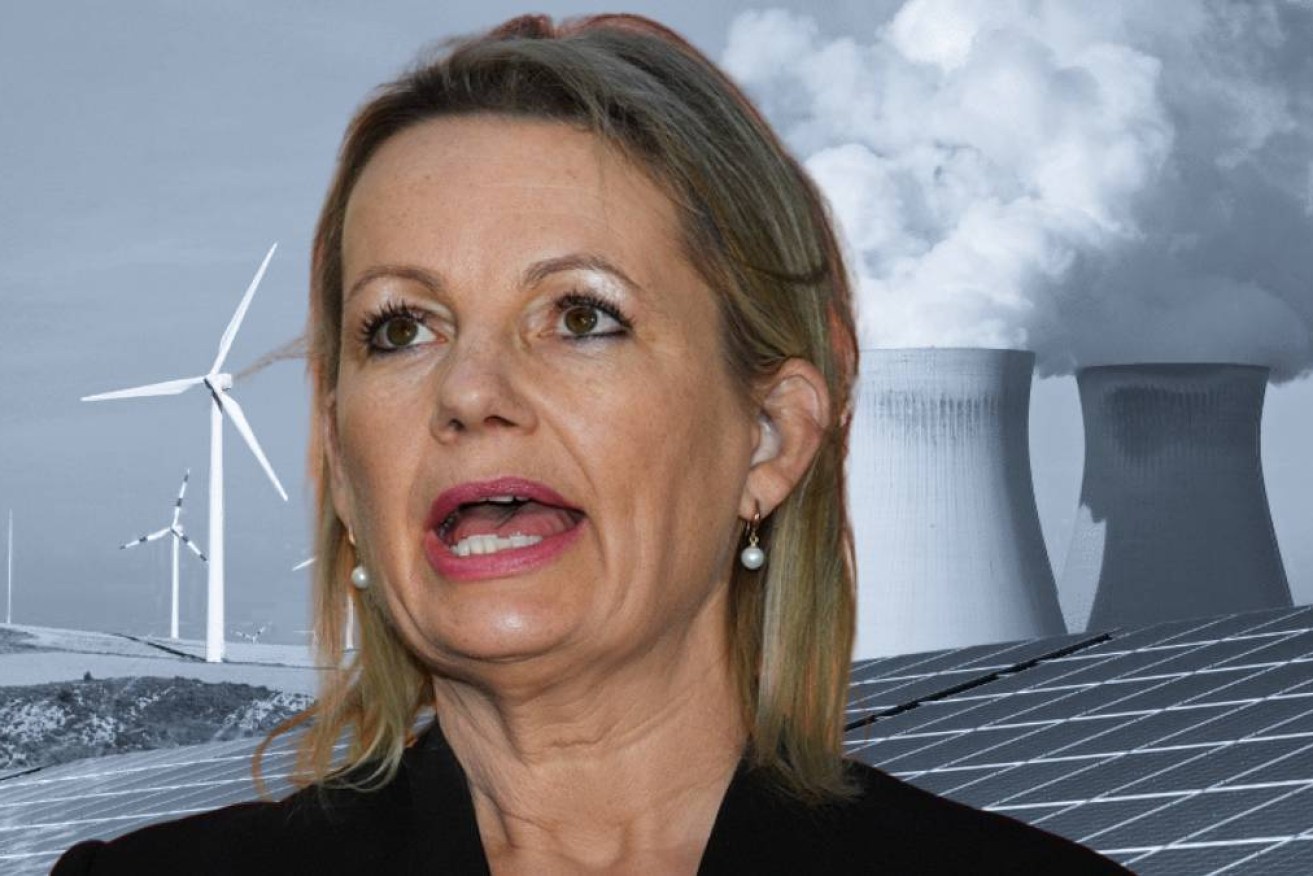
Sussan Ley is inviting us all to believe that there is a trade-off between reducing carbon emissions and the cost of electricity. Photo: TND/AAP
Those in the Coalition who are opposed to targeting net zero carbon emissions argue that it will cost too much.
But that claim is false and not supported by the evidence. How can they get away with it?
In the past week or so, since the Nationals dropped their commitment to net zero carbon emissions, the Liberals have been tearing themselves apart over what should be their policy response.
Liberal members of parliament met in Canberra on Wednesday to discuss net zero. That meeting lasted hours – but even then a final party position was to be left up to shadow cabinet to determine on Thursday.
There is much speculation as to whether the Liberals will split over this issue, or whether a compromise will be found.
Certainly, leader Sussan Ley has made it clear that there “cannot be net zero at any cost”.
Ley then went on to castigate Labor for what she claimed was a 40 per cent increase in Australian electricity bills since the Albanese government was elected, a bit over three years ago.
Ley’s clear implication is that this increase is excessive and is due to Labor’s support for switching to renewable energy, in pursuit of its net zero target.
In effect, Ley is inviting us all to believe that there is a trade-off between reducing carbon emissions and the cost of electricity, and thus the cost of living.
But where is the evidence to support this presumption that mitigating climate change may well involve an unacceptable cost to the economy and living standards?
Certainly, Ley and the Liberal Party have provided no evidence in support of this critical contention. Even more strange, and disturbing, is that neither Labor nor the commentariat have thought to examine the evidence as to whether renewable energy can only come at a cost to the economy.
This failure to consider the evidence risks establishing a public presumption that action to reduce the risks of climate change can come only at a cost, which may or may not be acceptable.
As will be shown below, however, in fact the evidence is that renewable energy is cheaper than fossil fuels. Further, this evidence is readily available, so it is a matter of real concern that it has been ignored so far in the public debate about net zero.
The cost of renewable energy
A couple of months ago, in August, the Climate Council produced a report called What is the Cheapest Form of Electricity in Australia?.
This report was based on evidence from Australia’s leading energy and science bodies, including the Australian Energy Regulator, Australian Energy Market Operator, Australian Energy Market Commission, and the CSIRO.
The principal conclusion was that: “Their analysis consistently shows that renewable power, backed by storage like pumped hydro and batteries, is the most cost-effective way to keep reliably powering Australian homes and businesses.”
Renewables are the cheapest form of power because, unlike fossil fuels, the sun and wind are infinitely and freely available in Australia.
In contrast, coal and gas-fired power stations pay international prices for these fossil fuels. Thus, according to the Climate Council Report, “on average in 2024-25, the wholesale price for power from renewables was $74 per megawatt hour (MWH) – compared to $136/MWH for power from coal or gas”.
Further, it is the high international price of gas that has played a big part in driving up household power bills over the past few years. According to the Climate Council Report, research from Griffith University “shows that because gas is so expensive, gas prices drive 50-90 per cent of pricing periods in the National Electricity Market”.
In addition, outages at coal-fired power stations are responsible for some of the most severe power prices spikes in recent years.
Overall, the CSIRO’s 2024-25 GenCost Final Report found for the seventh year in a row that renewables backed by storage and transmission are the lowest cost new-build electricity generation technologies.
A mix of wind and solar cost $120-$170/MWH on average in 2024, while the cost of building new gas generation was up to $199/MWH.
Already, more than 40 per cent of Australia’s electricity comes from solar, wind and hydro power, and this is rapidly increasing. Further, renewable energy is, in fact, reliable. The Climate Council has found that “a combination of household, community and big batteries and pumped hydro can store excess power when it is available and make it available later on when we need it”.
Also, over time the cost of renewables is expected to fall further: By 2030 the costs of renewable projects are expected to be between $76-$131/MWH.
Since 2013, global battery prices have fallen by 86 per cent. In the past year alone, the cost of battery storage has decreased by about 20 per cent, and the cost of large scale solar has dropped by 8 per cent for the past two years in a row.
In future, renewables can therefore help keep power prices in check, whereas if we continued our reliance on coal and gas rather than increasing renewables, the Climate Council estimates that power prices would increase by $449 a year for households, and $877 for a small business this decade.
No wonder the Climate Council expects that “Australia’s entire fleet of coal-fired power stations is expected to retire by 2038, and 80 per cent of them will shut down over the next decade”.
Clearly we need to get on with investment in renewable energy projects. Fortunately, the opportunities are being recognised, with the Climate Council forecasting that private investors will invest as much as $68 billion in renewable energy projects over the next five years.
The biggest risk is that the climate change sceptics succeed in creating so much uncertainty causing investment delays.
Conclusion
The evidence provides overwhelming support for the conclusion that Australia will gain financially from the switch to renewable energy, and that there is no cost to pursuing net zero. Rather the reverse.
Net zero is very much to our economic advantage as well as reducing the risks and consequent costs of climate change.
But that still leaves the puzzling question as to why the debate about net zero emissions in Australia has so far so completely ignored the evidence.
Clearly the Coalition is at fault, as it is considering abandoning net zero. But a competent Labor government could reasonably have been expected to point out how the evidence does not support abandoning net zero, and the economic advantages that could be expected to flow to Australia.
Frankly, I cannot understand why Labor has preferred to sit on the sidelines in this Coalition debate and has not cited the evidence to support its own policies to achieve net zero emissions.
After all, Labor knows that renewable energy is cheaper, and especially so in Australia, as that is the basis for its planned “Future Made in Australia”.
Michael Keating is a former secretary of the Departments of Prime Minister and Cabinet, Finance and Employment, and Industrial Relations. He is presently a visiting fellow at the Australian National University.
This article first appeared in Pearls and Irritations. Read the original here
Want to see more stories from The New Daily in your Google search results?
- Click here to set The New Daily as a preferred source.
- Tick the box next to "The New Daily". That's it.


Pork barrel rolls out again – it's time for a change
Long-awaited migrant plan reflects needs and fears