Right-wing extremist violence is more frequent and more deadly than left-wing violence


It’s clear that Trump's assertions about political violence from the left are not based on actual facts. Photo: Getty
After the September 10, 2025, assassination of conservative political activist Charlie Kirk, President Donald Trump claimed that radical leftist groups foment political violence in the US, and “they should be put in jail.”
“The radical left causes tremendous violence,” he said, asserting that “they seem to do it in a bigger way” than groups on the right.
Top presidential adviser Stephen Miller also weighed in after Kirk’s killing, saying that left-wing political organisations constitute “a vast domestic terror movement”.
“We are going to use every resource we have … throughout this government to identify, disrupt, dismantle and destroy these networks and make America safe again,” Miller said.
But policymakers and the public need reliable evidence and actual data to understand the reality of politically motivated violence. From our research on extremism, it’s clear that Trump’s and Miller’s assertions about political violence from the left are not based on actual facts.
Based on our own research and a review of related work, we can confidently say that most domestic terrorists in the US are politically on the right, and right-wing attacks account for the vast majority of fatalities from domestic terrorism.
Source: Real America's Voice
Political violence rising
The understanding of political violence is complicated by differences in definitions and the recent US Department of Justice removal of an important government-sponsored study of domestic terrorists.
Political violence in the US has risen in recent months and takes forms that go unrecognised. During the 2024 election cycle, nearly half of all states reported threats against election workers, including social media death threats, intimidation and doxing.
Kirk’s assassination illustrates the growing threat. The man charged with the murder, Tyler Robinson, allegedly planned the attack in writing and online.
This follows other politically motivated killings, including the June assassination of Democratic Minnesota state Rep. and former House Speaker Melissa Hortman and her husband.
These incidents reflect a normalisation of political violence. Threats and violence are increasingly treated as acceptable for achieving political goals, posing serious risks to democracy and society.
Defining ‘political violence’
This article relies on some of our research on extremism, other academic research, federal reports, academic datasets and other monitoring to assess what is known about political violence.
Support for political violence in the US is spreading from extremist fringes into the mainstream, making violent actions seem normal. Threats can move from online rhetoric to actual violence, posing serious risks to democratic practices.
But different agencies and researchers use different definitions of political violence, making comparisons difficult.
The FBI and Department of Homeland Security define domestic violent extremism as threats involving actual violence. They do not investigate people in the US for constitutionally protected speech, activism or ideological beliefs.
Domestic violent extremism is defined by the FBI and Department of Homeland Security as violence or credible threats of violence intended to influence government policy or intimidate civilians for political or ideological purposes. This general framing, which includes diverse activities under a single category, guides investigations and prosecutions.
Datasets compiled by academic researchers use narrower and more operational definitions. The Global Terrorism Database counts incidents that involve intentional violence with political, social or religious motivation.
These differences mean that the same incident may or may not appear in a dataset, depending on the rules applied.
The FBI and Department of Homeland Security emphasise that these distinctions are not merely academic. Labeling an event “terrorism” rather than a “hate crime” can change who is responsible for investigating an incident and how many resources they have to investigate it.
For example, a politically motivated shooting might be coded as terrorism in federal reporting, cataloged as political violence by the Armed Conflict Location and Event Data Project, and prosecuted as homicide or a hate crime at the state level.
Patterns in incidents and fatalities
Despite differences in definitions, several consistent patterns emerge from available evidence.
Politically motivated violence is a small fraction of total violent crime, but its impact is magnified by symbolic targets, timing and media coverage.
In the first half of 2025, 35 per cent of violent events tracked by University of Maryland researchers targeted US government personnel or facilities – more than twice the rate in 2024.
Right-wing extremist violence has been deadlier than left-wing violence in recent years.
Based on government and independent analyses, right-wing extremist violence has been responsible for the overwhelming majority of fatalities, amounting to approximately 75 per cent to 80 per cent of US domestic terrorism deaths since 2001.
Illustrative cases include the 2015 Charleston church shooting, when white supremacist Dylann Roof killed nine black parishioners; the 2018 Tree of Life synagogue attack in Pittsburgh, where 11 worshippers were murdered; the 2019 El Paso Walmart massacre, in which an anti-immigrant gunman killed 23 people. The 1995 Oklahoma City bombing, an earlier but still notable example, killed 168 in the deadliest domestic terrorist attack in US history.
By contrast, left-wing extremist incidents, including those tied to anarchist or environmental movements, have made up about 10-15 per cent of incidents and less than 5 per cent of fatalities.
Examples include the Animal Liberation Front and Earth Liberation Front arson and vandalism campaigns in the 1990s and 2000s, which were more likely to target property rather than people.
Violence occurred during Seattle May Day protests in 2016, with anarchist groups and other demonstrators clashing with police. The clashes resulted in multiple injuries and arrests. In 2016, five Dallas police officers were murdered by a heavily armed sniper who was targeting white police officers.
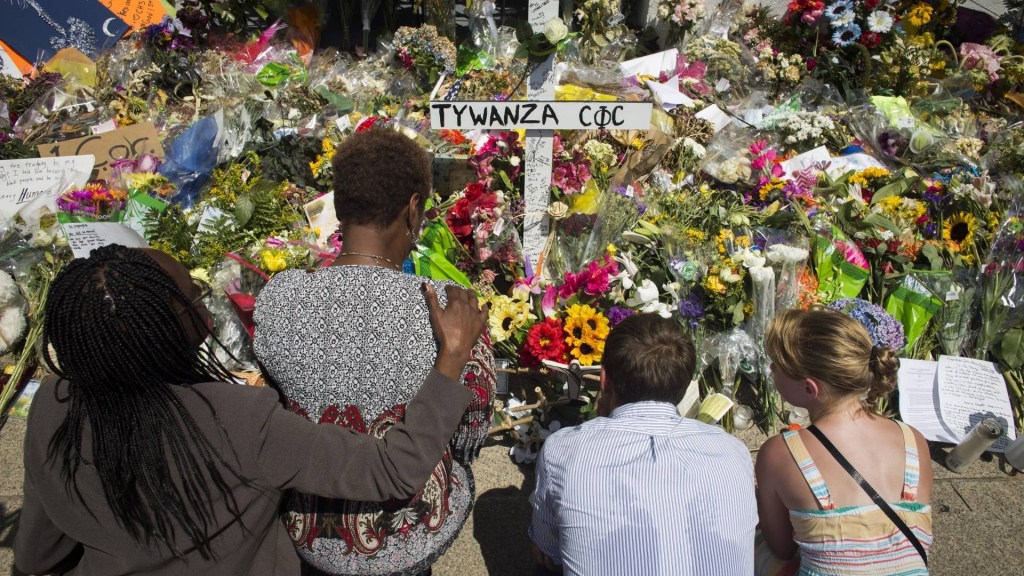
A memorial outside Emanuel AME Church in Charleston, South Carolina. Photo: AAP
Hard to count
There’s another reason it’s hard to account for and characterise certain kinds of political violence and those who perpetrate it.
The US focuses on prosecuting criminal acts rather than formally designating organisations as terrorist, relying on existing statutes such as conspiracy, weapons violations, RICO provisions and hate crime laws to pursue individuals for specific acts of violence.
Unlike foreign terrorism, the federal government does not have a mechanism to formally charge an individual with domestic terrorism. That makes it difficult to characterise someone as a domestic terrorist.
The State Department’s Foreign Terrorist Organisation list applies only to groups outside of the United States. By contrast, US law bars the government from labeling domestic political organisations as terrorist entities because of First Amendment free speech protections.
Rhetoric is not evidence
Without harmonised reporting and uniform definitions, the data will not provide an accurate overview of political violence in the US
But we can make some important conclusions.
Politically motivated violence in the US is rare compared with overall violent crime. Political violence has a disproportionate impact because even rare incidents can amplify fear, influence policy and deepen societal polarisation.
Right-wing extremist violence has been more frequent and more lethal than left-wing violence. The number of extremist groups is substantial and skewed toward the right, although a count of organisations does not necessarily reflect incidents of violence.
High-profile political violence often brings heightened rhetoric and pressure for sweeping responses. Yet the empirical record shows that political violence remains concentrated within specific movements and networks rather than spread evenly across the ideological spectrum.
Distinguishing between rhetoric and evidence is essential for democracy.
Trump and members of his administration are threatening to target whole organisations and movements and the people who work in them with aggressive legal measures – to jail them or scrutinise their favourable tax status. But research shows that the majority of political violence comes from people following right-wing ideologies.
Art Jipson and Paul J. Becker are Associate Professors of Sociology at the University of Dayton
Want to see more stories from The New Daily in your Google search results?
- Click here to set The New Daily as a preferred source.
- Tick the box next to "The New Daily". That's it.



Pork barrel rolls out again – it's time for a change

Long-awaited migrant plan reflects needs and fears