Why we must feed the children – now

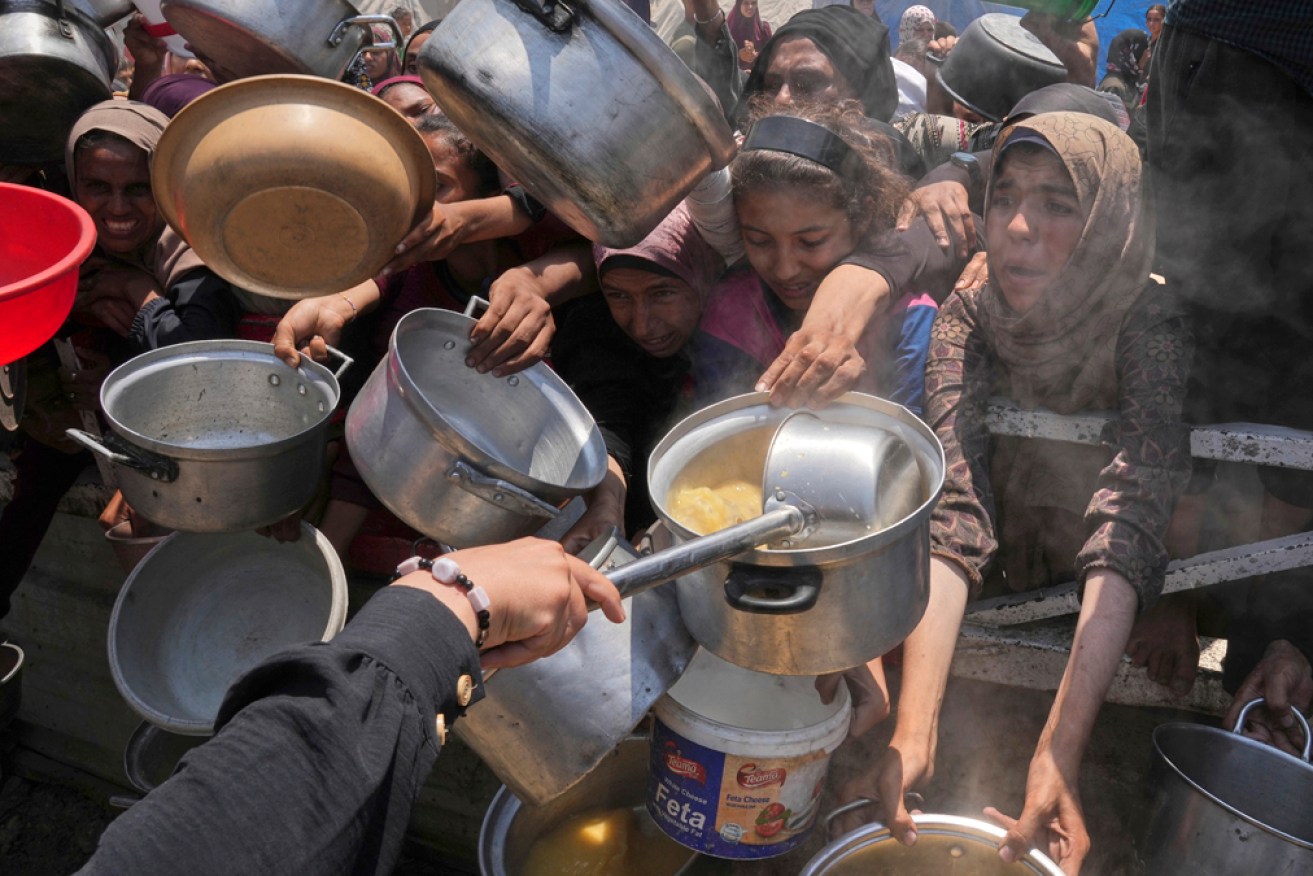
Images from Gaza have shocked the world. Photo: AAP
After a long day, I found myself scrolling through my Instagram feed to escape all the looming deadlines and mounting work on my desk.
I usually find a clip from Seinfeld or a skit about US President Donald Trump on Saturday Night Live that makes me chuckle. But to my surprise I came across a reel from the BBC where I actually found myself agreeing with comments from Trump.
When asked if he agreed with the Israeli Prime Minister’s claim that it was a “bold-faced lie” to say Israel was fuelling hunger in Gaza, the US President replied: “I don’t know… those children look very hungry… that’s real starvation stuff.”
Reassuringly, he went on “We can save a lot of people, … I see it and you can’t fake that. So, we’re going to be even more involved.”
It seems that Trump, like millions of others around the world, has become increasingly horrified by the stories and images of starving children in Gaza. The image below, published in The Atlantic, of five year old Lana Salih Juha suffering from severe malnutrition, is both heartbreaking and haunting.
Her suffering, like the millions of other children in Gaza, is entirely preventable. Armed conflict is always caused by adults and yet it is always children who bear the greater burden. As adults we never seem to genuinely accept or recognise this reality.
Indeed, the image of Lana reminds me of the image distributed by Eglantyne Jebb on a leaflet in London’s Trafalgar Square in 1919, to raise awareness about the devastating impact on children caused by the western blockade imposed on Germany and its allies after World War I.
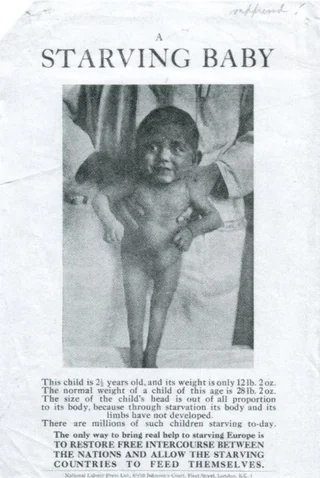
Source: Reddit
Jebb, who was prosecuted and fined for this act, went on to draft the first Declaration on the Rights of Child in 1924. Its principles remain as relevant today to the situation in Gaza, as they were over a century ago in Europe:
- Every child should be given what they need to grow up happy and healthy.
- When a child is hungry, they must be fed. When they are sick, they must be cared for. And when they need support, shelter or guidance, they must be given it.
- Whenever there is a crisis, children should be the first to receive aid.
Fulfilling these goals it not a question of can we – there is no shortage of food – but will we? Will we demand that our leaders take every feasible measure to pressure those adults who control Gaza to put food in the mouths of these children, to provide them with medical care, to offer them safety and shelter? Will we provide the support necessary to the non-government organisations and humanitarian organisations that are so desperately trying to help the children in Gaza?
Will we, as adults, turn away from this horror or actually reflect on the outrageous harm that we allow other adults to inflict upon children over and over again?
As World War II drew to a close, a young girl, Anne Frank, penned one of the final entries in her diary with sentiments that I am sure are felt by many children in Gaza:
If you’re wondering whether it’s harder for the adults here than for the children, the answer is no, it’s certainly not. … It’s twice as hard for us young people to hold on to our opinions at a time when ideals are being shattered and destroyed, when the worst side of human nature predominates, …
It’s difficult in times like these: Ideals, dreams and cherished hopes rise within us, only to be crushed by grim reality.
It’s a wonder I haven’t abandoned all my ideals, they seem so absurd and impractical. Yet I cling to them because, in spite of everything, I believe that people are truly good at heart.
The last line gets me every time I read it. Anne’s faith in humanity is challenged every time adults cause unthinkable harm to children.
Gaza is an unthinkable harm. It’s time to end this suffering and restore Anne’s faith. No more excuses from any adult anywhere. Just do it – feed the children.
John Tobin is a professor of human rights law in the Melbourne Law School at the University of Melbourne, and co-director of studies for the human rights program in the Master of Laws and co-director of research in human rights within the Institute for International Law and the Humanities
Want to see more stories from The New Daily in your Google search results?
- Click here to set The New Daily as a preferred source.
- Tick the box next to "The New Daily". That's it.


Pork barrel rolls out again – it's time for a change
Long-awaited migrant plan reflects needs and fears