This award-winning ghostly image was 10 years in the making

Source: Natural History Museum
Wim van den Heever’s award-winning image of a shy brown hyena in an abandoned mining town being reclaimed by the desert is a triumph of both artistic vision and extraordinary patience.
The South African wildlife photographer had the idea of capturing a hyena on film after spotting tracks around Kolmanskop in Namibia.
Because the animal is so elusive, however, he quickly realised he would need to use a camera trap – a remote-activated camera automatically triggered by motion. Even then, it still took him 10 years to get the photo that has just won top prize in the Wildlife Photographer of the Year Award 2025.
“The story I hope to tell about this picture is that humans and wildlife can co-exist,” van den Heever said in a video shared by the Natural History Museum in London, which runs the award.
“It’s practically the only picture that I have for 10 years’ worth of work trying to photograph this elusive animal in the deserted streets of Kolmanskop.”
Initially, his camera trap in front of the derelict house captured “absolutely nothing”, but he persisted. On the evening he was finally successful, a few stars appeared over the building before fog started rolling in from the ocean to create a perfect backdrop for the brown hyena that entered at the right of the frame.
“And then I’ve got one winning picture to show… When I looked at the picture as it came up on my camera I couldn’t believe my eyes, you know.
“It is the ghost that I’ve always dreamt of.”
Titled Ghost Town Visitor, the photo beat a record 60,636 entries from 113 countries and territories to take out top prize in the Wildlife Photographer of the Year Award 2025.
Van den Heever’s photograph also won the award’s Urban Wildlife Category, with jury chair Kathy Moran explaining that it offered a unique take on the idea of “urban”.
“It once was but is no longer a human-dominated environment,” Moran said of Kolmanskop.
“Abandoned by miners, wildlife has taken over. Repopulated, if you will. Is it still a town? It would seem that way to me – just no longer ours.”
Brown hyenas are the rarest hyena species in the world. Natural History Museum zoologist Dr Natalie Cooper said their population in the wild was estimated to be between 4000 and 10,000.
Kolmanskop – abandoned 70 years ago after the diamonds being mined ran out – is a place they pass through on their way to hunt fur seal pups or scavenge for carrion washed ashore along the Namib Desert coast.
“They’re really social animals – they live in family clans of about five to six individuals,” Cooper said.
“They live in very dry habitats where food is quite scarce so they often have to travel great distances to find food, sometimes up to 50 kilometres.”
The Natural History Museum is showing the top 100 images from the Wildlife Photographer of the Year Competition in an exhibition until July 12, 2026. They can also be viewed in an online gallery.
Other winners include a drone image capturing hundreds of fledgling emperor penguins walking along the edge of an ice shelf in Antarctica, rose-ringed parakeet nipping the tail of a Bengal monitor in India, and a caracal (wild cat) with a lesser flamingo in its mouth in Tanzania.
Western Australian photographer Ross Gudgeon’s macro image revealing the forest-like structure of a cauliflower coral in Lembeh Strait, Indonesia, was highly commended in the Natural Artistry category after previously taking out top prize in the Australian Geographic Nature Photographer of the Year competition, run by the South Australian Museum.
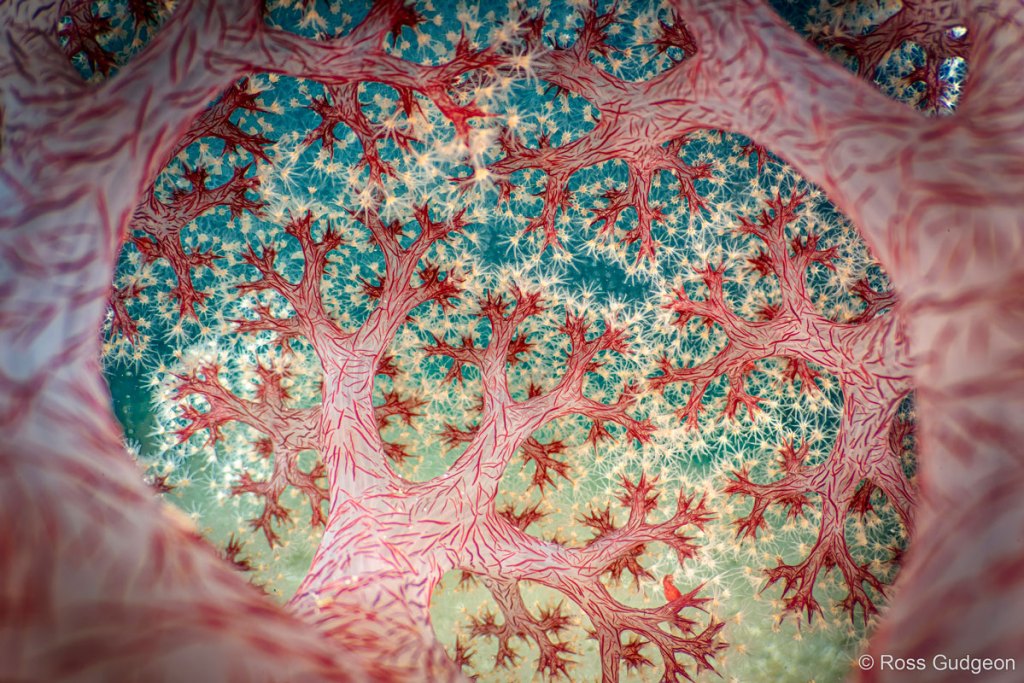
Fractal Forest, by Ross Gudgeon, reveals the forest-like structure of a cauliflower coral.
Like Ghost Town Visitor, Gudgeon’s Fractal Forest has an other-worldly quality, even though it was captured under water and in very different circumstances. He had to thread the end of an extended macro wide lens through the branches of the soft coral to get an image looking from the inside out.
“After some trial and error and with backlighting from my strobes I was able to produce my winning image,” Gudgeon said.
“The moral of my story is that beauty can be found anywhere.”
Category winners include:
Source: Wildlife Photographer of the Year 2025
Want to see more stories from The New Daily in your Google search results?
- Click here to set The New Daily as a preferred source.
- Tick the box next to "The New Daily". That's it.