Get ready for a budget slowdown. But Chalmers insists we won’t see a recession

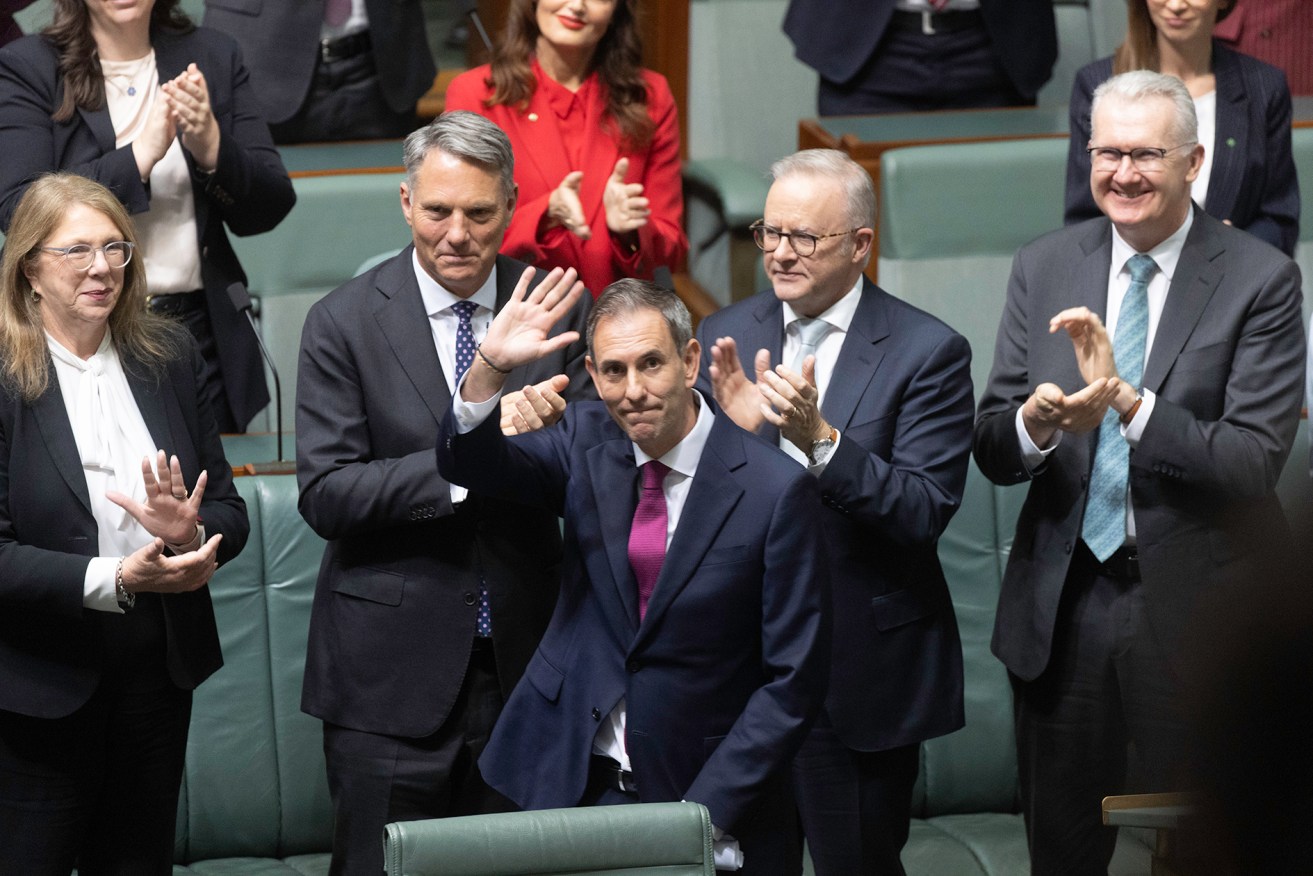
The main adversary hampering the budget is a war in the Middle East. Photo: Mike Bowers
Treasurer Jim Chalmers has called his budget “ambitious in the face of adversity”.
Speaking to reporters in the lockup on Tuesday night, he acknowledged his latest budget is “not exactly the same budget we would have handed down in February for obvious reasons”.
The main adversity is a war in the Middle East that has disrupted around a fifth of global seaborne oil and gas supply. It has also hit global supply chains for fertiliser, chemicals, aluminium and plastics.
Treasury assumes the global economy will slow from 3.5 per cent growth in 2025 to 3 per cent in 2026.
A slowing economy
As a consequence, the Australian economy is forecast to suffer a similar slowdown, with inflation rising more quickly than previously forecast.
The updated Treasury forecasts in the federal budget envisage growth in the Australian economy will slow from 2.25 per cent growth in 2025-26 to a modest 1.75 per cent next year.
Australia’s exports are forecast to barely grow at all – just 1 per cent.
Adding to the gloom for exporters, the prices of our key commodity exports – iron ore, coal, LNG and gold – are assumed to decline from what Treasury calls elevated levels.
Business investment and housing construction are also both projected to slow in 2026-27.
Supply chain disruptions due to the war pose a risk of weaker business investment, because most capital equipment is imported.
The government is optimistic employers will respond to the economic slowdown by cutting hours, rather than laying off workers.
The unemployment rate is expected to rise only slightly, from 4.3 per cent to 4.5 per cent, remaining well below pre-pandemic levels.
A surge in prices
In last year’s budget, Treasury was expecting a benign inflation outlook. The forecast was for consumer prices to rise by 3 per cent in 2025-26 and then 2.5 per cent in the next three years. This would be comfortably in the middle of the Reserve Bank’s 2-3 per cent target range.
But the inflation outlook has deteriorated markedly with the war in the Middle East driving up the prices of petrol, fertilisers and plastics.
This year’s budget predicts inflation will peak at 5 per cent this financial year before returning to around the midpoint of the Reserve Bank’s target range in the following years.
This is similar to the Reserve Bank’s latest forecast, which has inflation peaking at 4.8 per cent this quarter. The central bank also forecasts inflation to drop back into the target range as the oil price drops.
Cost of living stress continues
High inflation and rising interest rates from the Reserve Bank will lead households to tighten their belts.
Wages growth, at only 3.25 per cent, is predicted to lag well behind the 5 per cent growth in prices this year, putting more strain on household budgets.
On a more positive note, the moderation in wages will help keep the unemployment rate low.
In subsequent years, wages growth is forecast at 3.5 per cent, above the forecast 2.5 per cent inflation, allowing households to gradually restore their living standards.
It could be worse
The Treasury forecasts assume the Middle East conflict eases and allows global oil prices to fall from mid-2026 (that is, very soon).
The budget papers also include alternative scenarios. In the pessimistic scenario, an escalation in the conflict drives oil prices up to about double the current level of US$100.
Although growth would slow further, Chalmers says even under the severe scenario, we would still avoid a recession.
Under this scenario, inflation peaks at over 7 per cent and the unemployment rate hits 5 per cent. This would pose an even more challenging question for the Reserve Bank, which may feel it needs to increase interest rates even further to maintain the credibility of their 2-3 per cent inflation target.
More red ink
The budget continues to project deficits, equivalent to 1 per cent of GDP, for four years.
Further out, the gap between spending and revenue gradually narrows until the budget is back in balance around 2034-35. If the economy is weaker than Treasury is forecasting, however, these deficits will be even larger.
Continuing deficits translate into increasing government debt. But a growing economy means that debt relative to GDP peaks in 2028-29.
That’s on current estimates. But as the Treasurer pointed out, events in the Middle East may have an outsized impact. We’re hostage to developments in lots of ways.
Key details

John Hawkins is Head of the Canberra School of Government at the University of Canberra.
This article is republished from The Conversation under a Creative Commons licence. Read the original article.
Want to see more stories from The New Daily in your Google search results?
- Click here to set The New Daily as a preferred source.
- Tick the box next to "The New Daily". That's it.
Epic, landmark finale for Aussie star at Games

Housing reform is cooling demand. That's the point

Reform is hard. Labor needs to hold course
This budget will make most people better off