Delightful corner of London is ‘bursting with bookish charm’

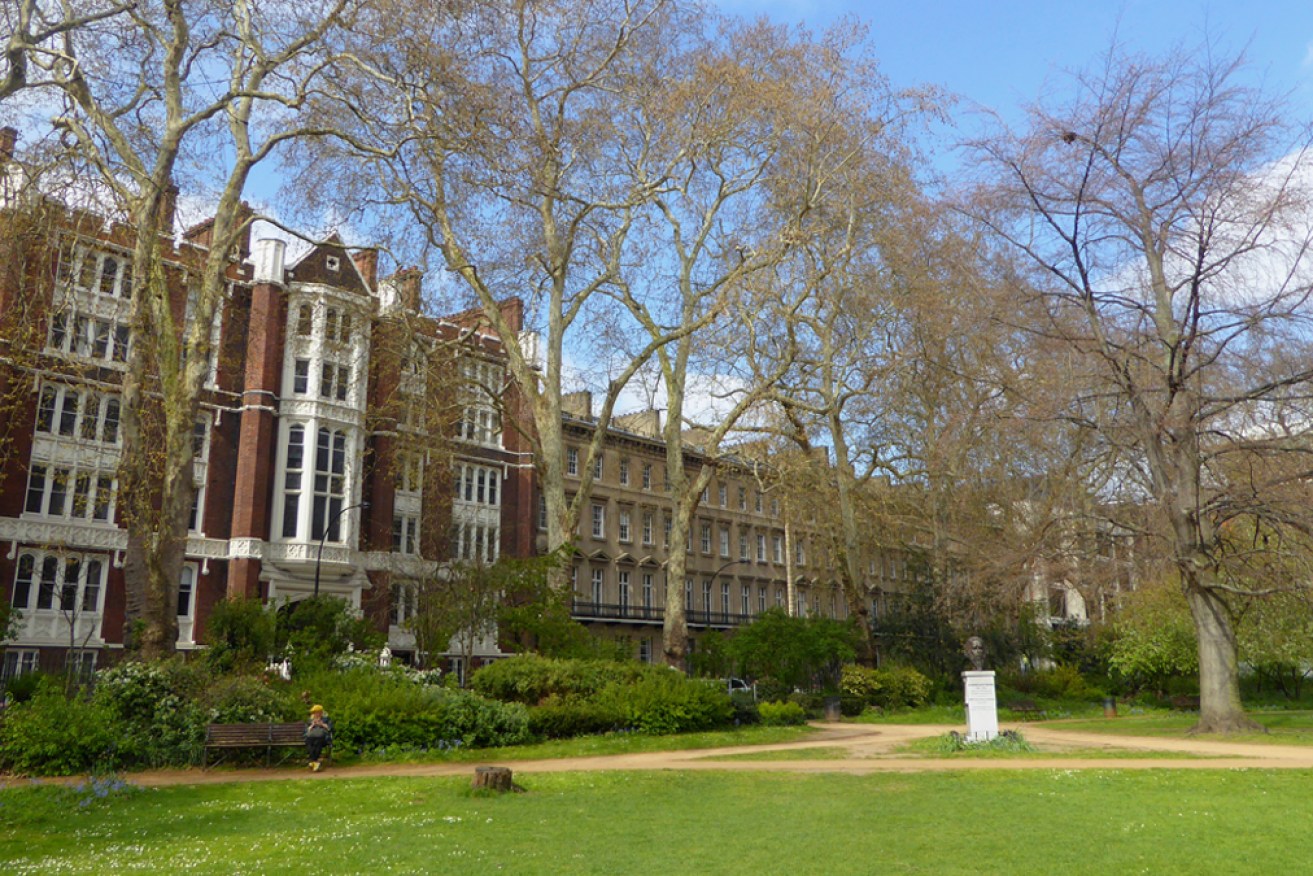
Taking a stroll in Gordon Square is one of the highlights of Bloomsbury. Photo: Ethan Doyle White via Wikimedia Commons
Wandering around Bloomsbury with a copy of T.S. Eliot’s The Waste Land in my hand – pretentious? Moi?
This was a little hardback edition published by Faber & Faber, purchased from the excellent London Review bookshop in Bury Place, across the road from the British Museum.
Eliot, arguably the 2oth century’s greatest poet, worked for some time as a publisher and editor at, coincidentally, Faber & Faber, in Bloomsbury. There’s one of those blue heritage plaques at 24 Russell Square marking where the great man worked.
Eliot was a major figure in the literary life of Bloomsbury, which is famous as the home of the Bloomsbury Group, although he was not a member, being far too stuffy for them. Bloomsbury was also where Charles Dickens lived for a time.
We love these literary connections to Bloomsbury, the sort of place you want to wander around wearing corduroy trousers and a tweed jacket, if you have them. As it happens, I have both.
We have stayed here a few times – first at The Montague on the Gardens in Montague Street beside the museum and the last couple of times at The Academy, in Gower Street, a luxury five-star boutique hotel comprised of five restored Georgian townhouses.
Bloomsbury has been described as a perfect blend of intellectual history and green tranquillity. It is considered the intellectual capital of London, surrounded by prestigious universities such as University College London, King’s College, and the London School of Economics. It is also home to the Royal Academy of Dramatic Art and an array of attractions.

The charming Bloomsbury Pub is typical of the area. Photo: Pixabay
With its beautiful Georgian architecture and leafy squares, it is bursting with bookish charm. Near to our digs is Waterstones Gower Street, our favourite bookshop that includes Dillons Café, where you will jostle for tables with students from nearby universities.
Bloomsbury is right in the city centre, within easy walking distance of Covent Garden, Oxford Street and Leicester Square, along with the iconic West End theatre district. You can easily stroll via Shaftesbury Avenue to the theatre district. On this last visit we saw MJ The Musical at the Prince Edward Theatre on Old Compton Street after a meal in a frantically busy Korean restaurant nearby.
The literary life of Bloomsbury may not interest everyone but for many the name is legendary. Because it is here that, in 1905, a group of writers, artists and intellectuals began to meet at the London home (46 Gordon Square) of the artist Vanessa Bell and her writer sister, none other than Virginia Woolf.
This became the Bloomsbury Group and their meetings continued for the next 30 years. As well as Woolf, key members included her husband, the author and publisher Leonard Woolf, writer Lytton Strachey, art critic Clive Bell, and the economist John Maynard Keynes.
The Bloomsbury Group is sometimes better known for unconventional personalities and lifestyles, but they certainly turned a spotlight on this district in the West End, part of the London Borough of Camden.
Bloomsbury offers a peaceful, residential feel despite being in the centre of London. Its elegant Georgian garden squares were laid out in the 17th to 19th centuries, designed to offer green space for the upper-middle-class. Bloomsbury Square (1660s), Bedford Square, Russell Square, Gordon Square, Tavistock Square, and Fitzroy Square – these are lovely places for a stroll with their gardens and paths, places for quiet reflection and to meet the odd squirrel or two.

A quiet moment in pretty Bedford Square. Photo: Wikimedia Commons
Walking and wandering, one marvels at the swish townhouses punctuated by the occasional embassy tucked away overlooking a verdant square. Think about what it’s like fighting for footpath space on Oxford Street – walking around Bloomsbury is the exact opposite, although you are never far from a busy thoroughfare.
For cosy cafes and funky shops, try Store Street or Charlotte Street for its high-end restaurants, and Woburn Walk is a charming, pedestrianised street designed by Thomas Cubitt in 1822 as one of London’s first purpose-built shopping streets. It has preserved Regency and early-Victorian, black-painted, bow-fronted shops, and cafés. Located near Euston Station, this picturesque spot was formerly home to poet W.B. Yeats. There is that literary connection again. You cannot escape it in Bloomsbury. And why would you want to?
Five things to do in Bloomsbury:
The British Museum
On a recent visit, we arrived at the British Museum‘s Great Russell Street entrance feeling smug. We had booked online to see a show featuring Japanese woodblock prints by Hiroshige and we waltzed past hundreds of people queuing for tickets.
Inside you get stadium crowds, and to view the Egyptian mummies you will jostle with folks from all over the world.

The author at the British Museum. Photo: Phil Brown
The Parthenon Sculptures are a highlight – the Elgin Marbles of course, named after Thomas Bruce, 7th Earl of Elgin, who removed them (with the permission of the Ottoman rulers) from the Athenian Acropolis between 1801 and 1812. Other highlights include the Rosetta Stone, the Lewis Chessmen, and the colossal Bust of Ramesses II.
It is neoclassical outside, modern within. Sir Norman Foster (Foster+Partners) designed the Queen Elizabeth II Great Court, which was opened in 2000. It transformed the central courtyard into Europe’s largest covered public square by installing a massive, tessellated glass roof. The project restored the central Reading Room, added new galleries and is simply stunning.
Russell Square Gardens
Russell Square is the most famous and the busiest of all the Bloomsbury squares.
Within walking distance of top tourist destinations such as the British Museum and Oxford Street, it is close to the mainline stations of Kings Cross, St Pancras, and Euston (a short walk), and in the heart of the University of London campus. It is one of the largest squares in London (with its own Tube station!) with a café terrace on which to watch the world go by.
A cab shelter, originally built for the drivers of hansom cabs, still stands in the north-west corner.
The square was designed as the centrepiece of the 5th Duke of Bedford’s early 1800s development plan for northern Bloomsbury (Russell was his family name) and is one of only three London squares designed by famous garden designer Humphry Repton. Its refurbishment in 2002 retained or restored many of its original design features, including the horseshoe-shaped path.
There is a gushing fountain in the centre of the square and in autumn it’s great for leaf peeping. In summer it’s ideal for a picnic … in the middle of London.

The delightful Waterstones on Gower Street. Photo: Phil Brown
Waterstones Gower Street
At 82 Gower Street, this Waterstones is known as Europe’s largest academic/specialist bookstore, offering a vast selection of new and second-hand books, an antiquarian department, a cafe, and a labyrinthine, cozy atmosphere.
It is a five-level book palace with a Gothic-style facade with carvings, gargoyles, and imps. Known for its nooks and crannies, it’s booklover heaven.
It features a dedicated second-hand book section, including vintage Orange Penguins and signed first editions. It was established in 1956 as Dillons Bookstore before becoming part of Waterstones in 1998. You could easily spend the day here with intermittent breaks in the café.
On our 2025 visit, I went searching for a relatively obscure travel book by W. Somerset Maugham (On A Chinese Screen) and of course they had it. They have everything!
Charles Dickens Museum
Located at 48 Doughty Street in London, the museum is the only surviving London home of the famed author. He lived here from 1837 to 1839, and it is the house where he wrote Oliver Twist and Nicholas Nickleby.
In his 1834 short story The Bloomsbury Christening, Dickens portrays the area as a home to a sometimes pompous or overly refined middle class, particularly around Bedford Square. Dickens did not just see the grand, intellectual side of Bloomsbury – he recognised the stark social inequality, where grand Georgian houses had grim workhouses nearby. His own four-story Georgian house is furnished to reflect the era, allowing visitors to see his study, dining room, and the basement wash house, which featured in A Christmas Carol.
The museum opened in 1925 and houses more than 100,000 items related to the author, including original manuscripts, personal belongings, letters, furniture, and portraits.
The Lamb
Famous poets Ted Hughes and Sylvia Plath met at this historic pub. Mind you, that did not end so well, as any literary aficionado will know. It’s also associated with Dickens, who lived nearby.
Located on Lamb’s Conduit Street between Holborn and Russell Square station, The Lamb focuses on cask and craft beers, wines from around the world and seasonal British dishes made from the finest fresh produce. It boasts that “nothing beats a Bloody Mary and a pub roast on a Sunday”.
Established in the 1720s, it is one of London’s oldest pubs with antique “snob screens” in the main bar. (They are movable wooden frames with etched glass panes installed in Victorian-era British pubs to provide privacy for middle-class drinkers from the working class and bar staff.)
The décor is Victorian and there is a “secret” back garden for those wanting to drink and dine alfresco.
There are other historic pubs in Bloomsbury, including The Bloomsbury Tavern, The Museum Tavern, The Plough, and the Bloomsbury Hotel.
More information: Visit London or Visit Britain
Want to see more stories from The New Daily in your Google search results?
- Click here to set The New Daily as a preferred source.
- Tick the box next to "The New Daily". That's it.
Australia’s coolest neighbourhood may surprise



New Aussie bucket-list holiday is a white Xmas