Fur seals, penguins and snow: (South) Georgia on my mind
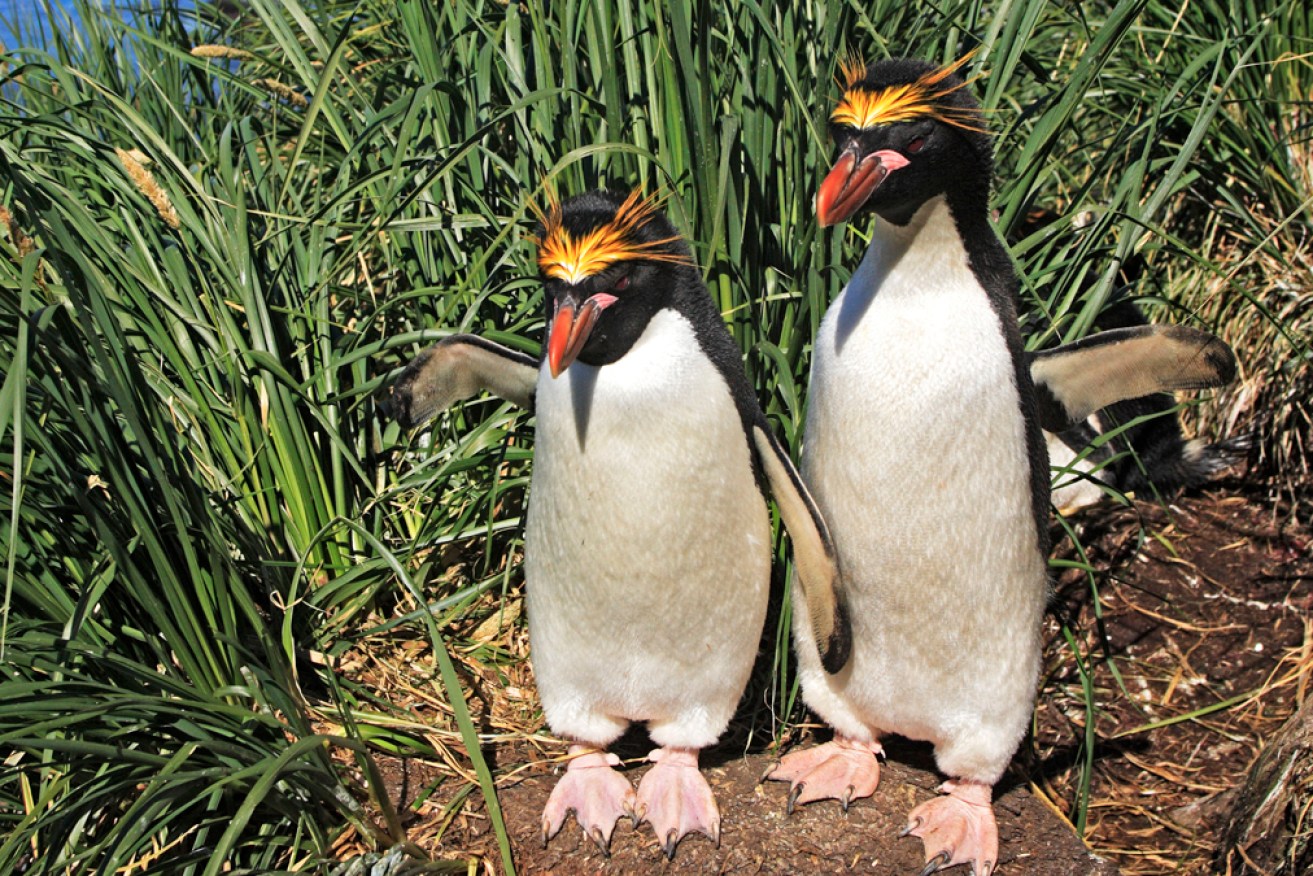
A pair of macaroni penguins show off their stylish crests. Photo: AAP
The feisty female fur seal was not backing down. We were doing what our guides said, making ourselves big like a soccer goalie, yelling and generally looking a bit crazy.
It wasn’t working. And getting bitten would have meant the end of our Antarctic adventure.
Finally, the pinniped retreated and we were able to slip past her to continue on our walk to a colony of king penguins.
Fur seals might look clumsy on land, but they can move deceptively fast. And if they bite and draw blood, infection can set in quickly so a stricken passenger would need to get to a hospital. And the nearest one was two days away by boat in Ushuaia at the bottom of Argentina, effectively ending everyone’s journey. No one wanted to be that passenger.
Our Intrepid Antarctic expedition cruise had docked at Fortuna Bay on one of the islands that make up South Georgia. The islands were the second-last stop on a 23-day journey to the frozen continent.
They are the mother lode for wildlife lovers. Every landing and cruise we did was teeming with seals, penguins and birds and the bonus of spectacular scenery. The mountains were not high, maybe 400-500 metres, but the dramatic rock formations rising straight up from the shore, smatterings of green and a sprinkling of fresh snow made for an eye-catching vista.
Captain James Cook made the first claim to South Georgia in 1775 for King George III and, after more than 200 years of sealers and whalers plundering the seas and land, it is now a self-governing protectorate of Britain.

Fur seals at Stromness Bay, with the whaling station ruins in the background. Photo: AAP
The rusting buildings of the industrial-scale slaughter of whales remain as an outdoor museum at the capital, Grytviken.
The whaling station, established by Norwegian captain C. A. Larsen in 1904, operated until 1964. Fur seals and birds roam around the derelict buildings and whales are a protected species.
Biosecurity is a serious business here. All our equipment is checked for even the tiniest foreign body. One of our expedition crew picked out a pebble in my mud boot the size of a sesame seed. Dogs are even brought onto the ship to ensure it is rat-free. If a ship fails the inspection, it will be banned from landing or at the very least put on a watch list. Thankfully, we passed.
History looms large in other ways on this British outpost. Antarctic explorer Ernest Shackleton arrived there on Endurance in 1914 before his ill-fated voyage. He returned in 1922 aboard Quest, but died of a suspected heart attack and was buried at the whalers’ cemetery.
Unfortunately, a visit to his grave was canned after expedition crew discovered seals infected with bird flu near the burial ground.
The settlement still had plenty to occupy our day. Just watching seals was enough – especially the abundance of playful babies. It also has a pretty little Norwegian Lutheran Church, built in Norway and erected on South Georgia in 1913 by Larsen. And, of course, being European it has a soccer field where the settlers used to play.
The small museum has a comprehensive history of the island, including some gruesome pictures of what is done to a whale carcass, and examples of unique flora and fauna. You can even send postcards from the tiny post office via British Mail, which, of course, we did.
While the history buff in me was thrilled with the visit to Grytviken, the main attraction was the wildlife. And we managed to make all the planned expeditions bar one landing, and that was because there was too much wildlife on the beach and it wasn’t safe for us or them. We had to content ourselves with a Zodiac cruise along the shore.
At the previously mentioned Fortuna Bay, we walked a couple of kilometres to a huge king penguin colony at the base of a glacier.
One thing you are not prepared for is the noise of penguin colonies – the squawking is constant. These adorable creatures like a chat. They are also extremely curious. We had been told to keep at least five metres away, but that proved difficult at times and it’s hard to resist moving away from these charming creatures.
At places we couldn’t land, the crew brought the Zodiacs as close as possible to the wildlife. It was a thrill to see a macaroni penguin colony that had made a home on jagged rocks at another bay. The name is believed to have originated from 18th century English sailors who were taken with the vivid yellow crest on the penguins’ heads that reminded them of the ostentatious dress of the “macaroni” dandies of the time.
The highlight of our time in South Georgia was visiting magnificent Gold Harbour. It was snowing, which was enchanting for those of us who rarely see falling snow (mainly we Australians). Our enthusiasm amused those from the northern hemisphere.

A glacier at Gold Harbour – one of the highlights of the visit. Photo: AAP
Strong winds had thwarted a previous attempt to land, but it was still a tricky business because of the swell and the sheer number of wildlife on the beach.
Huge elephant seals, mostly females and juvenile males, plonked among a 50,000-strong colony of king penguins in different stages of development, from couples incubating an egg to moulting juveniles. A few, possibly lost, gentoo penguins, with their distinctive red beaks and feet, were scattered about the bigger Kings. And more fur seals.
The seeming abundance of fur seals we saw belies a terrible threat to their survival. Bird flu has hit the seals in Antarctica hard, according to the scientists on the trip. Last season the wildlife was almost destroyed. This time it’s less devastating, but these waves of illness will not stop. The animals in Antarctica are particularly vulnerable as the virus needs heat to be killed, can survive in water and air and inside an animal for many months. There is no defence.
Avian flu is not the only danger to Antarctic wildlife. Climate change is having an increasingly detrimental effect on the amount of ice and water temperature and trawlers harvest huge numbers of the most important food source for the animals – krill. Without it the ecosystem will collapse.
The scientists on the ship, most of whom had undertaken multiple trips to Antarctica, offered a sobering perspective on what could await life here.
It was an enormous privilege to experience some of what these stunning islands have to offer. I hope future generations are able to do the same.
The author travelled at her own expense
Want to see more stories from The New Daily in your Google search results?
- Click here to set The New Daily as a preferred source.
- Tick the box next to "The New Daily". That's it.
Australia’s coolest neighbourhood may surprise


New Aussie bucket-list holiday is a white Xmas