Welcome to Stanley: It’s more British than the British
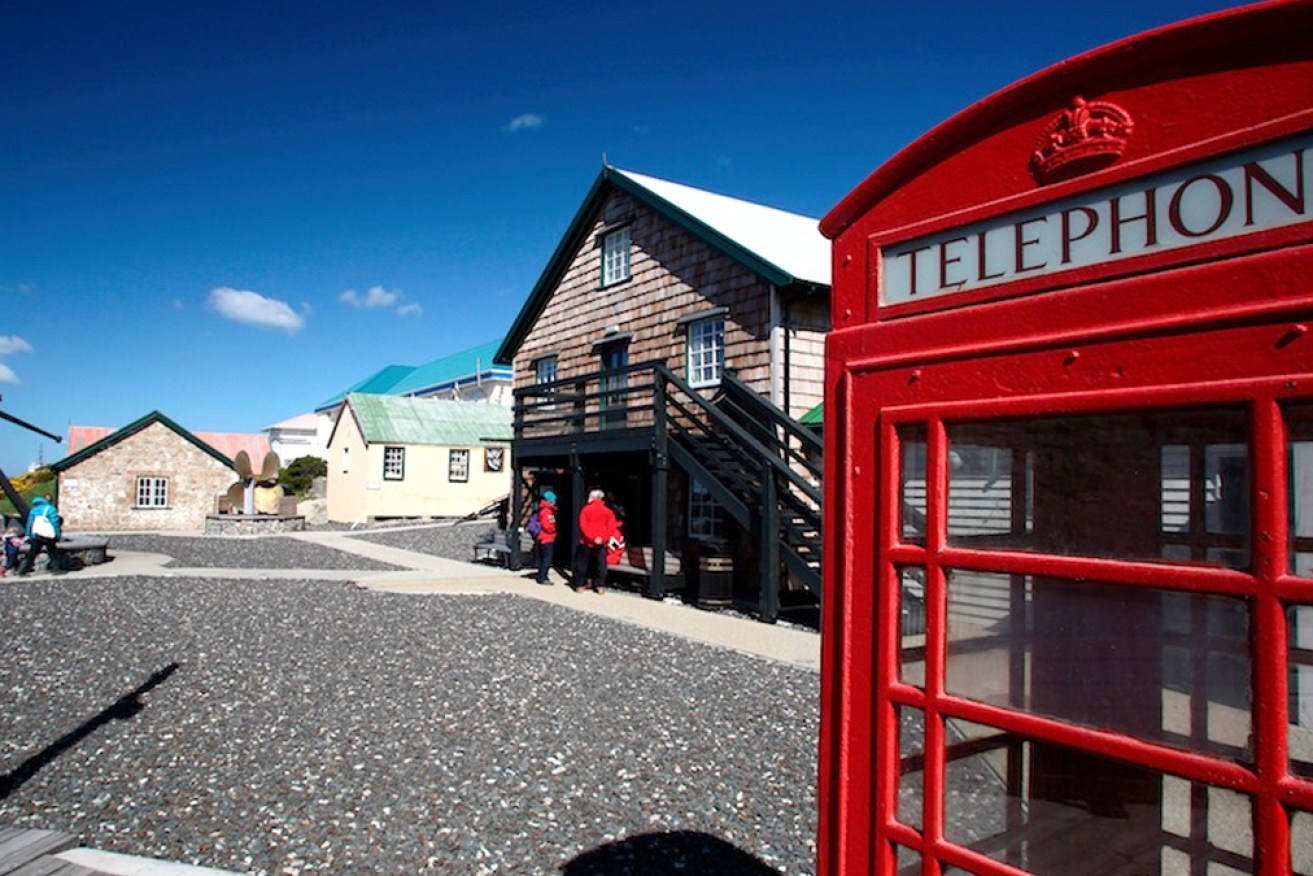
Classic red phone boxes are dotted around the islands. Photo: Falkland Islands Tourism/Georgina Strange
This is the most British place I have visited outside of Britain. In fact, it could more British than Britain. Union Jacks are everywhere, even painted on a roof, and a bust of former prime minister Margaret Thatcher has pride of place in front of the government building.
The houses look like they could have been transported straight from a London street and the pubs serve British staples such as fish and chips and curries.
We are in Stanley, capital of the Falkland Islands (or Malvinas if you are Argentinian. It’s a sore point) for a two-day visit – the last stop on a 23-day cruise in Antarctica.
The sun is blazing down on an unusually warm day (17 degrees!) on this windswept archipelago in the South Atlantic, a self-governing British protectorate since 1833 that is nearly 13,000 kilometres from Britain.
Stanley is only the second town we have visited on the voyage (the other was Grytviken in South Georgia, another British protectorate). The Falklands, unlike South Georgia, has a permanent population with an economy that relies on tourism and sheep farming for wool and Stanley itself is a tiny, but thriving town.
They have their own currency, the Falklands pound, and I was lucky to snag a couple of their coins with penguins etched on one side. British pounds, US dollars and the Euro are also accepted, but don’t even think about handing over an Argentinian peso.
The main islands, imaginatively called East and West, are divided by the Falkland Sound, named by an English sea captain after the fifth Viscount Falkland of Scotland. There are 776 smaller islands and we will visit two of them on our second day for our last look at wildlife.
The history of this outpost of the former British empire can be summed up in two words – it’s complicated. Various countries sighted and/or settled these islands over 500 years – France, the Netherlands, Britain and Spain.
The year 1833 was pivotal in deciding the fate of the Falklands. A newly independent Argentina laid claim, but the British weren’t having it and the Falkland islanders themselves voted in a referendum to remain under British control.
Almost 150 years later, the Argentinians again tried to take over the islands and lost the resulting conflict against a Thatcher-led Britain in 1982. Signs all over Argentina still assert that Malvinas is occupied territory. As I said, a sore point.
There really is nothing Argentinian about Stanley. Our first stop was the Christ Church Cathedral, a charming red brick building with a sculpture made from the massive jaws of a blue whale next to it.
The cool interior had lovely stained glass and plaques commemorating early settlers. The same names cropped up in the museum, which is chock full of information about the island’s history and development, prominent families, a maritime section (I love a model boat) and wildlife.
A pamphlet in the information centre trumpeted a sculpture depicting the solar system, which could be found further along the foreshore. Along the way we spotted native geese, the simple government house, a memorial to the fallen in 1982 and that bust of Thatcher. She may not have been the best-loved PM in Britain, but here she is revered.
The solar system sculpture was a disappointment. It was an orange ball (presumably the sun) with the planets circling it. Except half of them were missing. It definitely did not live up to the hype.
This taste of civilisation was pleasant, but I was hankering to see more wildlife. Our last day of excursions was magical.
Our first stop was privately-owned Saunders Island and another difficult landing in rough conditions. The owner has sheep and cattle and provides a service ferrying passengers who cannot manage the two-hour return walk to the albatross colony and then onto the rock hopper penguins.
The walk itself was stunning. Endless sky and dramatic cliff faces. We were treated to a couple of Magellenic penguins nursing an adorable fluffy chick before arriving at the black-browed albatross colony. These birds are big and the dark smudge above their eyes, like smeared mascara, inspired the name. We could have watched these majestic birds soaring above and nursing their newly-hatched babies all day, but we had to move on to ensure we reached the rock hopper colony in time to get back to the ship.
We smelt these penguins well before we saw them – the guano covered almost every rock. They are ridiculously cute, with a little yellow mohawk on their heads. Their name is self-explanatory – they do jump from rock to rock on their way to the sea and skip when on flat ground. There antics had us in fits of laughter.
The afternoon destination was the island of West Point – a much easier landing at a boat ramp this time. A couple live in a house near the jetty (with, of course, a Union Jack in front of the house) and provide afternoon tea for returning walkers.
It was an easier, though still long, walk, this time to a colony shared by black-browed albatross and rock hoppers. There is some sniping as neighbours jostle for space and the high tussock grass made it difficult for short people (yes, me) to see. I managed to find a rock to stand on and hoped I wouldn’t fall.
The return walk to the ship was bittersweet. I was thrilled to be able to live out my long-held dream to visit Antarctica and deeply sad that it was over. A fellow traveller described the experience as sublime. She was right.
Want to see more stories from The New Daily in your Google search results?
- Click here to set The New Daily as a preferred source.
- Tick the box next to "The New Daily". That's it.
Australia’s coolest neighbourhood may surprise

New Aussie bucket-list holiday is a white Xmas