Fuel security needs a rethink – and rail is a big part of it

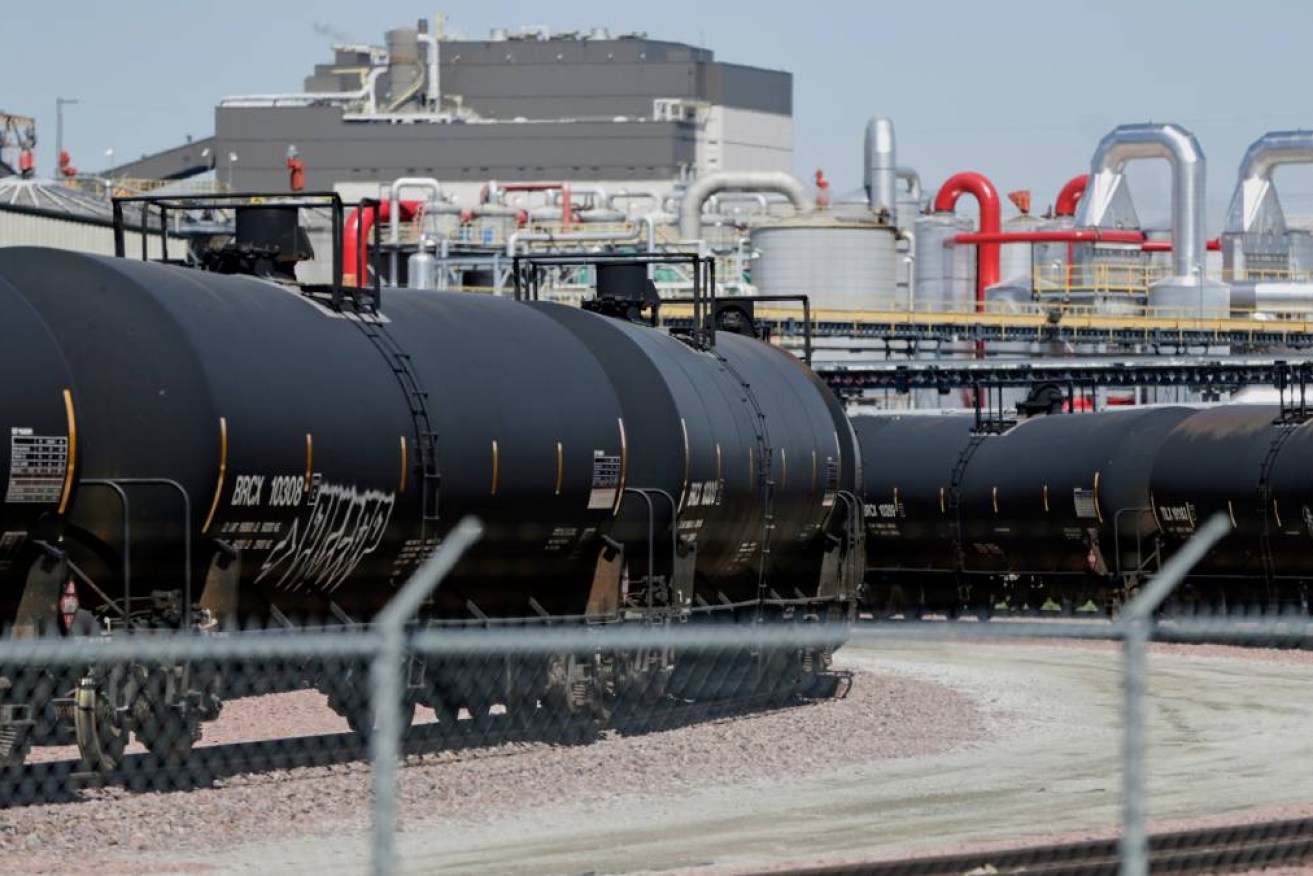
Rail should once again be part of Australia's oil link. Photo: AAP
Australia’s reliance on imported fuel, declining reserves and road-heavy transport system have created vulnerabilities that require urgent policy reform.
Few recall that during World War II, petrol and diesel fuel use was rationed.
Or that in 1942 no fewer than 31 inland aircraft fuel depots were constructed in Australia to store a total of 90 million litres of fuel.
They were all supplied by freight trains. Of these inland fuel depots, 11 were in NSW, including at Cootamundra, Lake Bathurst and Parkes.
A further six were in Queensland, with four each in Victoria, South Australia and Western Australia, and one each in Tasmania and at Alice Springs.
Younger people have never experienced petrol rationing.
During the oil shocks of the 1970s, there were restrictions on buying petrol. For the remainder of the 20th century, Australia had a high degree of oil self sufficiency from Bass Strait and other fields.
As a result, Australia has developed a sense of complacency. It also adopted transport policies that effectively encouraged high rates of car ownership with a stubbornly high average fuel consumption.
We also moved to the extensive use of trucks on public roads to move freight and planes to move people.

The location of fuel storage facilities served by rail during WWII. Image: Dr Yoke Berry
From 2018-19 to 2024-25, Australia’s use of diesel and petrol grew from 44.8 to 49.3 billion litres. Almost all of the growth was due to the use of diesel for road vehicles, mining and agriculture.
Road transport and aviation are energy intensive, and much more so than either rail or sea transport.
A fully laden train is five or more times more energy efficient than a car with one person in it. This is due to rail having “economy of size” with larger payloads than road and a steel wheel on a steel rail having much less friction than a rubber tyre on a road.
In addition, rail has the option of electric traction. In this case, energy efficiency can be enhanced by the use of regenerative braking.
For moving freight, rail is on average about three times more energy-efficient than road.
However, as observed by the Productivity Commission in 2000: “Rail and sea transport are not achieving their potential in the current system, while road and air transport are overused to compensate. The result is a system that inflates national costs and energy use.”
At that time, Australia had no fewer than eight oil refineries, and used oil trains to distribute petrol and diesel to regional centres such as Canberra and Dubbo.
Today, Australia has just two oil refineries and rail is no longer used in NSW to move liquid fuel at all. In addition, our liquid fuel reserves have fallen way below the International Energy Agency’s 90 day stockholdings requirement.
Two solutions
Rather than reverting to “offshore” storage of holding oil reserves in overseas countries including the US, as favoured by the former Coalition government, we propose two other solutions.
The first has often been outlined. Along with more use of electric vehicles, Australia needs improved policy settings to encourage more people and freight to move by the more energy-efficient mode of rail as opposed to road transport.
This will require more investment in mainline rail track and changes to road pricing.
The second solution is to build inland fuel storages in regional Australia by expanding the Boosting Australia’s Diesel Storage Program.
They would be large enough to hold at least 90 days fuel supply for the surrounding area. These terminals would be built adjacent to rail lines and supplied from the ports and refineries by block trains.
The terminals’ fuel would then be delivered, as required, to the end user by road transport. The terminals would be ideally constructed at least 10 kilometres from major built-up areas. This could include Canberra, which uses about 1.2 million litres of petrol and diesel a day, supplied by a small army of B-doubles from Sydney.
The ownership and operation of these terminals could be undertaken by separate entities.
Inland fuel centres are a scheme nobody will want to pay for. Yet they would benefit the majority of Australians who use liquid fuels.
It could be in part funded by a modest 1-cent-a-litre charge on all liquid fuel sold in Australia.
Everybody would benefit from such a scheme. The levy would need to be imposed only until the infrastructure supporting the scheme was paid for.
Although trucks will still be used for delivery from terminal to end user, there would be a big reduction in use of road tankers for the long haul.
Side benefits include safer roads, less road maintenance and less fuel use, along with a reduction of emissions in transporting the fuel.
Dr Philip Laird OAM is an Associate Professor at the University of Wollongong. He is a fellow of the Chartered Institute of Logistics and Transport and a life member of the Railway Technical Society of Australasia
Geoff Smith worked many years in freight and, in particular, with rail transport
This article first appeared in Pearls and Irritations. Read the original here
Want to see more stories from The New Daily in your Google search results?
- Click here to set The New Daily as a preferred source.
- Tick the box next to "The New Daily". That's it.


RBA’s inflation warning stokes rate rise fears