Australia’s tariff fate revealed in Trump announcement

Source: X
Australia will be spared higher tariffs after the Trump administration announced new levies for dozens of countries.
On Thursday night (local time), the White House revealed US President Donald Trump’s decision to hike import taxes for products from nations that “failed to engage in negotiations with the United States or to take adequate steps to align sufficiently on economic and national security matters”.
Australia is not included on the list and its products will continue to be subject to a baseline “universal” 10 per cent tariff that was implemented on April 2.
Trade Minister Don Farrell said the comparatively low rate was a win for Australia, but “we don’t want to leave the issue here”.
“We believe in free and fair trade and we will continue to put the argument to the United States that they should remove all tariffs on Australia,” he said.
“In fact I’ve invited [Commerce] Secretary [Howard] Lutnick to come to Australia and continue those discussions,” he said.
Farrell said the outcome was “a vindication of our cool and calm negotiations”.
Elsewhere, New Zealand imports will be subject to a greater 15 per cent tariff, while other nations face more punitive rates.
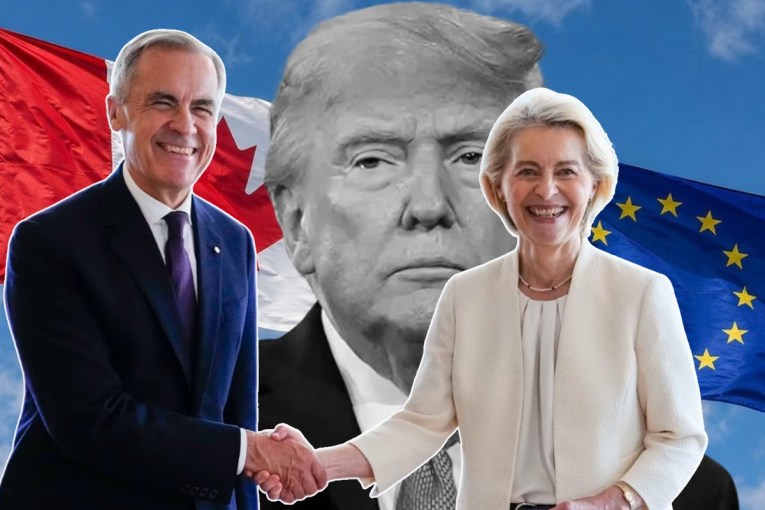
They include Canada, one of the US’s top trading partners, which has been hit with a hike from 25 per cent to 35 per cent.
“Canada has failed to cooperate in curbing the ongoing flood of fentanyl and other illicit drugs, and it has retaliated against the United States for the president’s actions to address this unusual and extraordinary threat to the United States,” the White House said in a fact sheet.
Trump also said this week that Canada’s decision to recognise the Palestinian state complicated efforts to broker a trade agreement.
On Thursday, he said Canadian Prime Minister Mark Carney had called ahead of the supersized tariff hit, but “we haven’t spoken to Canada today”.
Among the nations to be slugged with the highest tariffs are Syria (41 per cent), Laos and Myanmar (40 per cent), Switzerland (39 per cent), Iraq and Serbia (35 per cent), and Algeria, Bosnia and Herzegovina, Libya and South Africa (30 per cent).
Thursday’s order capped off a hectic day as nations sought to negotiate with Trump. It set the rates for 68 countries and the 27-member European Union, with a baseline 10 per cent rate for any nations not specifically listed.
A senior administration official said the rates were based on trade imbalance with the US and regional economic profiles.
Trump’s announcement came just hours before his self-imposed August 1 deadline. He said some countries had “agreed to, or are on the verge of agreeing to, meaningful trade and security commitments with the United States”.
Others either had not negotiated with the US or had “offered terms that, in my judgment, do not sufficiently address imbalances in our trading relationship or have failed to align sufficiently with the United States on economic and national-security matters”, Trump said.
The Albanese government recently wound back biosecurity restrictions on US beef imports, although ministers insisted the move was a coincidence and not in response to the tariffs.
Washington has complained to Australia about non-tariff trade barriers, including long-standing restrictions on beef following a prior outbreak of mad cow disease.
Source: Fox News
Ahead of Thursday’s announcement, the unknowns permeating Trump’s trade war created a sense of drama that has defined his rollout of tariffs for months. The single consistency has been his desire to levy import taxes that most economists say will ultimately be borne to some degree by US consumers and businesses.
“We have made a few deals today that are excellent deals for the country,” Trump said on Thursday afternoon without detailing the terms of those agreements or nations involved.
US Senate Democratic Leader Chuck Schumer slammed the update, calling Trump’s trade war “an experiment in chaos, lies, and inflation”.
Trump imposed Friday’s deadline after his previous “liberation day” tariffs in April brought a sharemarket panic. His unusually high tariff rates unveiled in April led to recession fears, prompting him to impose a 90-day negotiating period.
When he was unable to create enough trade deals with other countries, Trump extended the timeline and sent letters to world leaders that simply listed rates, prompting a slew of hasty deals.
He reached a deal with South Korea on Wednesday, and earlier with the European Union, Japan, Indonesia and the Philippines.
Lutnick said on Fox News Channel’s Hannity that there were agreements with Cambodia and Thailand after they had agreed to a ceasefire to their border conflict.
-with AAP
Want to see more stories from The New Daily in your Google search results?
- Click here to set The New Daily as a preferred source.
- Tick the box next to "The New Daily". That's it.