Angus Taylor’s fuel standards claim lacks vital context

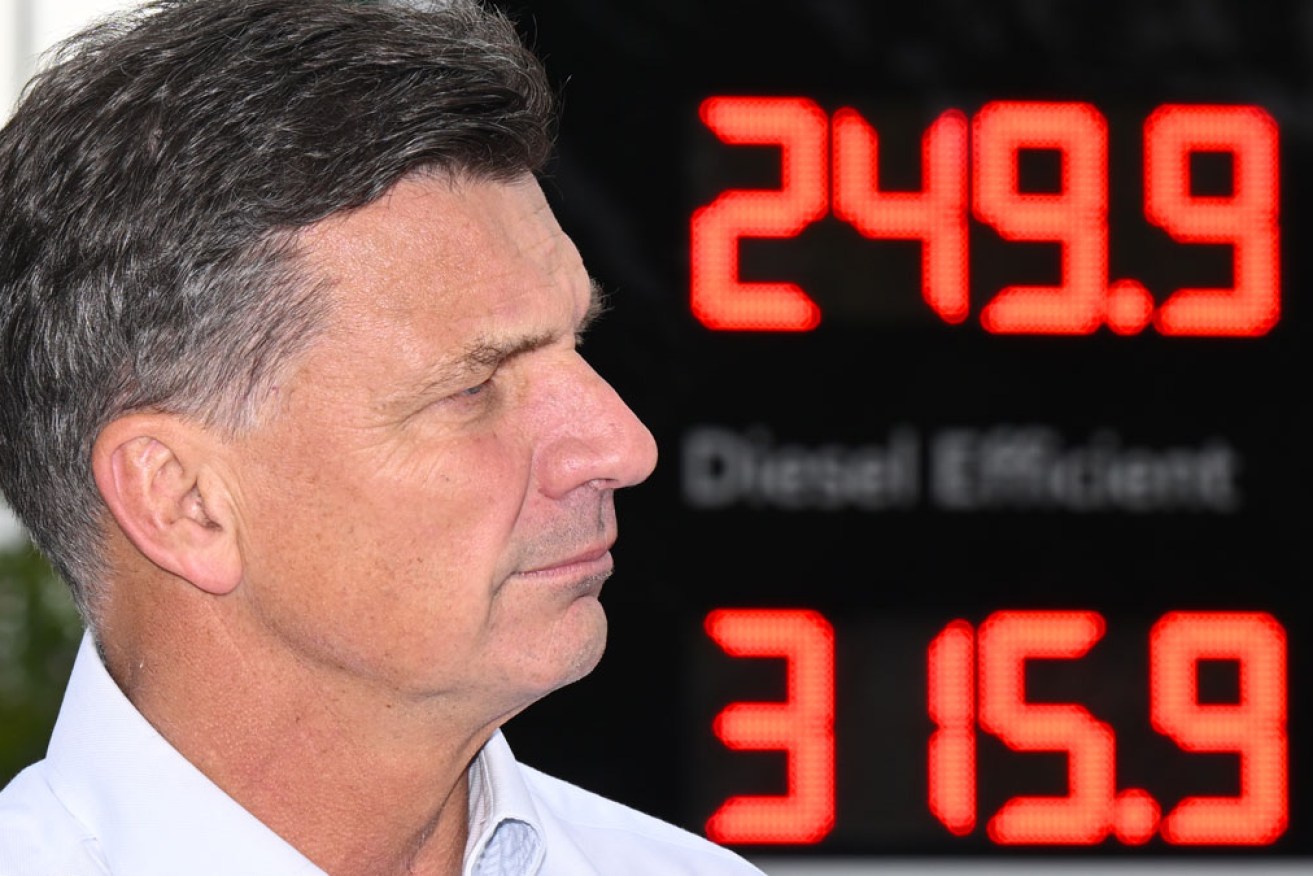
Taylor has repeatedly blamed Labor's emissions standards for forcing an oil refinery to export fuel. Photo: AAP
Opposition Leader Angus Taylor’s claims that Labor’s emissions standards were exacerbating Australia’s fuel crisis has taken an interesting turn.
Taylor has repeatedly blamed Labor’s emissions standards for forcing an oil refinery to export fuel.
However, it was the previous Coalition government that created the standard when Taylor was energy minister and paid refineries to achieve it by 2024.
The Albanese Labor government then mandated the standard into law, with refineries banned from selling high-sulphur fuel after 2025.
Ampol failed to complete the required upgrades to its Brisbane refinery before the 2025 deadline and, as a result, began exporting higher-sulphur petrol to countries that still used it.
Taylor has claimed on several occasions that Labor was “forcing” Ampol to export this higher-sulphur fuel amid high prices sparked by the Iran war.
“They [Ampol] are being forced by Labor’s emissions standards to export their fuel right now,” Taylor said in a Sky News clip he posted on Facebook on March 19.
In a 2GB radio interview on March 16, Taylor said it was “absolutely ridiculous” that Ampol’s refinery was exporting petrol while bowser prices were rising.
“It’s just absurd that you’ve got a minister that has in Chris Bowen that has imposed emissions constraints on this refinery, which means they have to export their fuel,” Taylor said in the interview.
He also posted on Facebook that fuel exports were occurring “because of regulation brought forward by him [Energy Minister Chris Bowen], driven by his emissions obsession”.
When asked for evidence in support of his claims, Taylor’s office pointed to a parliamentary library report that included a detailed timeline of fuel emissions standards in Australia.
The timeline showed Scott Morrison’s Coalition government introduced a regulation called the Fuel Quality Standards (Petrol) Determination 2019, which set stricter sulphur limits of 10 parts per million (ppm) from July 1, 2027.

The previous government paid Australia’s two refineries to produce cleaner fuel. Photo: AAP
Then, in May 2021, the Coalition government announced it would help refineries to meet the new standards earlier by providing grants for infrastructure upgrades to “help refiners bring forward the production of better-quality fuels from 2027 to 2024”.
The Coalition did not mandate the fast-tracked timeline in law.
In 2022, it granted Ampol’s Brisbane refinery and Viva Energy’s Geelong refinery $137.5 million each (including GST) to upgrade their facilities to produce low-sulphur fuel by the end of 2024.
An April 2022 post on the NSW Liberals’ website said the grants would cover up to 50 per cent of the refineries’ total upgrades, and the projects were “expected to be completed before the end of 2024”.
Guidelines published by the government said the objective of the grant was to “support infrastructure upgrades to produce fuel domestically that complies with improved fuel quality standards to be introduced between 2024 and 2027”.
After coming to power in May 2022, the Albanese government updated the fuel regulations, including mandating a 2024 deadline in law.
The Albanese government then announced in December 2023 that it would delay the lower-sulphur deadline to December 2025 to coincide with the introduction of new aromatic standards for petrol sold in Australia.
A spokesperson for Bowen’s Department of Climate Change, Energy, the Environment and Water told Drive in August 2022 that while the previous Coalition government “announced an intention” to bring the 10 ppm sulphur limit forward from 2027 to 2024 “they did not make the required legislative instrument to bring the changes into force”.
Grattan Institute energy program director Tony Wood said the Labor government’s requirement for reduced-sulphur fuel originated from standards initially set by the Coalition.
“Angus Taylor is complaining, saying ‘oh my goodness, the refinery is exporting its fuel overseas, it should be providing to Australians’,” Wood said.
“Yet the weird thing about that is that the reason they’re doing that is because he’s the one who set the standard in the first place,” he added.
Samantha Hepburn, an expert in energy law at Deakin University, said Ampol’s Lytton refinery “could not complete the desulfurisation upgrade that was required to meet the standards, so had to sell it to export markets with lower fuel standards”.
In its response, Taylor’s office also pointed to Bowen’s 2023 announcement of stricter sulphur and aromatic limits from December 2025.
Australia’s two refineries were awarded $28.6m (including GST) each in government subsidies to help them upgrade their facilities to meet the new aromatic standards, according to 2024 grant documents.

Bowen (L) first moved the fuel standards deadline to 2024, then 2025. Photo: AAP
In December 2025, Viva Energy opened a new Ultra-Low Sulphur Gasoline (ULSG) plant in Geelong that the company said met the new sulphur and aromatic standards.
However, Ampol announced to shareholders in October 2025 that construction delays meant its ULSG upgrades would not be complete before mid-2026.
Ampol did not respond when asked whether its aromatic upgrades were complete.
It is unclear how much fuel refined at Lytton may still be barred from sale in Australia due to aromatic limits.
A 2024 government analysis found refineries needed only minor reductions in aromatics to meet the standard.
“Data indicates the current levels of aromatics in petrol are already substantially below current limits and mostly meet the revised limit,” the analysis said.
The Albanese government announced on March 12 that it would temporarily relax fuel standards for two months to alleviate supply shortages caused by conflict in the Middle East.
The lower standards would allow Ampol to blend higher-sulphur fuel into the Australian supply rather than export it.
Ampol told investors on March 20 that the relaxed limits would enable it to supply an additional 80 to 100 million litres of petrol per month domestically.
The increase in supply amounts to between 15.4 and 19.2 per cent of the Ampol refinery’s total average monthly production over the December quarter last year.
Macquarie University energy expert Lurion De Mello said the fact that Ampol’s domestic supply would increase as a result of the temporarily relaxed standards showed the low-sulphur standards had constrained domestic supply.
-AAP
Want to see more stories from The New Daily in your Google search results?
- Click here to set The New Daily as a preferred source.
- Tick the box next to "The New Daily". That's it.

RBA’s inflation warning stokes rate rise fears