Ring gets it wrong with ‘creepy’ neighbourhood search

Source: Ring
An expensive ad designed to tug on heart-strings to promote a home security system’s helpful tech is instead being blasted as “creepy” and “dystopian”.
Amazon-owned Ring ran the ad trumpeting the “Search Party” feature on its doorbell security system during this week’s Super Bowl in the US – when 30-second spots averaged $US8 million ($A11.3 million).
Search Party is an artificial intelligence system that helps pet owners locate missing fur-babies. Amazon CEO Andy Jassy said this week the feature had reunited 99 US dog owners with their lost pets since it launched across America 90 days ago.
“Good example of real-world impact, and proud of what the Ring team has built here,” he wrote.
Search Party is a part of Ring’s virtual neighbourhood watch Neighbors platform, which is also available in Australia. Accessed through the Ring app, it allows users to share information about local events or help that might be needed.
With the latest upgrade, Ring account-holders can use Search Party to upload a picture of their missing dog and activate a free search.
The AI-empowered tech then scans nearby Ring accounts for recent videos, automatically looking for animals that resemble the photo of the lost pet.
If a match is found, Search Party alerts the owner to the general location where their dog was spotted. It also notifies the Ring device owner, who can decide whether to share the clip with the pet owner and other neighbours.
Ring’s ad featured a family searching for their missing retriever puppy Milo. The ad ends with the happy family being reunited with Milo — after multiple images of Ring cameras all over their neighbourhood used AI to scan passing dogs.
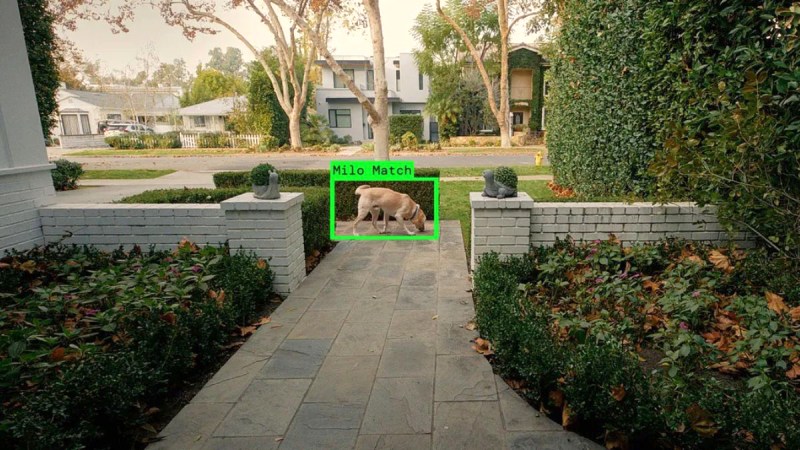
Golden retriever puppy Milo stars in the new ad. Photo: Amazon
The ad presented the feature as a wholesome way to reunite pets with their owners.
“Before Search Party, the best you could do was drive up and down the neighbourhood, shouting your dog’s name in hopes of finding them,” Ring’s chief inventor Jamie Siminoff said.
“Now, pet owners can mobilise the whole community – and communities are empowered to help – to find lost pets more effectively than ever before. That’s why we believe it’s so important to make this feature available to anyone who shares a lost dog post in Neighbors.”
Search Party so far only works for dogs, although Ring has previously said it plans to add additional pet-tracking features to its cameras. Already, many viewers have spotted more sinister implications.
“Do you see what I did there? I disguised mass human surveliance [sic] as a puppy search party,” one X user wrote.
“Marketing team at Ring Camera HQ seriously sat around and was like, ‘How do we sell unconstitutional surveillance of our citizens during the Super Bowl?’. And one guy was like “DOGS!’,” another person said.
A third X user said their main takeaway from the viral ad was “never buy a Ring camera”.

The feature allows owners to launch a neighbourhood search for their missing pet. Photo: Amazon
In an interview with GeekWire last year, Siminoff described Search Party as a breakthrough made possible by advances in AI, saying it couldn’t have been built at reasonable cost even two years ago.
Asked how Ring balanced such kinds of benefits against privacy concerns, he said its approach is to give customers full control.
“You don’t balance it,” he said. “You give 100 per cent control to your customers. It’s their data. They control it.”
But one of the issues most concerning to some is that Search Party is turned on by default.
“The feature is advertised as a way to reunite missing dogs with their owners, a noble cause indeed, but Search Party does this by turning individual Ring devices into a surveillance network,” journalist Lawrence Bonk wrote in Engadget in article that, among other things, outlined how to turn off the feature.
“I’ve never seen a slope quite so slippery, as the technology could easily be rejiggered to track people.”
Lawrence also points out that Amazon’s claim of finding 99 dogs in 90 days doesn’t really stack up.
“Approximately 10 million pets go missing in America each year. Many people aren’t keen on helping to create a surveillance state for a tool with what looks to be around a 0.005 percent success rate,” Bonk wrote.
“That percentage is sure to rise with mass adoption, but you get the jist.”
Want to see more stories from The New Daily in your Google search results?
- Click here to set The New Daily as a preferred source.
- Tick the box next to "The New Daily". That's it.