How AI avatars are rallying Australians to their cause
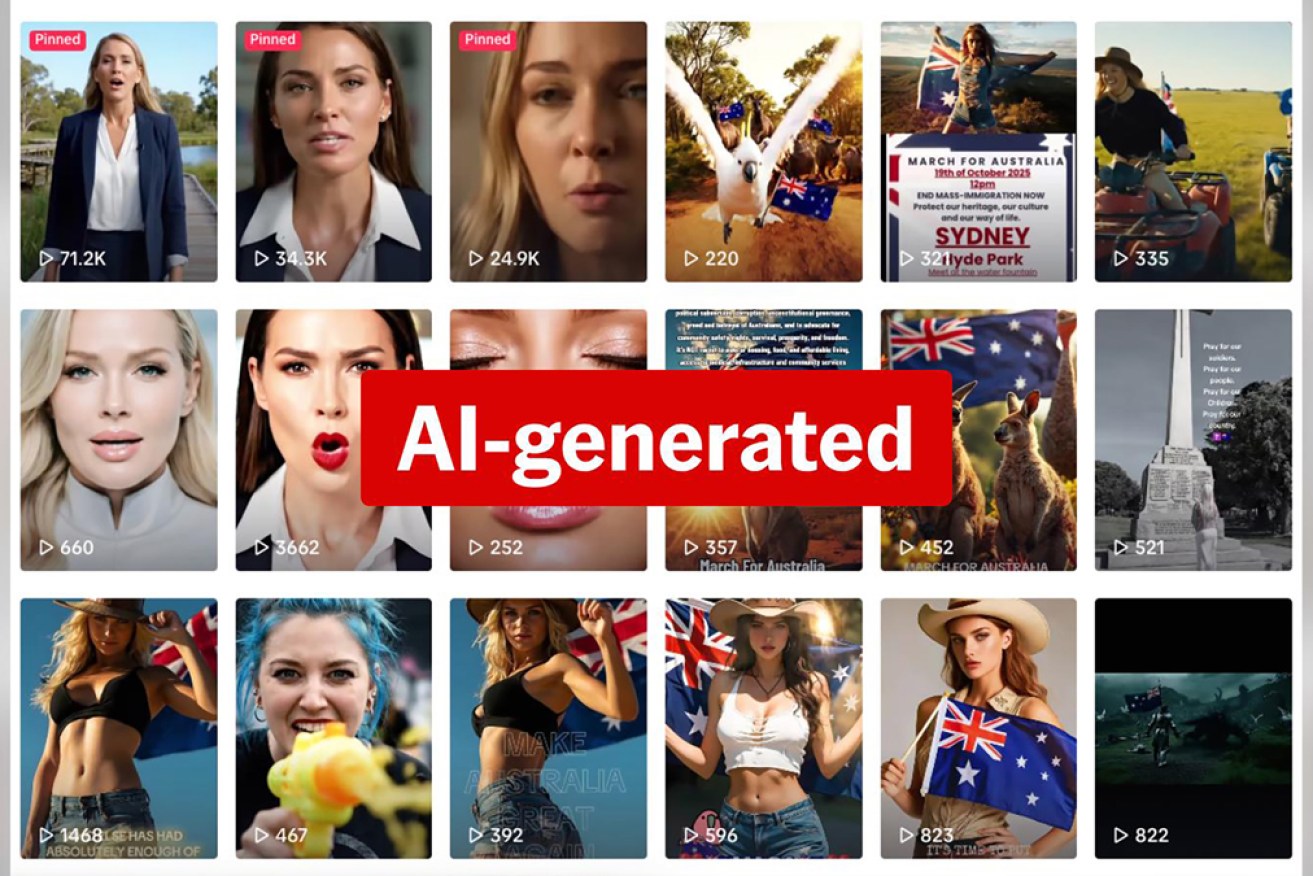
In an undated screenshot taken from TikTok, AI-generated avatar videos push claims of a “migrant invasion” and election rigging. Photo: AAP
She looks every bit the city professional – sharp blazer, confident tone, polished backdrop.
But the woman who issued a rallying cry for Sunday’s anti-immigration marches and the end to Australia’s “invasion” hadn’t just stepped out of a CBD boardroom.
She’s a digital creation conjured by a few words fed into an artificial intelligence video generator.
An investigation revealed a wave of similar AI-generated avatar videos spreading online, pushing claims of a “migrant invasion” and election rigging, sometimes with violent overtones.
In one video, a gun-toting man stands before a cheering crowd, warning that a “civil riot” is coming from “hard-working Australians”.
Content was analysed from two main accounts: LoveMyAu primarily features young, professional-looking female AI avatars across TikTok, X and Facebook; while SaltyHypsi showcases young Anglo-Australian men, often dressed in military gear on TikTok.
Many of the LoveMyAu videos promote anti-immigration March for Australia events, the latest of which was on Sunday.
“We must resist or we cease to exist,” a blue-suited woman says as she looks into the camera in one video.
“Invasions have never been welcomed,” declares another.
“Invaders do not get to walk in and take countries unopposed.”
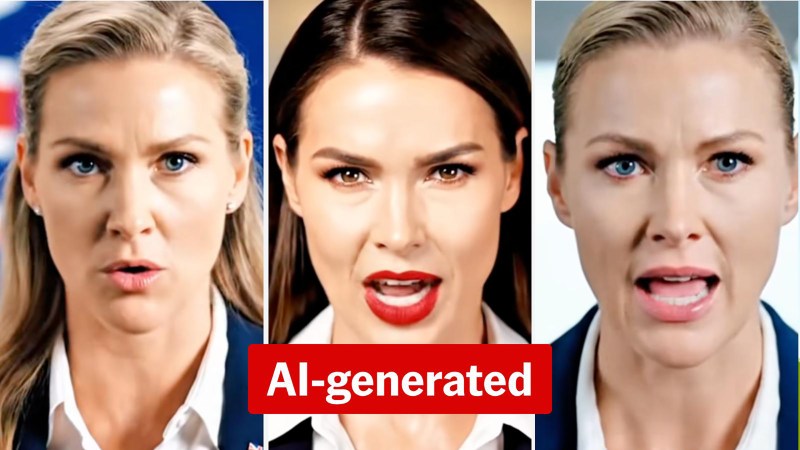
The images feature ‘six o’clock news faces’ that make them socially acceptable. Photo: AAP
Another video, which attracted more than 70,000 views, shows a series of smartly dressed women strolling along a boardwalk, delivering lines reminiscent of a political broadcast.
“I believe the government has used mass immigration to manipulate election results,” one says.
Other videos from the same account use similar avatars to accuse the government of throwing “our own people” to the streets to house migrants and urge Australians to “fight, fight, fight” or lose everything.
While the avatars are lifelike, they bear familiar AI hallmarks – unnaturally smooth skin, inconsistent lighting and shadows, while the lip-syncing is slightly off. Some clips still display the Veo watermark, identifying Google’s AI video generator.
The SaltyHypsi account includes avatars of soldiers, men speaking at rallies and figures prompting viewers to sign petitions against digital ID and taxes on tobacco and alcohol.
One video with more than 60,000 views shows a man in body armour holding a gun before a crowd waving Australian flags.
“Our Prime Minister is refusing to take Australian citizens seriously,” he says.
“A civil riot is what is coming from hard-working Australians.”
In another, a man seemingly standing in the Australian bush declares: “Australia, the time for marching has ended and taking action might be our final chance to protect Australia and the future of our children”.
Neither account responded when questions were submitted.

Other posts show gun-toting men in front of flag-waving crowds. Photo: AAP
Such videos can be created in seconds by typing a prompt into one of the numerous text-to-video AI generators.
Dr Jessamy Perriam, a digital sociologist at ANU’s School of Cybernetics, said the appearance of the avatars was not accidental and they were likely designed to be an enhanced version of the people they would like to influence.
“They’re creating avatars to look like their aspirational acceptable Australian to others who don’t match that description,” she said.
AI also enabled users to make their messages appear more socially acceptable by having them delivered by a “six o’clock TV news face” while preserving the anonymity of those behind it, Perriam said.
“Would there be as much engagement with these videos if it were just a video of the person creating it sitting in front of a webcam, saying the same words?” she said.
Bill Browne, a director at The Australia Institute who specialises in digital technology and political advertising, said the comments beneath many of the videos showed some viewers were confused about whether the people depicted are genuine.
“It is disturbing how easy it is to make convincing depictions of something that never happened and someone who never existed,” he said.
“I don’t think politicians, regulators or the public fully appreciate yet the implications of artificial intelligence or large language models.”
University of Sydney academic Fiona Martin has researched AI and the use of deepfakes and said the use of such avatars was likely to expand rapidly in coming years. She saw such content as trying to heighten emotional reactions, play to confirmation biases and encourage people to recruit others to the cause.
“The problem is, even if we regulate against AI political personas in Australia, you’re seeing hostile state actors running operations out of countries that will never regulate this activity,” she said.
-AAP
Want to see more stories from The New Daily in your Google search results?
- Click here to set The New Daily as a preferred source.
- Tick the box next to "The New Daily". That's it.