Why we may one day live in houses made of earth and cardboard

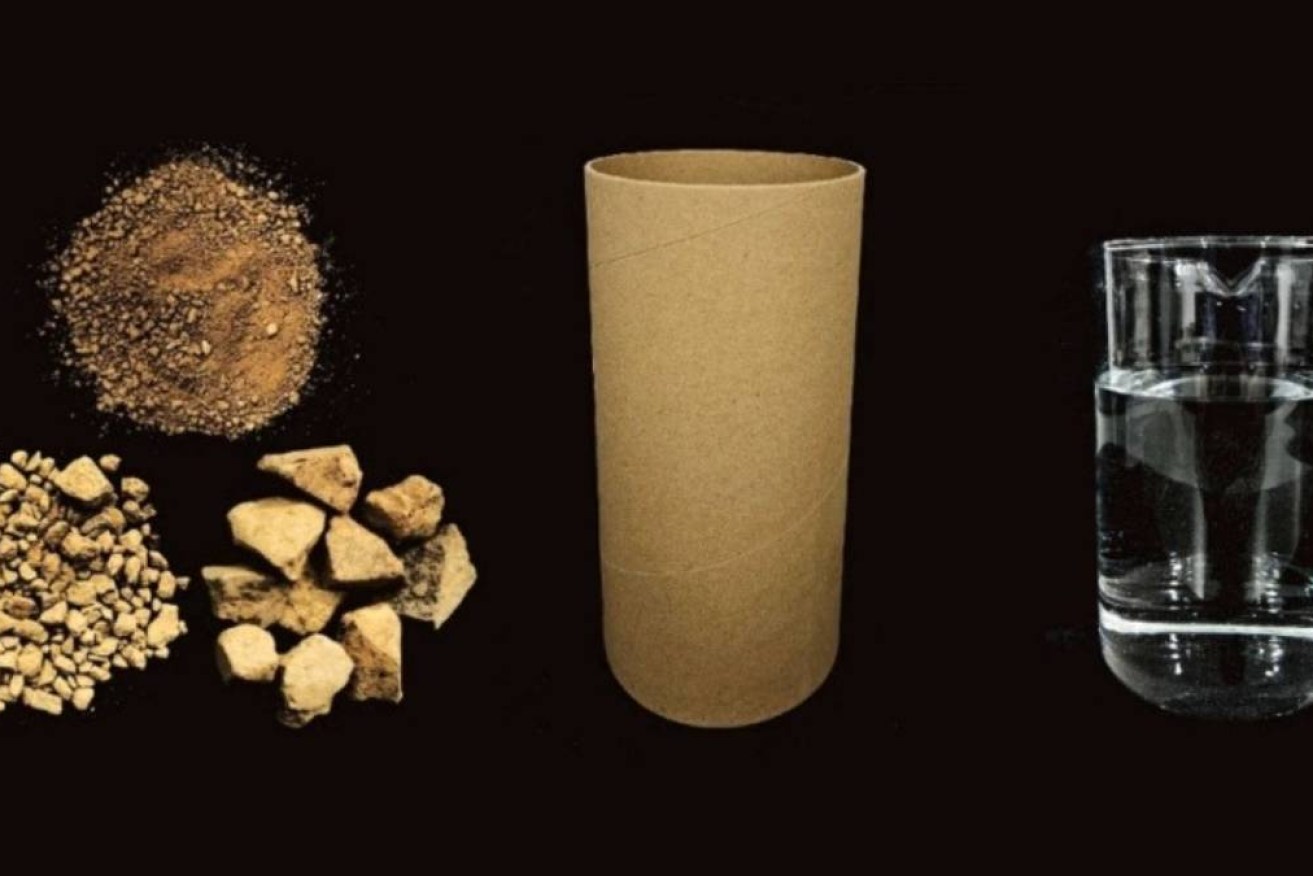
These three simple ingrediets could change the way be we build houses. Photo: Ma et al
Australian researchers have used cardboard, water and soil to create a construction material with low carbon emissions, cost and impressive strength.
The “cardboard-confined rammed earth” (CCRE) material could be used as an alternative to concrete for low rise structures using locally sourced materials that are easier to recycle.
“Instead of hauling in tonnes of bricks, steel and concrete, builders would only need to bring lightweight cardboard, as nearly all material can be obtained on site,” study co-auther Yi Min ‘Mike’ Xie, from RMIT University said.
“This would significantly cut transport costs, simplify logistics and reduce upfront material demands,” he said in the study published in the journal Structures.
Rammed earth structures use compacted natural materials to fabricate foundations, floors and walls.
“Rammed earth has been a staple of construction material for centuries, particularly in regions rich in natural soil resources such as the Middle East and North Africa, where traditional structures reach heights of up to 10 stories,” the authors said.
It has gained attention more recently in the building sector as an environmentally friendly and economical building material.
Dr Jiaming Ma of RMIT, lead author of the paper, said the development marks a significant advancement toward a more sustainable construction industry.
“Modern rammed earth construction compacts soil with added cement for strength. Cement use is excessive given the natural thickness of rammed earth walls,” he said.
The cement industry is responsible for about 8 per cent of global carbon dioxide emissions.
“By simply using cardboard, soil and water, we can make walls robust enough to support low-rise buildings,” Ma said.
The researchers fabricated 20-centimetre-tall, spiral-wound cardboard cylinders with walls ranging from 1-4 millimetres in thickness.
They then compacted moistened soil – sourced from quarries in Victoria – into the tubes using an industrial sand rammer that delivered 1000 blows a minute.
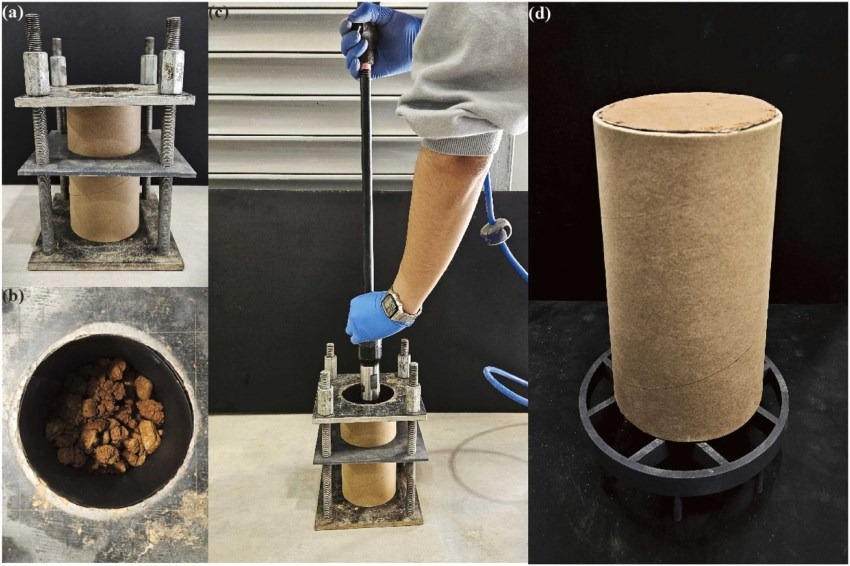
The compacted earth could replace concrete in some applications. Photo: Credit Ma et al
The tubes were subjected to compression testing after being left to dry for 28 days. This revealed they were comparable in strength to conventional cement-stabilised rammed earth.
“Although their strength remains below that of typical concrete, the performance of cardboard-confined rammed earth is adequate for standard load-bearing applications, particularly in low-rise buildings,” the authors write.
They also developed an analytical model to predict the compressive strength of CCRE cylinders with different dimensions.
Further analysis indicates a CCRE column would have a life cycle cost of just $17.68, which is competitive with cement-stabilised alternatives and a 63.9 per cent reduction on concrete columns.
“The carbon footprint of a full-size CCRE column is calculated at 17.41 kgCO₂e, which is 38.6 per cent lower than that of cement-stabilised rammed earth (28.37 kgCO₂e) and 77.7 per cent lower than ordinary concrete (77.95 kgCO₂e),” they add.
Ma said cardboard-confined rammed earth could be an effective solution for construction in remote areas such as regional Australia, where red soils – ideal for rammed earth construction – are plentiful.
“Rammed earth buildings are ideal in hot climates because their high thermal mass naturally regulates indoor temperatures and humidity, reducing the need for mechanical cooling and cutting carbon emissions,” he said.
Buildings constructed from CCRE could also make use of wastepaper and cardboard.
“During the 2020-21 period, cardboard and paper accounted for 7.7 per cent of all generated waste in Australia, with more than 2.2 million tons sent to landfill,” write the authors.
The researchers are looking to partner with industry to develop the material for widespread use.
This article first appeared in Cosmos Magazine. Read the original here
Want to see more stories from The New Daily in your Google search results?
- Click here to set The New Daily as a preferred source.
- Tick the box next to "The New Daily". That's it.