Vampire-like fish goes viral after rare river sighting

Source: Sean Blocksidge / Instagram
If you have a inherent fear of slimy creatures, the pouched lamprey might by your worst nightmare. This blood-sucking, flesh-eating fish is older than the dinosaurs and swims in Australian rivers.
Did we mention that it also has a savage-looking disc-like mouth full of small horny teeth?
The good news – for humans at least – is that this prehistoric jawless fish is parasitic only on other fish.
It is also now rare to see one in Australia’s rivers, which is why a video captured by Western Australia tour guide Sean Blocksidge showing pouched lampreys swimming against the current of the Margaret River to lay their eggs upstream has gone viral.
“I suppose what I’m most thrilled about, and just quite blown away at [is] how excited people were about the whole thing,” Blocksidge told ABC News of the post, which was shared on Margaret River Discovery Company’s Instagram account.
“I mean, we’ve hit just over a quarter of a million views on one post. It’s quite remarkable.”
Blocksidge, who filmed the lampreys in the river about 270 kilometres south of Perth, believes part of the fascination is that many people were previously unaware the fish even existed.
“I think also the connection to deep, deep history – we’re talking about something that’s older than dinosaurs.”

The pouched lamprey has small, beady eyes. Photo: Sean Blocksidge
According to National Geographic, the lamprey species has existed for more than 360 million years, “feeding on flesh and blood since the depths of prehistory”. Fossils discovered in 160-million-year-old rock in China in 2023 were preserved with the fish’s distinctive mouth and teeth.
The pouched lamprey is one of about 40 species of lamprey that can still be found around the world. It is native to the Southern Hemisphere, and has been spotted in coastal rivers in Victoria, South Australia and Tasmania, as well as WA.
However, it spends most of its adult life at sea, with lamprey researcher David Morgan telling the ABC that the fish are thought to spend time circumnavigating Antarctica, “hitching rides on whales or large fish”, before coming back into the river system and then spawning in spring.
Morgan, who believes heavy rainfall has increased the number of pouched lamprey in WA, said some were bloodsuckers while others were flesh-eaters.
“Some will pierce the skin of their hosts and just let the blood flow, the others will rasp away [at flesh] with their little sucker, which also allows them to climb waterfalls and weirs,” he said.
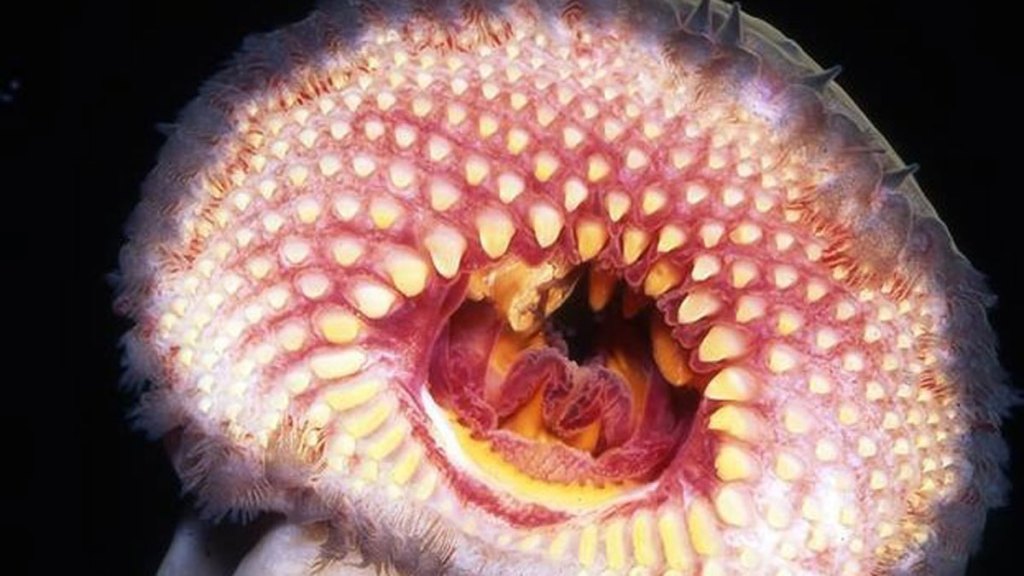
All the better to eat you with: The lamprey has a disc-shaped mouth full of teeth.
Breeding males have a large baggy pouch on the underside of their head that can add to the fish’s disturbing appearance.
Lamprey numbers are declining in Australia and New Zealand, with some experts fearing they could become endangered.
In South Australia’s Murray-Darling Basin, the pouched lamprey was badly affected by the “millennium drought” and barriers to migration such as barrages and weirs, although researchers have found it has bounced back in recent years.
In WA, the fish is listed as a “priority three” species, which refers to “possibly threatened species where data is insufficient to assess threatening processes that could affect them”.
Source: Stephen Beatty / Facebook
Blocksidge acknowledges it is “a bit of an ugly animal” and reckons that might be one reason the pouched lamprey doesn’t get the attention it deserves.
“It wasn’t so long ago – only a couple of decades – that locals would gather at the waterfalls to watch thousands of these ancient creatures wriggling upstream,” he notes in his Instagram post.
“But a 50 per cent decrease in river flow over recent decades, thanks to our drying climate, has taken a heavy toll on their numbers. These days, it’s so rare to see them …”
While lamprey adults usually reach around 60-70 centimetres, Blocksidge said the ones he saw in the Margaret River were “big units”, close to a metre long.
“Watch for them on rainy days, stormy nights, or under a full moon – wriggling through riffles, scaling rapids, or suctioned onto rocks for a breather. You might also spot them in the Donnelly or Blackwood rivers,” he said.
Want to see more stories from The New Daily in your Google search results?
- Click here to set The New Daily as a preferred source.
- Tick the box next to "The New Daily". That's it.