3D-printing glue gun offers hope for mending broken bones
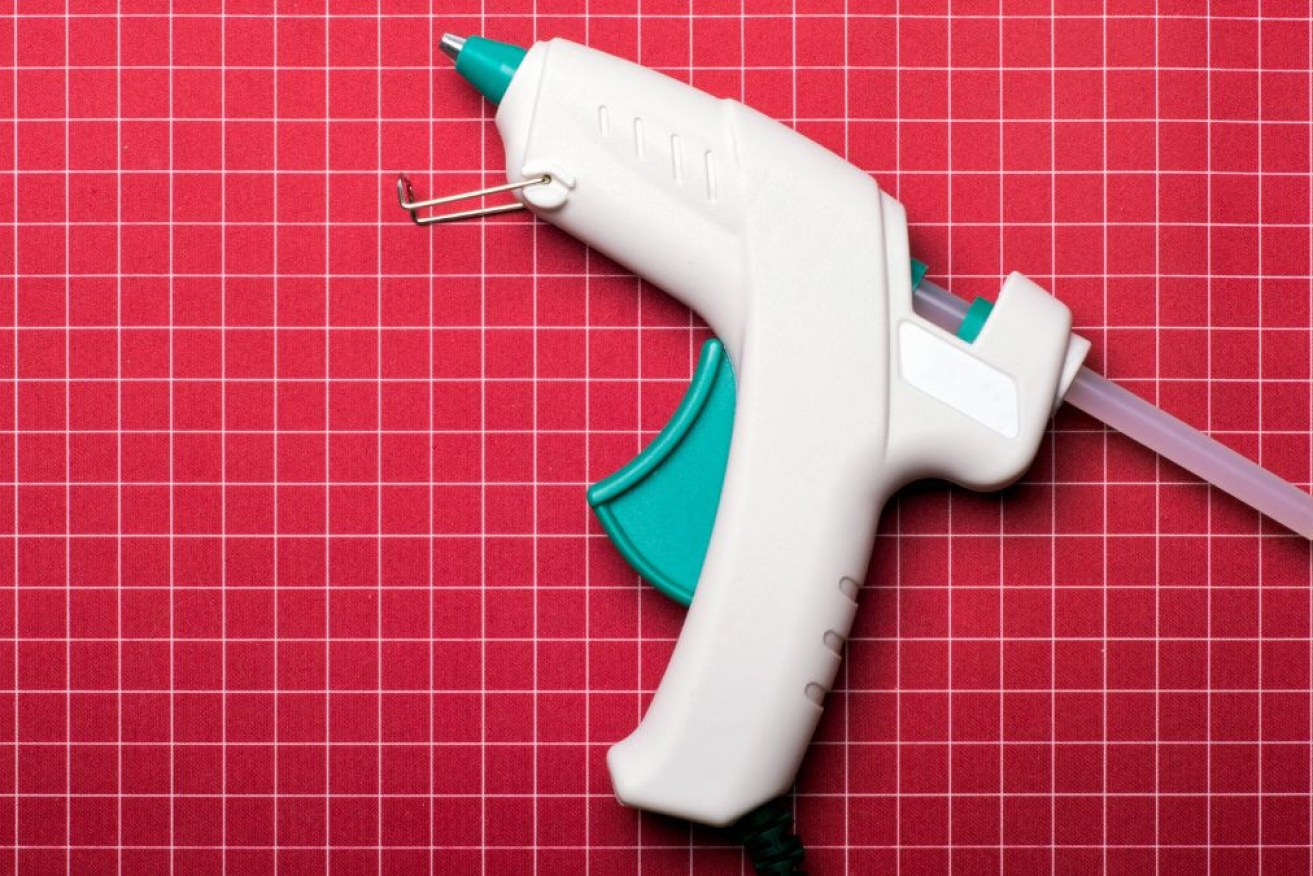
The "glue" in the study was made up of a product that aids bone healing and a biocompatible thermoplastic. Photo: Canva
A bone repair solution that could reduce surgery times might soon find its way onto the operating table, with researchers testing out a 3D-printing glue gun on rabbit bone fractures in a study published in the journal Device.
They showed the glue gun device can print bone grafts directly onto fractures and breaks during surgery by designing the graft on the spot.
Bone grafts and implants have historically been made from metal or donor bone, although some recent studies have also used 3D-printed material. When a bone has broken in irregular ways, these implants need to be carefully designed and produced prior to the surgery, which can potentially extend waiting and surgery times.
This is not the case for the new device.
“Our proposed technology offers a distinct approach by developing an in situ printing system that enables a real-time fabrication and application of a scaffold directly at the surgical site,” said Jung Seung Lee, a professor and co-author of the study from Sungkyunkwan University, Republic of Korea.
“This allows for highly accurate anatomical matching, even in irregular or complex defects, without the need for preoperative preparation such as imaging, modelling, and trimming processes.”
The filament used in the glue gun has two main components. The first is hydroxyapatite (HA), which promotes natural bone healing. The other is a biocompatible thermoplastic called polycaprolactone (PCL).
PCL is a liquid at temperatures as low as 60 degrees. This means it is flexible enough to fit in the gaps of broken bones, but cool enough to prevent any tissue damage during surgery.
“Because the device is compact and manually operated, the surgeon can adjust the printing direction, angle, and depth during the procedure in real time,” Lee said.
“Also, we demonstrated that this process could be completed in a matter of minutes. This highlights a significant advantage in terms of reducing operative time and improving procedural efficiency under real surgical conditions.”
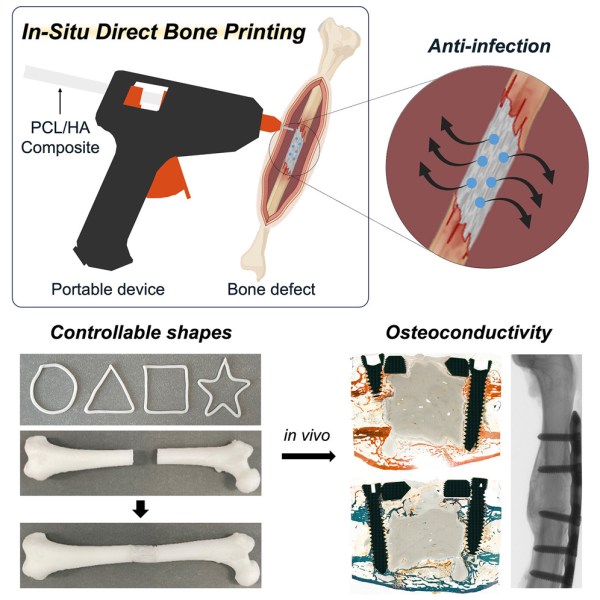
The process has the potential to transform how broken bones are repaired. Image: Device
Surgeons can also adjust the ratios of PCL and HA to vary the harness and strength of the grafts needed for different bones throughout the body.
The researchers were aware of the risk of infection that can arise from surgery. To combat this, the team incorporated two antibiotics, vancomycin and gentamicin, into their material. These anti-bacterial compounds prevent the growth of Escherichia coli and Staphylococcus aureus, two of the most common post-surgery infections.
“This localised delivery approach offers meaningful clinical advantages over systemic antibiotic administration by potentially reducing side effects and limiting the development of antibiotic resistance, while still effectively protecting against postoperative infection,” Lee said.
Vancomycin and gentamicin were shown to release slowly over several weeks, but according to the authors of the study, “the drug-release profile can be modulated by selecting drugs of varying molecular weights or by altering the scaffold composition to adjust pore size, porosity, and polymer matrix characteristics”.
“Such modifications enable the tuning of drug-release kinetics to match specific therapeutic requirements and ensure effective and sustained drug delivery for target applications,” they write.
In their proof-of-concept, the researchers tested the bone-repairing glue gun on rabbits with fractures to their femurs.
At 12 weeks post-surgery, the team observed no signs of infection and greater bone healing compared to rabbits with traditional bone cement grafts.
“The results showed that the printing group exhibited superior outcomes in key structural parameters such as bone surface area, cortical thickness, and polar moment of inertia, suggesting more effective bone healing and integration,” Lee said.
The team plans to next focus on preparing to test their device on human bones.
“Clinical adoption will require standardised manufacturing processes, validated sterilisation protocols, and preclinical studies in large animal models to meet regulatory approval standards,” Lee said.
This article first appeared in Cosmos magazine. Read the original here
Want to see more stories from The New Daily in your Google search results?
- Click here to set The New Daily as a preferred source.
- Tick the box next to "The New Daily". That's it.