Tiny workshop knocks socks off Aussie manufacturing
Source: AAP
Down the block from the Horse and Hound Hotel and across from a farm supply shop doing a roaring trade in sheep drench, sits one of Australia’s last woollen sock factories.
Lindner Socks produces 40,000 pairs every year from a nondescript shopfront on Crookwell’s main drag, a quiet captain of industry in the heart of NSW Southern Tablelands sheep-grazing country.
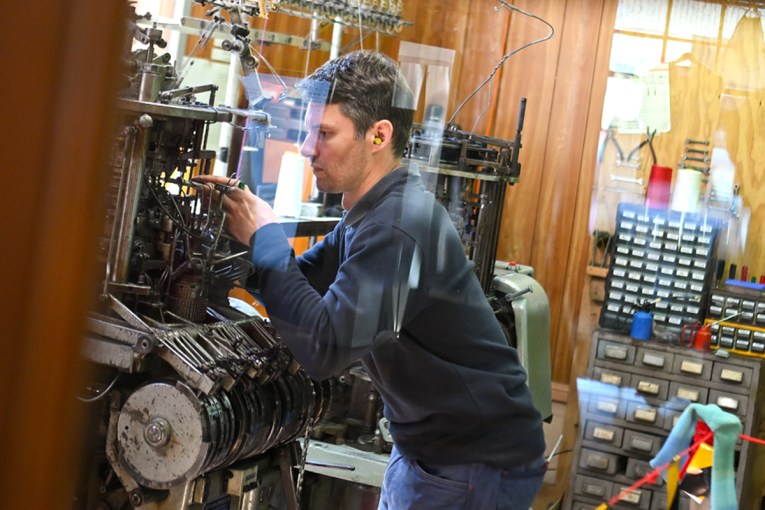
The air in the wood-panelled factory is rich with the warm scent of oil, which keeps rows of knitting machines humming with a rhythmic clickety-clack.
The half-century-old knitters are equipped with a ring of needles that follow a pattern, hooking, spinning and whirring to form tightly crocheted and cosy tubes of merino wool.
Lengths of socks come off the machines like strings of sausages, ready to be cut and finished by hand.
“The pattern is set up like an old printer,” sock maker Andrew Lindner says over the thrum of the machines on the factory floor.
“It’s like an old analogue computer or a pianola.”
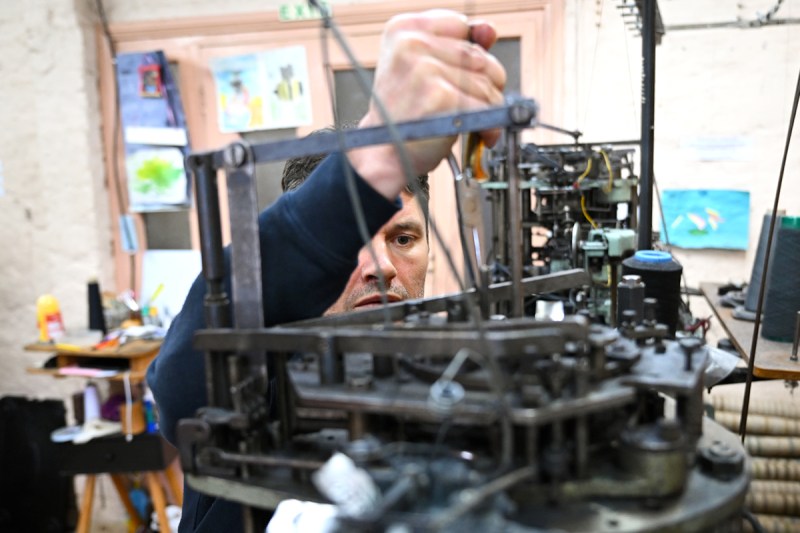
Tenth-generation sock maker Andrew Lindner services a knitting machine. Photo: AAP
A 10th-generation sock maker, Lindner is carrying on the tradition of his father and German forebears.
Their surname comes from the German word linde, meaning lime, for a family who lived near a citrus grove.
While life has changed markedly since 1700s Germany, consumers are increasingly looking to the past for quality and connection in their clothing, Lindner says.
“What we’re doing here is not just socks,” he says.
“Humans are finding we’ve had everything at our fingertips at a cheap price but it’s not quite doing what we want.
“We want to go back to a farm, see stuff come out of the ground, taste things, get back to the natural good and reconnect.”
The quirks of the nation’s economy come to life inside the walls of the compact Crookwell factory.
Lindner is an outlier in textiles, with about 97 per cent of clothes sold in Australia made offshore.
Free trade policies introduced from the 1980s were the death knell for local textile manufacturing, while capabilities to scour and spin fibres on a large scale also disappeared.
Despite being a global leader in wool production, Australia exports about 280,000 tonnes a year for textiles, along with one million tonnes of cotton.
While small amounts of merino wool can still be processed in micro mills in Victoria and South Australia, much of the nation’s favourite fibre has to be sent overseas for processing into yarn.
Deakin University textiles researcher Chris Hurren says this has forced Australia to confront the significance of sovereign capability, as oil prices rise and political instability fractures supply chains.
It’s an opportunity for small manufacturers like Lindner, which could well be trailblazers for the future by sticking with traditions, he says.
“If we had difficult global tensions, we wouldn’t be able to clothe ourselves,” Hurren says.
The fashion industry and major universities are banding together to create a circular economy and bring fibre processing back to Australia, a movement Hurren says is gaining momentum.
“It’s close to that sort of thing coming back into Australia because of the level of automation … and the capabilities we have with low-cost power from renewable sources,” he says.
“There’s potential, it’s just getting that policy in place.”
One policy mandates that defence force combat uniforms must be made in Australia, which keeps local companies like Stewart & Heaton in business.
The industry push also aims to cut textile waste; research in 2023 found that the average shopper buys 27 kilograms of new apparel every year, while tossing out 23 kilograms.
While Australian garment makers can voluntarily join a scheme to divert clothing from landfill, knowledge about consumer behaviour has long been limited.
Adelaide University researcher Kate Sansome interviewed almost 600 shoppers and people in the fashion industry about their wardrobe cycles.
She found durability was a key influence in keeping and caring for garments.
“There’s physical durability, which is the design and whether it’s been manufactured to last for a very long time,” Sansome says.
“Then emotional durability is thinking about the aesthetic of the clothing; do you feel like it fits your style, is it something that … represents yourself.”
Lindner says his small-batch creations give him a competitive edge.
“This is old school,” he says.
“Like your organic slow-cook wood fire, we’re bringing in all these beautiful ingredients.”
Sometimes, while lying awake at night, Lindner imagines what his customers need in the paddock, on the snowfields or even how his products might assist with smelly feet.
Ultimately, it comes down to attention to detail and using natural materials that go the distance, he says.
“If we see you come back in three months’ time, we probably haven’t done our job,” he says.
“But three or four years later, a person might bring in a visitor, so over time it grows.
“In fact, not selling might be even more powerful.”
-AAP
Want to see more stories from The New Daily in your Google search results?
- Click here to set The New Daily as a preferred source.
- Tick the box next to "The New Daily". That's it.