‘Ultimate DIY project’: Bunnings stirs up flat-pack home market

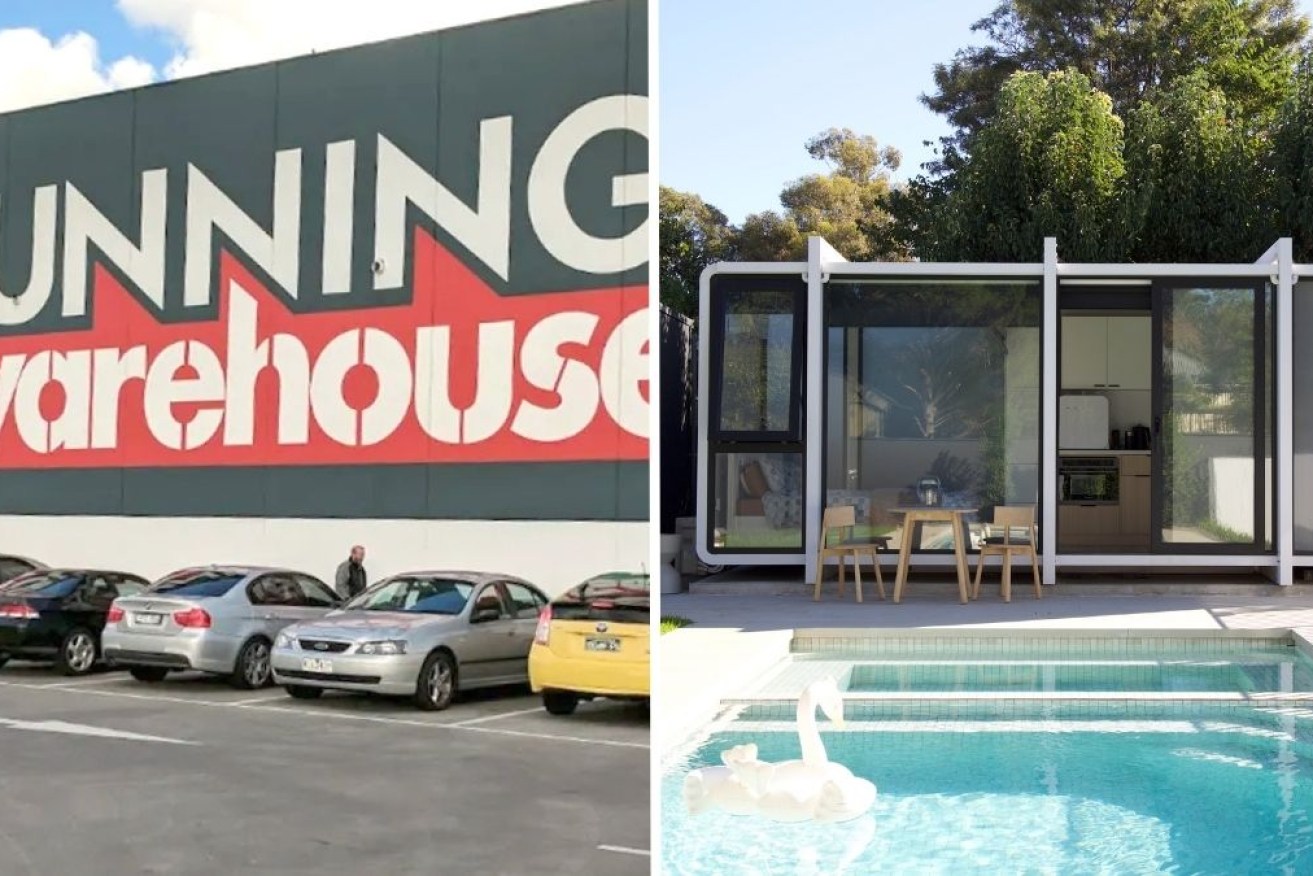
Two of Elsewhere Pods' range can be bought through hardware retailer Bunnings. Photos: TND/Elsewhere Pods
As property prices soar and interest rates begin to tick up, one Australian start-up has teamed up with Bunnings for what might just be an innovative solution.
This week, the hardware giant began selling luxury tiny homes described as the “ultimate DIY project” by their creator.
Bunnings is selling two of Elsewhere Pods’ flatpack dwellings online or through special order – a 2.7-metre by 2.4-metre pod priced at $26,100 and a larger 4-metre by 2.4-metre studio at $42,900.
Both are designed to potentially require no building permit (although check with your local council first) and just take two days to install.
Bunnings says the tiny cabins offer “customers a sleek, modern and architectural option for flexible extra space at home”.
“They provide an affordable way for customers to add functional space to their homes,” a spokesperson said.

Elsewhere Pods founder Matt Decarne in one of his tiny cabins. Photo: Elsewhere Pods
Elsewhere Pods founder Matt Decarne came up with the idea after his mother lost her home in the 2020 northern NSW floods.
He said his tiny buildings could be customised to suit their buyers, were ideal for difficult and hard-to-reach sites and can be built without any heavy machinery.
“Once we were able to explain [to Bunnings] how special this flat-pack system is and how simple it is to build, and started talking about DIY, this is when they became quite excited,” he told The Australian Financial Review.
“What we’ve launched with Bunnings is a subset of our broader designs that are standardised for simplicity and also that are limited to designs which don’t trigger building permits.”
It’s not the first time Bunnings has offered kit houses. As long ago as 2019, it began selling flat-pack homes in New Zealand under its own brand. It also offers outdoor rooms and expandable container homes and home offices under other Australian brands.
Elsewhere, Amazon has also offered its flat-packed Amazon House for about seven years.
It’s all part of a trend towards prefabricated or modular homes – tiny or more regular-sized – as one solution to Australia’s housing supply crunch. They can be assembled in factories in as little as 12 weeks and can offer a cheaper way to live or expand an existing house.
Decarne told the AFR that before the Bunnings deal, 40 per cent of his pod sales were for Airbnb investors looking to generate an income from regional properties. Another customer has Australia’s smallest Class 1A-approved dwelling at Bright, in Victoria’s high country.
Source: Elsewhere Pods
Elsewhere, former Sydney couple Chris and Beau (whose surnames were not provided) joined the kit home trend after fleeing the “madness” of the harbour’s city’s spiralling property prices.
They are building a small three-bedroom kit home on Russell Island, about 50 kilometres from the centre of Brisbane – with an overall budget of less than $150,000.
“We came up with that as the kit cost us about $50,000 and then generally when you speak to these kit home manufacturers, they say double that price plus add 20 per cent – and that might be where you can end up for the total cost of your build,” Chris told Yahoo Finance last week.
“We did the calculations and we worked out, hang on, there’s a great arbitrage here, an opportunity for us to grow our wealth but also have a place to live if we want to that’s more affordable.”
In Melbourne, Maria Hatzi built a two-bedroom granny flat with a kitchen, living area, bathroom and laundry for about $250,000. She hopes her teenage son can move in one day, to help save to buy his own place.
“I prefer to see my kids happy than them struggling. So we’re happy to do that,” she told Yahoo Finance.
Last year, a Housing Industry Association survey found builders expected to construct 10 times the granny flats in 2026 than had been built in 2022.

Source: HIA
“Affordability challenges, combined with recent planning reforms, are motivating the shift towards granny flat construction. It’s likely the desire for space and amenity is still there, especially for those with the financial capacity to afford it. But this is not to say there aren’t those who would prefer a smaller and more manageable home, even in a broadly affordable market,” the HIA said.
“Without dramatic improvements in affordability, alternative housing types are going to become even more important as a matter of not just preference, but necessity.”
The Australian Tiny House Association said more and more local government areas across Australia were developing specific tiny house policies.
“ATHA are cautiously optimistic that this number will grow as more councils realise the potential of tiny houses to be a sustainable housing option and help remedy the housing crisis,” it said.
The concept of tiny homes isn’t entirely new but the growth is. ATHA president Danielle Lester told the AFR they represented “one of the few remaining ways to secure adequate housing without taking on unsustainable debt” for single-income households, older women, regional workers and even first-home buyers.
Want to see more stories from The New Daily in your Google search results?
- Click here to set The New Daily as a preferred source.
- Tick the box next to "The New Daily". That's it.