‘Restrict supplies, push up prices’: Petrol’s $4 a litre threat

Source: Sky News Australia
The federal government is unable to reassure Australians that petrol prices won’t rise to an unprecedented $4 a litre as the Middle East war sends shockwaves through supply chains.
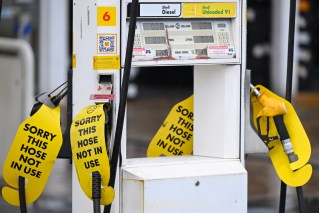
The price of petrol has already reached almost $3 a litre at some stations in Sydney and Melbourne as it soars nationwide.
NSW Premier Chris Minns said on Monday that more than 100 petrol stations across the state had run out of diesel, while 35 “don’t have access to anything”. He said his government was looking at ways to ensure the supplies to those stations, which are mostly in regional areas.
“That’s an area … we want fixed in the next couple of days with some of the big fuel suppliers,” he said.
“For demand management processes from there, we’re going to have to take it step by step and that may mean further remedial action in the weeks ahead, depending on what happens in the Middle East, but we should get this in the right order.
“Some of those steps will have an impact on the economy today and we may need to take them, but I don’t want to take them before it’s necessary.”
Earlier, Assistant Foreign Affairs and Trade Minister Matt Thistlethwaite was asked if prices could rise as high as $4 a litre.
“I can’t speculate on what’s going to happen with prices, but obviously, the longer the conflict goes on, the more potential it has to restrict supplies and push up prices,” he told Sky News on Monday.
“That’s why the Prime Minister and our government has been calling on the Trump administration and the Netanyahu administration to try to negotiate a ceasefire.”
Source: Network Ten
Prime Minister Anthony Albanese has also been phoning his global counterparts to try to shore up Australia’s fuel stocks amid the crisis.
It comes after Energy Minister Chris Bowen revealed on Sunday that six tankers bound for Australia had their journeys cancelled or postponed because of the ongoing war.
“Some of those have already been replaced by the importers and refiners with other sources,” Bowen told ABC’s Insiders on Sunday.
“That gives us some context of what we are dealing with. That’s not to say it isn’t a very challenged environment internationally and, of course, the flow of oil to Asian refineries has slowed, and that has downward impacts on us.”
Australia relies heavily on fuel imports, mostly from South Korea and Singapore, which in turn rely on oil from the Middle East.
Thistlethwaite said Albanese was working the phones to ensure Australia wasn’t forgotten in the global rush for oil.
“The Prime Minister’s negotiating with our Asian neighbours and counterparts to try and maximise the amount of fuel that is available in Australia,” he said.
Thistlethwaite suggested Australia could leverage its natural gas exports to incentivise countries such as South Korea to continue sending fuel.
The International Energy Agency has suggested encouraging people to work from home to try to reduce demand for petrol, a move the government described as “sensible” on Sunday.
On Monday, Bowen told federal parliament the first step in reducing petrol consumption was voluntary restraint through public campaigns.
“Only after that, would any further actions be considered. I made it clear yesterday, I think we’re a long way from that,” he said.
Cabinet minister Mark Butler said fuel companies had increased their imports from the US in response to the shipping cancellations.
“We’re seeing, as I understand it, an increase in shipments from the US that we haven’t seen for many, many years,” he told Nine’s Today program on Monday.
“I think the companies, but also the government, [are] working very hard to make sure that we can get supplies from wherever possible.”
As unrest in the Middle East enters its fourth week, and the Strait of Hormuz remains closed, Australia’s food supply chain faces threats from rising fuel prices and impacted global fertiliser trade. Logistics companies warn petrol and diesel price hikes are putting their operations under increasing pressure.
United Workers Union has called on an overhaul of industry settings to protect the 2.3 million essential food workers in the sector from farms to meat processing, dairy and supermarkets.
“These workers play a vital role in Australia’s food ecosystem – there is no food security without job security. With a war raging in the Middle East and its effects already hitting Australian supply chains, this issue cannot wait,” United Workers Union food and beverages director Mel Gatfield said on Monday.
The union pointed to rising living costs, including higher petrol prices, climate change weather events and global instability driven by the conflict in the Middle East impacting food security.
“What we’d like to see is a sense of urgency on both fronts: ensuring stable, secure jobs in the broader food sector, and protecting vulnerable Australians from food insecurity,” Gatfield said.
Deputy opposition leader Jane Hume said stronger supply chains were the solution.
“The way to deal with the crisis we’re facing now is to address those distribution channels and to make sure that we have the supply chains in place to deliver fuel where it’s needed,” she told ABC TV.
“Without that, the economy simply runs to a stop.”
-with AAP
Want to see more stories from The New Daily in your Google search results?
- Click here to set The New Daily as a preferred source.
- Tick the box next to "The New Daily". That's it.