Visitors to Thailand warned of big changes in year of mourning

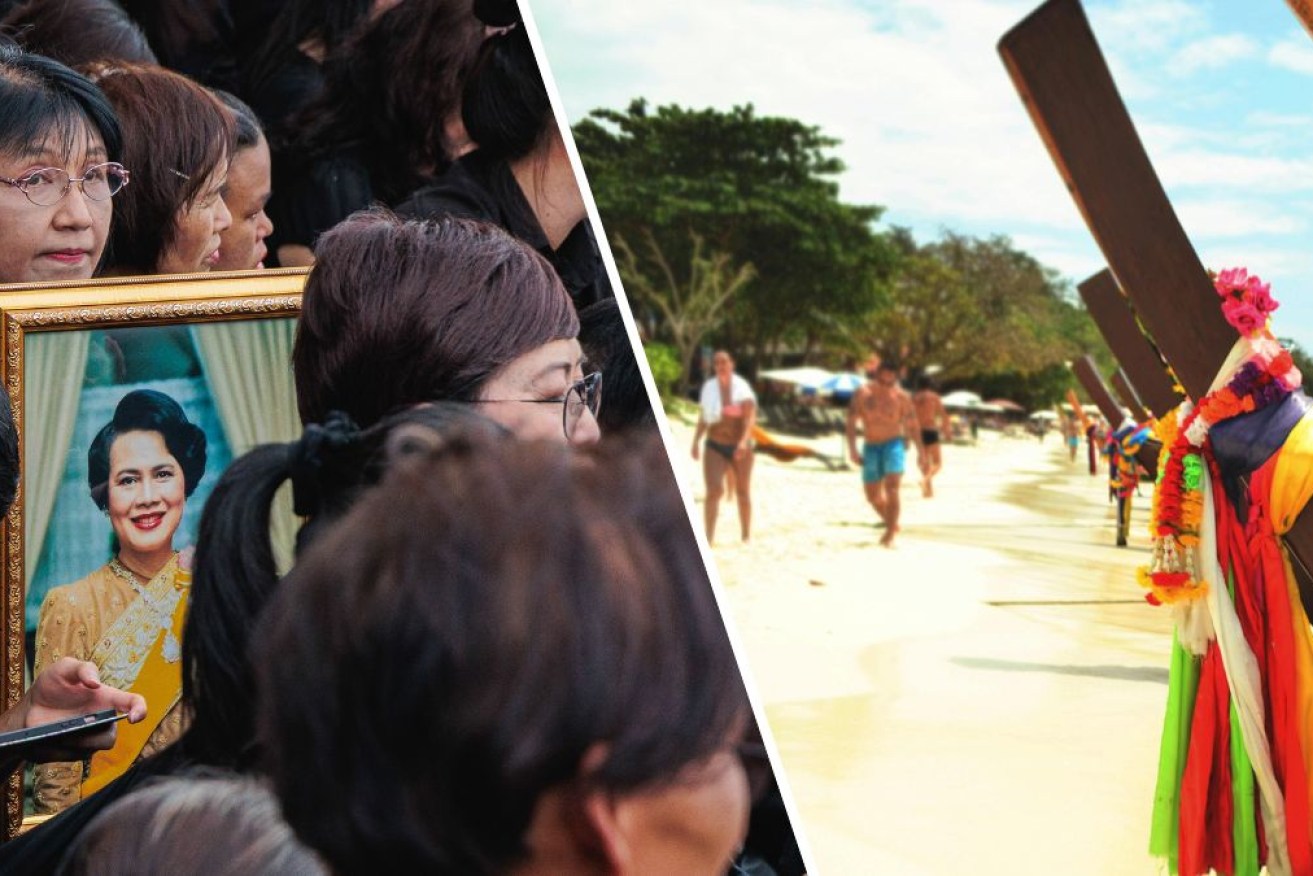
Thais have begun a year of mourning after the death of the Queen Mother. Photos: AAP/Pexels
Australians heading to Thailand have been warned they may need to change their travel plans as the nation begins a year of mourning.
It follows the death of Thailand’s beloved Queen Mother Sirikit, at the age of 93, last Friday.
Thailand’s prime minister, Anutin Charnvirakul, has ordered all government offices, state enterprises and educational institutions to fly the national flag at half-mast for 30 days from October 25.
There will also be strict rules for Thais, including that civil servants and state enterprise employees must wear black and observe a one-year mourning period. The wider population has been asked to mourn for 90 days and dress in black, subdued or neutral tones.
Visitors have also been asked to wear muted colours to show respect – particularly when visiting public places, temples or government buildings.
Thailand’s tourism authority has said the country remains “open and fully operational”, including “all tourist attractions, transportation services, restaurants, shops, and events” – although visitors are likely to notice some changes.
“Public activities, entertainment activities, and business operations are encouraged to exercise discretion and to adjust their formats appropriately in reflection of the national atmosphere of mourning, with festive and celebratory elements postponed until further notice,” it said.
The government had also asked the wider entertainment industry –including businesses such as bars and nightclubs – to ensure its activities are “conducted with solemnity and respect in line with the national mourning period”, The Nation newspaper wrote at the weekend.
“Events can be held appropriately within the bounds of respect for the royal family’s contributions,” it said.
One major festival, Vijit Chao Phraya – a 45-day light and sound spectacle in Bangkok – has already been pushed back to December 1 from its original start date of November 1. It gets 1.5 million visitors and generates an estimated $A23.4 billion in revenue.
Other festivals will also have changed dates and other modifications.
Concerts by K-Pop group BlackPink went ahead at the weekend. Fans were asked to wear black out of respect for Sirikit.

The Grand Palace in Bangkok has been closed to mourn the Queen Mother. Image: The Grand Palace
The Thai tourist authority said daily life and tourism would continue, but there would be an emphasis on respectful dress and a code of conduct.
One British expatriate who has lived and worked in the country for years said visitors should be sensitive about the national mood.
“The key thing is to try to appreciate that, from the Thais’ perspective, it is a very emotional time for them,” he told the Seven Network.
“Bottom line, remember it’s a very respectful time. Be sensible. Dress modestly. Just be aware, and feel the mood. It will be very evident.”
The Royal Household Bureau said last Friday that Queen Mother Sirikit had died in a hospital in Bangkok on Thursday.
Sirikit, who had suffered from a blood infection in recent days, had been largely absent from public life in recent years due to declining health. Her husband, King Bhumibol Adulyadej, died in October 2016.
Photos released by the palace for her 88th birthday showed her son, King Maha Vajiralongkorn, and other royals visiting Sirikit at Chulalongkorn Hospital, where she was receiving long-term care.
Although overshadowed by her late husband and her son, Sirikit was beloved and influential in her own right. Her portrait was displayed in homes, offices and public spaces across Thailand and her August 12 birthday was celebrated as Mother’s Day. Her activities ranged from helping Cambodian refugees to saving some of the country’s once-lush forests from destruction.
As the Thai monarchy’s role in society was increasingly scrutinised during recent decades of political turbulence, so too was the queen’s part in it. Stories circulated of her behind-the-scenes influence during upheaval marked by two military takeovers and several rounds of bloody street protests. When she publicly attended the funeral of a protester killed during one clash with police, it for many marked her taking a side in the political schism.
But while some in Bangkok gossiped about her involvement in palace intrigues and her lavish lifestyle, her popularity in the countryside endured.
“Misunderstandings arise between people in rural areas and the rich, so-called civilised people in Bangkok. People in rural Thailand say they are neglected, and we try to fill that gap by staying with them in remote areas,” she said in an interview with The Associated Press in 1979.
Royal development projects were set up across Thailand, some of them initiated and directly supervised by the queen.
While royalty elsewhere has only ceremonial or symbolic roles, Queen Sirikit believed the monarchy was a vital institution in Thailand.
“There are some in the universities who think the monarchy is obsolete. But I think Thailand needs an understanding monarch,” she said in the 1979 interview.
“At the call, ‘The king is coming’, thousands will gather.
“The mere word king has something magic in it. It is wonderful.”
-with AAP
Want to see more stories from The New Daily in your Google search results?
- Click here to set The New Daily as a preferred source.
- Tick the box next to "The New Daily". That's it.






'Blessed': Australian found safe in Nepal