‘Intruded’: China hits back over RAAF incident

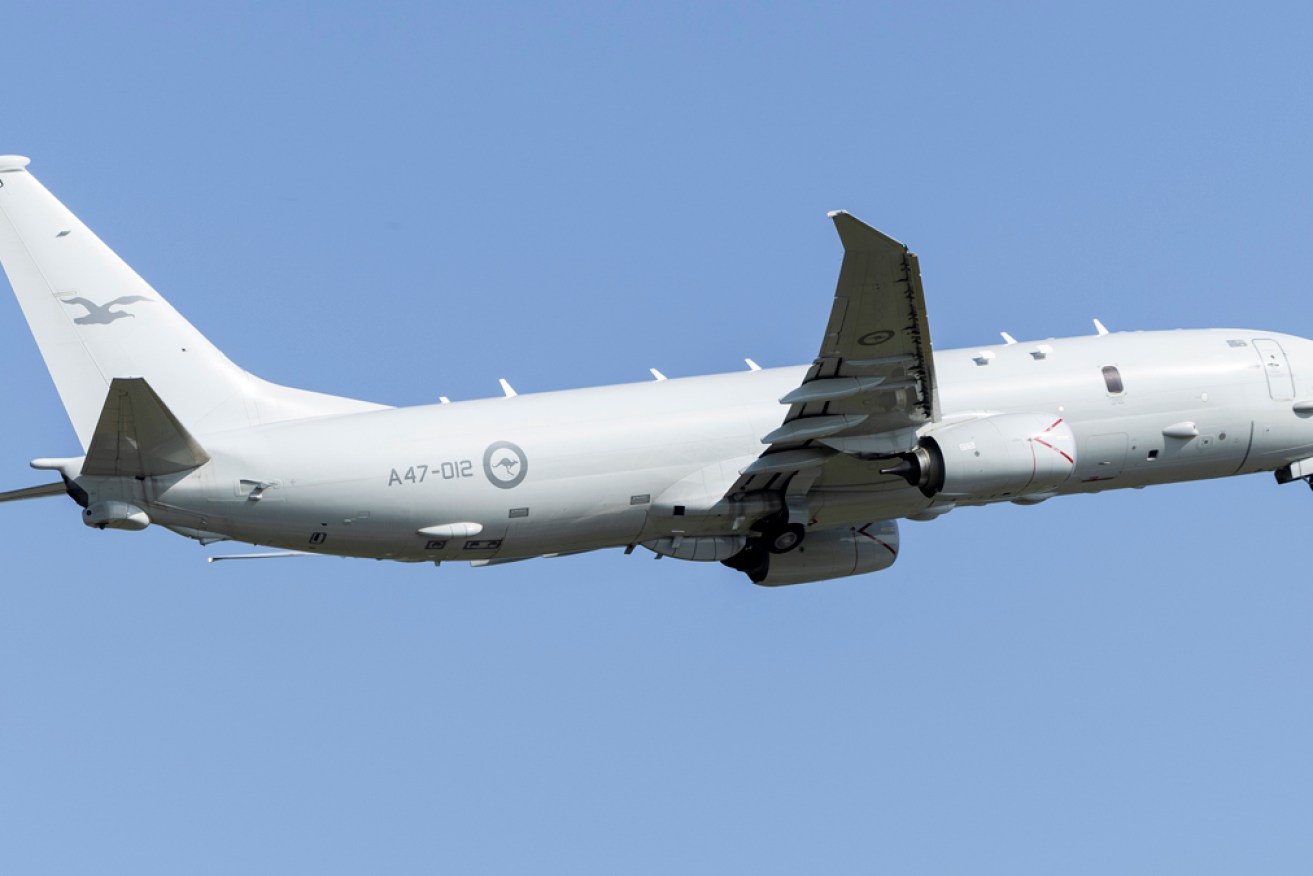
A Chinese jet released a flare near an Australian surveillance P-8am Poisedon in the latest defence incident. Photo: Australian Defence Force
China has hit back at Australia’s allegations that an incident involving one its military jets could have caused engine failure or even a crash if it had struck an RAAF plane.
The incident in international airspace over the South China Sea between the nations was made public by Defence Minister Richard Marles on Monday, amid fears Beijing is growing more aggressive in the contested region.
While occurrences of “unsafe and unprofessional” behaviour in the region were yet to result in a significant incident between Australia and China, the potential consequences of a flare striking a plane are severe.
“It could impact the blades, it could disrupt airflow, it could start a fire,” security analyst and academic Jennifer Parker said on Tuesday.
“A catastrophic engine failure or fire could, in the worst circumstances, result in that plane crashing.”
The exact location of the planes at the time of the incident has not been released. But Marles reiterated on Tuesday that the planes were in international airspace at the time.
“At every moment our crew was adhering to international law,” he said in Adelaide.
However, a spokesman for the People’s Liberation Army denied the Australian government’s claim, saying the RAAF P-8A Poseidon had “intruded” into Chinese airspace.
“The troops in the theatre are on high alert at all times to resolutely defend national sovereignty,” Senior Colonel Li Jianjian said.
Al-Jazeera reports that Chinese Foreign Ministry spokesman Guo Jiakun said that “the Australian military aircraft deliberately intruded into the airspace around China’s Xisha Islands” – Beijing’s name for the Paracel Islands – “without Chinese permission”.
Parker said China’s claim to the Paracel Islands was not legitimate and Australia had operated militarily in the region for decades.
“Their claims that we are impeding on their airspace are not consistent with international law,” she said.
“I don’t agree with China’s claims whatsoever. In fact, most countries don’t agree with China’s claims when it comes to the South China Sea.”
Marles previously said the RAAF aircraft was on a routine patrol on Sunday when the People’s Liberation Army jet flew alongside it.
The Chinese aircraft twice released flares “very close” to the Australian plane, he said.
“We have made our position very clear to China, both through our embassy in Beijing but also to the Chinese embassy in Canberra,” Marles said on Tuesday.
Despite the recovery of the Australia-China relationship on economic and diplomatic terms under the Albanese government, Parker said such incidents highlighted how aggressive China was still prepared to be.
It was crucial Australia continued to maintain a military presence in the South China Sea because of its importance as a trade route for the Australian economy, she said.
“Our national security interests are directly at odds with China’s national security interests,” Parker said.
“The security relationship between the two countries is not stabilised and is not about to stabilise.”
Lowell Bautista, a Western Sydney University expert in the law of the sea, said Australia should continue to improve military-to-military communication with China to prevent similar future incidents.
The government should reaffirm Australian military operations were protected under international law and intended to uphold regional peace rather than undermine it, Bautista said.
“Australia’s message should be clear: We seek peace, not provocation,” he said.
-with AAP
Want to see more stories from The New Daily in your Google search results?
- Click here to set The New Daily as a preferred source.
- Tick the box next to "The New Daily". That's it.





'Blessed': Australian found safe in Nepal