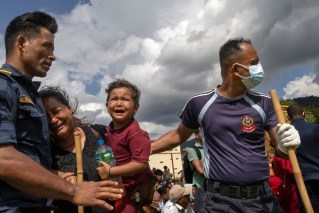
Nepal’s PM quits as anti-corruption protests spiral
Source: X
Nepal’s prime minister has resigned following violent protests against a ban on social media platforms and government corruption.
Khadga Prasad Oli said he was stepping down immediately.
His resignation came after protesters set fire to the homes of some of Nepal’s top political leaders in opposition to a social media ban that was lifted early on Tuesday (local time), a day after deadly anti-government protests when police opened fire and killed 19 people.
Local reports and videos shared on social media showed protesters attacking residences of the top political leaders in and around Kathmandu.
A curfew was imposed in the capital and other cities, and schools in Kathmandu were closed.
The houses set on fire included those of Sher Bahadur Deuba, leader of the largest party Nepali Congress, President Ram Chandra Poudel, Home Minister Ramesh Lekhak and leader of the Communist Party of Nepal Maoist Pushpa Kamal Dahal.
One video circulating online claims to show Oli’s house also burning.
A private school owned by Deuba’s wife Arzu Deuba Rana, the Foreign Minister, was also set on fire.
Source: X
The mass protest and attack on parliament on Monday began as opposition to the ban on social media platforms. They were fuelled by growing frustration and dissatisfaction against the political parties among the people, who accuse them of corruption.
Several protests were reported on Tuesday, despite the indefinite curfew in Kathmandu.
“Punish the murders in government. Stop killing children,” the protesters chanted while police using loudspeakers urged them to return home.
The protesters’ anger turned towards the government led by Oli, who has become increasingly unpopular.
Several widely used social networks, including Facebook, X and YouTube were blocked in the Himalayan nation last week after failing to comply with a requirement to register and submit to government oversight.
Monday’s rallies against the ban swelled to tens of thousands of people in Kathmandu. Crowds surrounded the parliament building before police opened fire on the demonstrators.
Nineteen people were killed.
“Stop the ban on social media. Stop corruption, not social media,” the crowds chanted, waving national flags.
Seven of those killed in Monday’s protests and scores of the wounded were received at the National Trauma Centre, the country’s main hospital.
“Many of them are in serious condition and appear to have been shot in the head and chest,” Badri Risa said.

The seat of government is well alight as anarchy takes over. Photo: AAP
Families waited for news of their relatives while people lined up to donate blood.
Oli said he was forming an investigating committee to submit a report in 15 days and that there would be compensation for the lives lost and free treatment for the wounded.
Home Minister Ramesh Lekhak also resigned at an emergency cabinet meeting late on Monday.
The violence unfolded as Nepal’s government pursues a broader attempt to regulate social media with a bill aimed at ensuring the platforms are “properly managed, responsible and accountable”.
The proposal has been widely criticised as a tool for censorship and for punishing government opponents who voice their protests online.
The bill includes asking the companies to appoint a liaison office or a point of contact in the country.
Rights groups have called it an attempt by the government to curb freedom of expression and fundamental rights.
The registration requirement applied to about two dozen social networks widely used in Nepal. Google, which owns YouTube; Meta, the parent company of Facebook, Instagram and WhatsApp; and Elon Musk’s X platform did not respond to requests for comment from The Associated Press.
TikTok, Viber and three other platforms have registered and operated without interruption.
Nepal in 2023 banned TikTok for disrupting “social harmony, goodwill and diffusing indecent materials”.
The ban was lifted in 2024 after TikTok’s executives pledged to comply with local laws, including a ban on pornographic sites, that was passed in 2018.
-AAP
Want to see more stories from The New Daily in your Google search results?
- Click here to set The New Daily as a preferred source.
- Tick the box next to "The New Daily". That's it.


'Blessed': Australian found safe in Nepal