‘Death to Trump’: Terror probe after bomb threat on flight

Source: X (Marina Medvin)
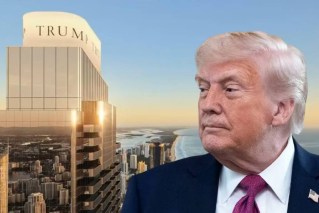
A plane passenger was tackled to the floor while shouting “death to America, death to Trump” on board a flight bound for Scotland where the US President is holding trade meetings.
The man emerged from the bathroom on EasyJet flight 609, pumping his fist in the air and also shouting “I’m going to bomb the plane” and “Allahu Akbar” (God is Great) in the aisle.
Video shows a male passenger getting up from his seat, wrestling the man to the floor and restraining his arms as the flight continues on its journey to Glasgow.
The BBC reports that counter-terrorism police are assessing the video.
There were reportedly no explosives on board. The plane had taken off from Luton Airport, England, about 7am on Sunday (local time).
The incident happened while Donald Trump was hosting trade talks at his golf course in Turnberry, western Scotland, about an hour south-west of Glasgow.
On Monday (AEST), he finalised a trade deal with European Commission President Ursula von der Leyen for a 15 per cent tariff on EU goods imported to the US.
The US and EU are each other’s largest trading partners and account for a third of global trade.
Von der Leyen said the 15 per cent tariff would be a “challenge”, but she said it gave access to the American markets.
“We have a trade deal between the two largest economies in the world, and it’s a big deal. It’s a huge deal. It will bring stability. It will bring predictability,” she said.
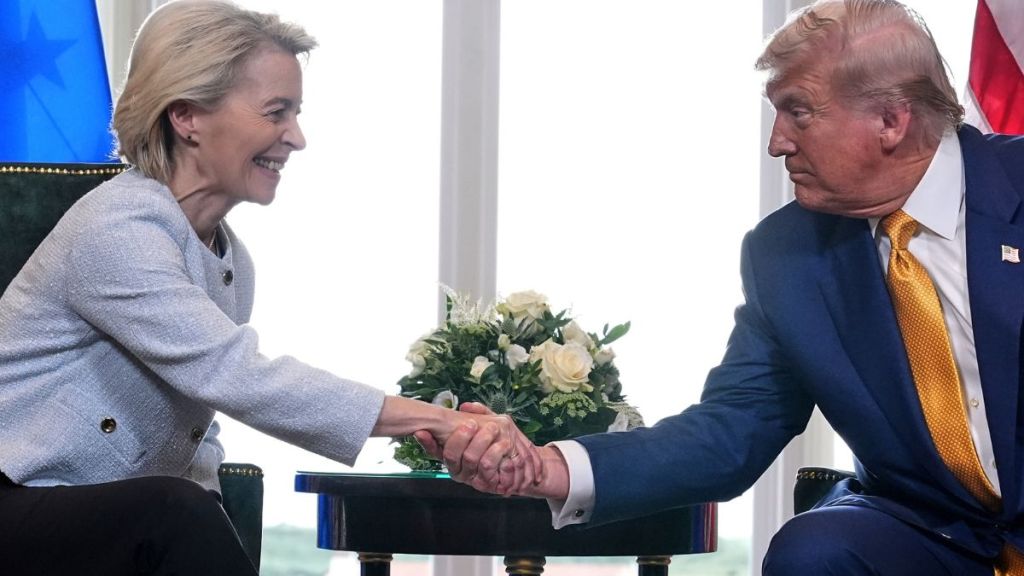
Trump and von der Leyen shake hands on the US-EU trade deal. Photo: AAP
‘Biggest deal’: Trump
“I think this is the biggest deal ever made,” Trump said after his hour-long meeting with von der Leyen, who said the 15 per cent tariff applied “across the board”.
The deal, which also includes $US600 billion ($901 billion) of EU investments in the US and $US750 billion ($1.1 trillion) of EU purchases of US energy over Trump’s second term, will bring clarity for EU companies.
Even so, the baseline tariff will be seen by many in Europe as a poor outcome compared with the initial European ambition of a zero-for-zero tariff deal, although it is better than the threatened 30 per cent rate.
German Chancellor Friedrich Merz welcomed the announcement, saying a trade conflict had been averted that would have hit Germany’s export-driven economy and its large auto sector hard.
But Bernd Lange, the German Social Democrat who chairs the European Parliament’s trade committee, said he was “quite critical” because the tariffs were imbalanced and the pledged investment would likely come at the expense of EU industry.
The euro rose about 0.2 per cent against the dollar, pound and yen within an hour of the deal being announced.
The deal mirrors key parts of the framework agreement the United States clinched with Japan last week.
“We are agreeing that the tariff … for automobiles and everything else will be a straight-across tariff of 15 per cent,” Trump said.
That rate will not, however, apply to steel and aluminium, for which a 50 per cent tariff will remain, although von der Leyen said it would be cut and replaced with a quota system.
She said the rate also applied to semiconductors and pharmaceuticals, and there would be no tariffs from either side on aircraft and aircraft parts, certain chemicals, certain generic drugs, semiconductor equipment, some agricultural products, natural resources and critical raw materials.
“We will keep working to add more products to this list,” she said, adding that the situation on spirits was still to be established.
Trump, who is seeking to reorder the global economy and reduce decades-old US trade deficits, has so far reeled in agreements with Britain, Japan, Indonesia and Vietnam, although his administration has failed to deliver on a promise of “90 deals in 90 days.”
Arriving in Scotland, Trump said the EU wanted “to make a deal very badly”. As he met von der Leyen, he said Europe had been “very unfair to the United States”.
His main bugbear is the US merchandise trade deficit with the EU, which in 2024 reached $US235 billion ($353 billion), according to US Census Bureau data.
The EU points to the US surplus in services, which it says partially redresses the balance. Trump also talked on Sunday about the “hundreds of billions of dollars” that tariffs were bringing in.
US and EU teams had been in final talks on tariffs for crucial sectors like cars, steel, aluminium or pharmaceuticals.
US trade representative Jamieson Greer and Commerce Secretary Howard Lutnick flew to Scotland on Saturday and EU Trade Commissioner Maros Sefcovic arrived early on Sunday.
Lutnick told Fox News Sunday that the EU needed to open its markets for more US exports to convince Trump to reduce a threatened 30 per cent tariff rate that is due to kick in on August 1.
“The question is, do they offer President Trump a good enough deal that is worth it for him to step off of the 30 per cent tariffs that he set,” Lutnick said, adding that the EU clearly wanted — and needed — to reach an agreement.
Without a deal, the US was going to impose 30 per cent tariffs from August 1 and the EU had prepared counter-tariffs on €93 billion ($164 billion) of US goods.
-with AAP
Want to see more stories from The New Daily in your Google search results?
- Click here to set The New Daily as a preferred source.
- Tick the box next to "The New Daily". That's it.