How Australian democracy has changed since 1975, in six charts

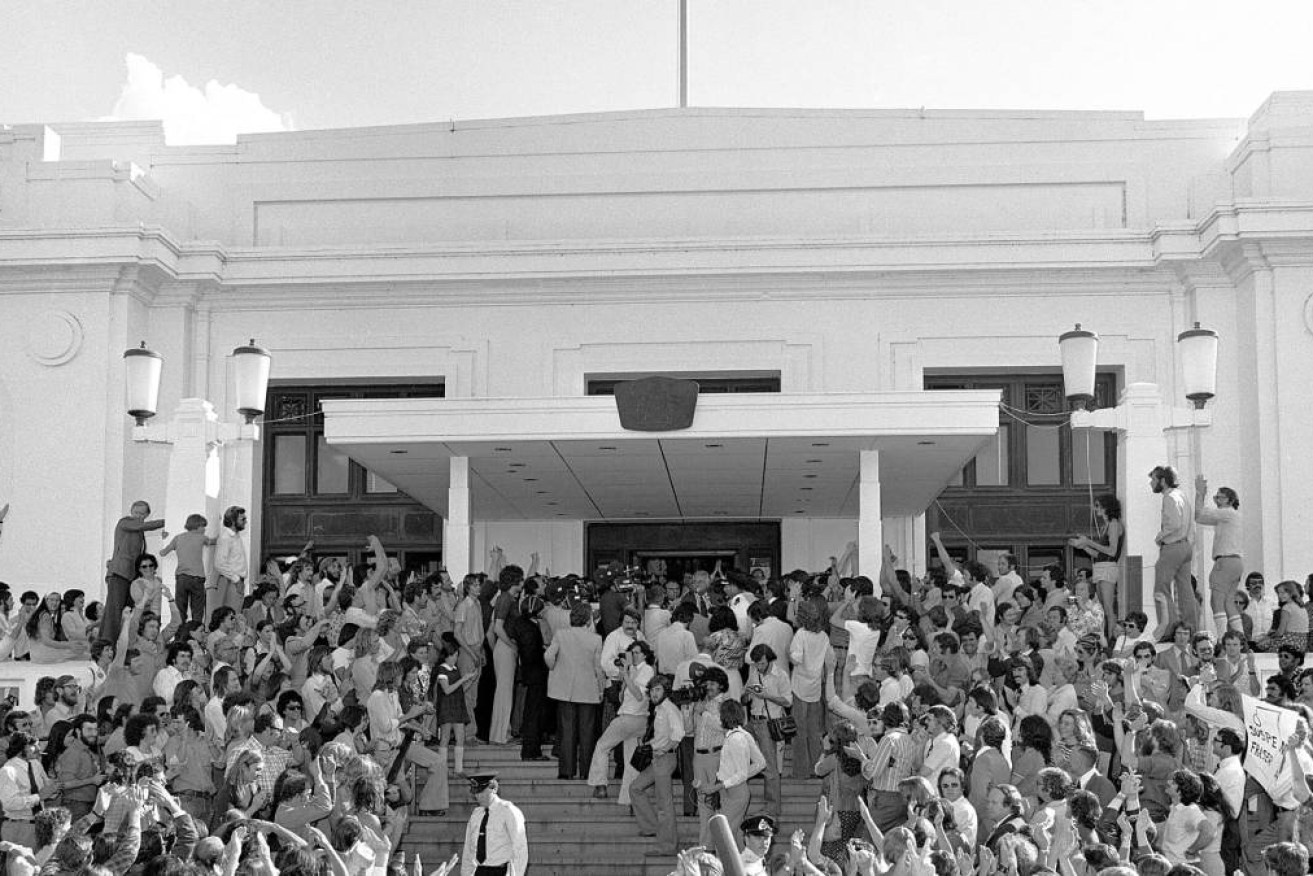
This week marks 50 years since the Dismissal of the Whitlam Labor Government by Governor-General John Kerr, Photo: Museum of Australian Democracy
This week marks 50 years since the dismissal of the Whitlam Labor government by governor-general John Kerr after the Liberal–Country opposition led by Malcolm Fraser blocked supply in the Senate.
Half a century on, here are six ways that Australian politics looks very different to how it did when Gough Whitlam was prime minister in November 1975.
More crossbenchers
At the 1974 double-dissolution election, Australians elected no minor party or independent MP in the House of Representatives and just two in the Senate – independent Michael Townley and the Liberal Movement’s Steele Hall.
There were only 60 seats in the Senate at the time, meaning 31 votes were needed to pass legislation. Liberal opposition leader Malcolm Fraser started with 29.
After Townley joined the Liberals and Liberal state governments made convention-defying Senate appointments that replaced Labor senators with independents, Fraser had the numbers to delay the supply bills that fund the government.
Today, there are 20 Senate crossbenchers and 13 in the House. It has been almost two decades since a major party had a majority in the Senate.
The major parties accuse crossbenchers of being “dysfunctional” or “disruptive”, but it was Liberals and Nationals who created the biggest constitutional crisis in Australian history.
A large and diverse Senate crossbench makes blocking supply much harder: Today, a belligerent opposition would have to convince about a dozen crossbenchers to stop funding the democratically elected government.

The additional seats won by independents and minor parties reflect the declining vote share won by the major parties.
In 1975, the Liberal-National Coalition won 53 per cent of the vote, Labor 43 per cent and independents and minor parties just 4 per cent.
By 2025, the Liberal-National vote was just 32 per cent, Labor’s 35 per cent and the vote for independents and minor parties 34 per cent. In fact, the Liberal-National Coalition’s 1975 win would be the last time either major party won a majority of the primary vote.

Parliament is much more diverse
When Whitlam won the 1972 “It’s time” election, there were 93 male Labor MPs and senators and not one woman. The five women in Parliament were from the conservative side of politics.
By the 1975 election, three Labor women had won seats.
There are now 112 women in Parliament, almost as many as there are men (114).
There are more women in Prime Minister Anthony Albanese’ 23-person Cabinet than there were female politicians of any kind in 1975.
Today it is Labor that excels in gender representation and the Liberal-National Coalition that lags, although the Leader of the Opposition, Sussan Ley, is a woman.

But it is not just by gender where Parliament has become much more representative.
In 1975, there was just one Aboriginal parliamentarian – Liberal senator Neville Bonner.
It took 70 years for an Indigenous Australian to enter federal parliament, and after Bonner was dropped as a Liberal candidate in 1983 it would be 16 years before another would join.
Today, there are nine Indigenous Australians people in Parliament: Six in the Senate and three in the House. Of all the Indigenous Australians elected to federal Parliament, the majority are in office today.
Much larger electorates
In 1975, there were only 127 lower house MPs and 60 senators (10 per state). It would be nine years before the Hawke Labor government increased the size of Parliament to about 150 MPs and 76 senators.
But under Whitlam, Parliament made a significant contribution to political representation: The territories were entitled to elect senators for the first time at the 1975 election. The Northern Territory and ACT were already represented in the House of Representatives, but even those territory MPs were granted full voting rights only in the 1960s.
Despite the smaller Parliament, MPs in 1975 represented much smaller electorates: About 55,000 voters each. Today, a single MP must represent the views of about 125,000 voters.

Many more staff
Whitlam was the first prime minister to formalise personal staff arrangements for ministers. By the end of the Whitlam government, there were 242 ministerial staffers.
As of 2024, the Albanese government had 496, an increase of more than 100 per cent.
More substantial is the increase in electorate staff. It is a bit hazy how many staff MPs received to run their electorate officers and engage with constituents in 1975, but by 1984 they had two apiece. Today, each MP gets five electorate staff, or more if they represent a regional or rural electorate.
As the Australia Institute has pointed out, as Australia’s population grows, the number of people a local MP represents is only going to increase.
More electorate staff paper over this problem, which can be fixed only by increasing the number of parliamentarians.
Parliament does not sit as long
In the four years in which the Whitlam government existed (1972 to 1975), the House of Representatives sat for 21 to 25 weeks a year, for about three days each sitting week – or 678 to 913 sitting hours a year.
In the past four years (2021 to 2024), the House sat for 13 to 18 weeks a year, for about 3½ days each sitting week – or between 417 and 634 hours a year.
The low of 13 weeks and just 417 sitting hours was in 2022, an election year – but there were three election years between 1972 and 1975, and the House sat for more weeks in each than it did in any year 2021 through 2024.

There have been two positive changes since 1975: The introduction of the Federation Chamber in 1994 that allows for parallel debate (so two MPs can speak in the same block of time) and shorter hours each day. Between 1972 and 1975, the House sat for 11 hours a day, compared to a still-punishing 9½ hours a day between 2021 and 2025.
Fewer new laws passed
Between 1972 and 1975, there were 647 acts of Parliament compared to 500 between 2021 and 2024.
The volume of legislation cannot be explained solely by Whitlam’s reforming zeal; in the four years 1976 to 1979, Liberal prime minster Malcolm Fraser took advantage of his majority in both houses to pass 772 acts of Parliament.

Of course, these six charts represent only a sample of the changes to Australian democracy over the past 50 years. Among other notable changes are:
- the rise of public funding of political parties and the regulation of the political finance system
- the dramatic increase in the number of independent MPs
- the building and opening of Australian Parliament House, with the original building becoming Old Parliament House and the Museum of Australian Democracy
- the modern committee system, in which there are many more parliamentary committees and they play a much greater scrutiny role
- the use of technology to record and broadcast Parliament to a wide audience.
The drama of the dismissal, and the constitutional questions it raised, remain very real to Australians.
It has cast a long shadow on Australian politics, and only in recent years has the correspondence between governor-general John Kerr and Buckingham Palace been published.
What do the next 50 years hold for democracy in Australia and the world?
Bill Browne is director of the Australia Institute’s democracy and accountability program
Want to see more stories from The New Daily in your Google search results?
- Click here to set The New Daily as a preferred source.
- Tick the box next to "The New Daily". That's it.
Pork barrel rolls out again – it's time for a change
Long-awaited migrant plan reflects needs and fears