Senator’s ‘cheapest form of electricity’ claim misleads


Senator Matt Canavan's claim about the cost of coal power omits crucial details from a CSIRO report. Photo: TND
What was claimed
The CSIRO has admitted that coal is the cheapest form of electricity.
Our verdict
Misleading. It found that coal and renewables have roughly the same midpoint cost in 2024, and the latter is projected to be the cheapest in 2030.
A Nationals senator’s claim that Australia’s public science organisation has admitted that coal is the cheapest form of electricity is misleading.
The CSIRO’s report found that new coal and renewables projects, with firming, had roughly the same price midpoint in 2024, and it projected renewables would be significantly cheaper in 2030.
Experts also say basing the claim on 2024 figures is unrealistic because new power plants take years to construct and new projects will not be built at those prices.
Senator Matt Canavan made the claim in a a Facebook post featuring an image of a bar chart showing the “Levelised cost of electricity” for various power generation technologies for 2024.
“BREAKING: The CSIRO has finally admitted that coal is the cheapest form of electricity,” he wrote.
“This is even after they bias almost all of their assumptions against coal and in favour of wind and solar!”
Contacted for evidence supporting his claim, Canavan’s office pointed to an opinion piece published in Central Queensland Today, which he posted on Facebook.
The chart, from the CSIRO’s latest GenCost report, estimates the levelised cost of electricity (LCOE) for various generation technologies.
It presents a price range that a new power plant may need to charge per megawatt hour of electricity to cover its construction and operation and turn a commercial profit.
These are not the prices that consumers pay today or the costs faced by existing electricity generators (Page 121).
Senator Canavan’s claim is misleading in two ways.
First, he has used the lowest end of the price range rather than the midpoint, which experts say is the most reasonable measure for comparison.
The GenCost report shows that the midpoints of the levelised cost ranges for renewables and for coal were roughly the same in 2024.
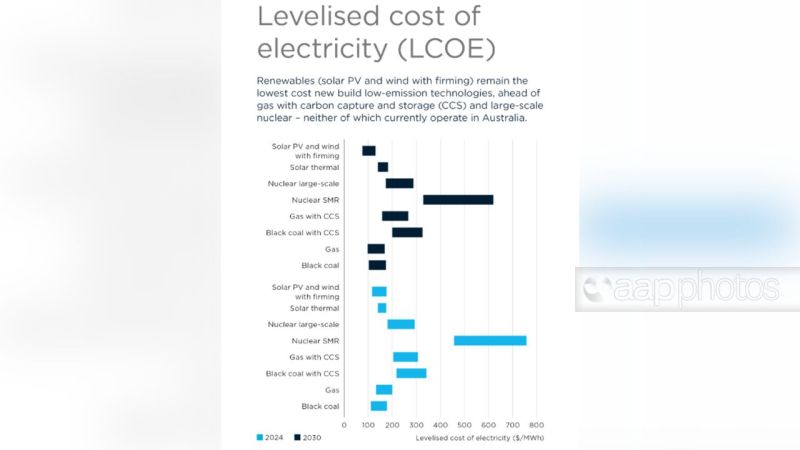
Canavan’s post omitted part of the graph showing renewables are expected to be cheaper in 2030. Image: AAP/GenCost
Black coal prices range from $111 to $178 a megawatt-hour (MW/h), while solar PV and wind cost $120 to $168 MW/h (p96).
Black coal’s low end of $111 MW/h for 2024 is below that of renewables at $120 MW/h; however, the upper end of the price range is $10 MW/h higher for coal.
Crucially, the midpoints for both are roughly the same at $144.5 MW/h for coal and $144 MW/h for renewables with firming, which includes additional costs like transmission and storage such as batteries (p96).
Report author Paul Graham said that as the cost ranges for various technologies often overlapped, midpoints provided the most reasonable basis for comparison.
He said there was no reason to compare only the lowest end or the highest end of the ranges. That meant the midpoint was “all you’ve got left” to compare technologies.
Monash University energy researcher Roger Dargaville said the 2024 data showed the midpoint for black coal without carbon capture was “more or less on par” with renewables.
Only comparing 2024 cost ranges was unrealistic because new power plants could not be built that quickly, experts said.
In a chart alongside 2024 figures in the report were estimates showing renewables will be the cheapest form of new generation in 2030.
However, Canavan’s post displayed only the part of the chart with the 2024 data, without the 2030 figures.
“GenCost finds that renewables are least-cost at both the lower end of the range and at the midpoint in 2030,” a CSIRO spokesperson said.
The report confirmed that “renewables remain the lowest-cost new-build electricity generation technology”, a CSIRO statement said.
Tom Longden, an energy systems expert from the University of Western Sydney, said 2030 cost projections were the most realistic for new generation projects.
“[It’s] important to take into account not just construction … but also the approvals lead time,” Longden said.
“A project like that will take time, even just finding the financing and everything else.”
For 2030, the report estimated the levelised cost for new coal projects would be $103-$174 MW/h, with a midpoint of $138.50 MW/h.
Meanwhile, renewables ranged from $76 to $116 MW/h, with a midpoint of $96 MW/h, making them significantly cheaper than coal.
“[The] cost range for variable renewables (solar PV and wind) with integration costs is the lowest of all new-build technologies in 2030 and at a similar range with black coal in 2024,” the GenCost report says (p75).
The report said levelised cost measures didn’t provide a realistic evaluation of a power plant’s operational costs and performance.
Instead, it was intended as a “simple screening tool” for assessing “relative competitiveness” of technologies (p68). Bruce Mountain, an energy economist at Victoria University, said the levelised cost of electricity was a “highly stylised and simplified” metric that was just “one measure of cost”.
“It should not be thought of as more than one contextual perspective in understanding the economics of different generating technologies,” he said.
-AAP
Want to see more stories from The New Daily in your Google search results?
- Click here to set The New Daily as a preferred source.
- Tick the box next to "The New Daily". That's it.
Gagging and blacklisting: What's going on in the NT
How Pauline Hanson might have finally gone too far


Labor’s migration plan: Politics or a real solution

Pork barrel rolls out again – it's time for a change
Long-awaited migrant plan reflects needs and fears
Labor to stop ‘visa hopping’ in migration crackdown

Foreign students' families blocked in migration plan