Coalition MPs falsely claim China’s live-fire drill was in ‘our waters’

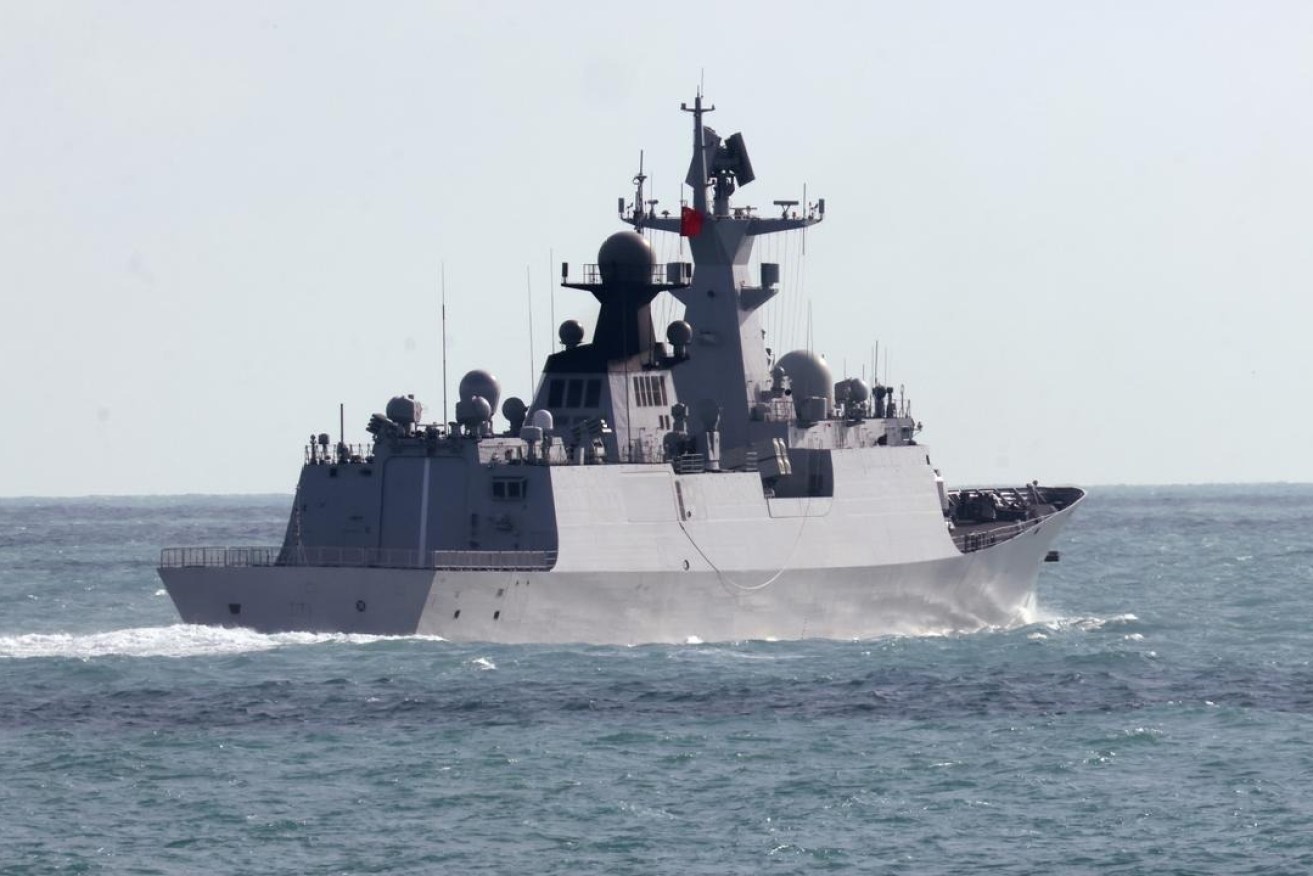
Experts say China's live-fire drills occurred in international waters. Photo: AAP
The Chinese navy did not conduct training exercises with live ammunition in Australian waters earlier this year, despite a claim by the opposition home affairs spokesperson.
Experts say China’s live-fire exercises on February 21-22 were in international waters in the Tasman Sea, over which Australia has no sovereignty.
They also said if China had carried out a drill in Australia’s territorial waters, it would have contravened a United Nations legal treaty, to which both countries are signatories.
Opposition home affairs spokesperson Andrew Hastie made the claim in a July 14 interview, arguing that Prime Minister Anthony Albanese should raise the issue during his then-upcoming visit to China.
“If we keep having flotillas sail around our waters – test fire in our waters – without permission or without letting us know about it, if our sailors and airmen are continually harassed up in the Indo-Pacific, as we’ve seen over the last few years, that’s a problem,” Hastie told the ABC’s Afternoon Briefing program.

International law experts said Hastie’s claim wasn’t correct. Photo: AAP
Other Liberal politicians have made similar claims, including Senator James Paterson and former NSW MP David Coleman.
Patterson told Sky News in February that the drill was “in our waters”, while the then opposition foreign affairs spokesman Coleman told the same channel that China’s exercise was not something that had been seen “in our waters” previously.
Patterson’s office said that he had “misspoken”, pointing to examples of him referring more generically to the drill as occurring “in our region”.
“He meant to say ‘in our region’ rather than ‘in our waters’,” a spokesperson said.
Coleman’s office did not respond to inquiries.
When asked about his claim, Hastie said that China’s People’s Liberation Army Navy (PLAN) had “irresponsibly” conducted live-fire exercises during an “unprecedented” circumnavigation of Australia.
The drill caused “49 aircraft to divert without notice”, Hastie said.
“The PLAN live-firing exercise was conducted near civil air lanes and disrupted Australian commercial flights,” Hastie said.
China’s flotilla sailed between Australia and Pacific neighbours, including New Zealand, Papua New Guinea, the Solomon Islands and Vanuatu in February.
The flotilla also conducted two live-fire drills while in the Tasman Sea.
The Labor government publicly criticised China for the lack of notice given ahead of the drills. But it said at the time that the exercises were on the “high seas”, which are outside territorial waters.
Defence officials confirmed in Senate estimates later in February that the drill took place in international waters, which matches reporting on the approximate location by media sources.
Experts said there was a clear distinction between Australian waters and the high seas under international law, particularly in relation to activities of military vessels.
Tim Stephens, a professor in international law at the University of Sydney, said the claim that China’s drill was in “our waters” was “not correct”.
He said if there had been such a drill in Australia’s territorial waters, it would have contravened international laws.
“I’m not aware of any suggestion that any navy is doing that, because they would know that clearly is in violation of the UN Convention on the Law of the Sea,” he said.
The UN convention, which came into force in 1994, defines sovereignty over waters and air surrounding signatory nations based on the distance from their territorial coastline in nautical miles.
Nations have sovereignty over territorial seas and airspace 12 nautical miles (22 kilometres) out from their coast.
Beyond this, nations retain economic rights over waters up to 200 nautical miles (370 kilometres) out. This is called a state’s exclusive economic zone.
Beyond the EEZ is what signatory states recognise as the high seas, often colloquially called international waters.
Signatories recognise the high seas as “open to all states”, including for freedom of navigation.
While the Tasman Sea is in Australia’s region, much of it is considered the high seas, which is open to all states for navigation and other activities.

Australia participates in freedom of navigation exercises in the South China Sea. Photo: AAP
Donald Rothwell, a professor of international law at the Australian National University, said Australia had no sovereignty over the high seas in the Tasman where China conducted its drills.
“There was never any debate that the PLAN live-fire incident took place in the high seas,” Rothwell said.
Rothwell said that after the live-fire test, China’s fleet entered Australia’s EEZ as part of its sailing around the continent.
“There has been a conflating of where the live-fire exercises took place (high seas) and the circumnavigation occurred (part high seas and part EEZ),” he said.
Claudio Bozzi, an international law expert at Deakin University, said other nations could navigate Australia’s territorial waters under the principle of “innocent passage”.
Under the UN convention, states can navigate through territorial waters as long as their passage is continuous and they don’t “exercise or practice with weapons”.
This contrasts with international waters, where live-fire exercises are permitted, Bozzi said.
“In international waters, authorised government (i.e. naval, but not only) vessels may conduct live fire exercises,” he said.
“It is a matter of protocol [not law] to contact the nearest coastal state and nearby vessels and aircraft to announce their intention to do so. To do so the vessel would use dedicated universal emergency radio frequencies.”
Australia has routinely taken part in freedom of navigation operations in the South China Sea in recent years, including in co-operation with other nations such as the United States.
Hastie also referenced the disruption of civil flights that resulted from China’s live fire drill.
Australia manages airspace across much of the Tasman under international agreements.
However, Bozzi said the scope of Australia’s airspace management extended far beyond its sovereign airspace, the air column directly above its landmass and territorial seas.
-AAP
Want to see more stories from The New Daily in your Google search results?
- Click here to set The New Daily as a preferred source.
- Tick the box next to "The New Daily". That's it.



'Blessed': Australian found safe in Nepal