Green light, red light: Ships fired at in Hormuz
Source: X
Iranian authorities have reversed a decision to reopen the Strait of Hormuz and reports say two Indian-flagged ships came under fire in the waterway.
Iran says it is tightening control over the strait, but US President Donald Trump says Iran cannot blackmail the United States by shutting the waterway.
Iran said it was responding to a continued US blockade of Iranian ports, calling it a violation of their ceasefire, while Supreme Leader Mojtaba Khamenei said Iran’s navy was ready to inflict “new bitter defeats” on its enemies.
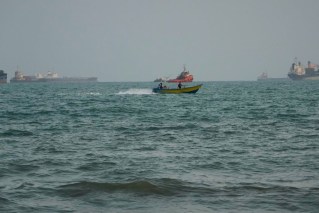
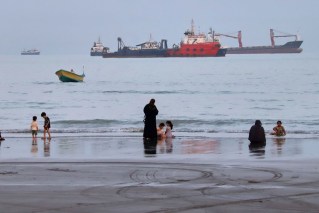
Shipping sources said at least two vessels reported coming under fire and being hit while trying to transit the waterway.
India later said the Iranian ambassador in New Delhi had been summoned and that it had expressed deep concern to him that two Indian-flagged ships had come under fire in the strait.
State media in Iran quoted the Supreme National Security Council as saying Iranian control over the strait included demanding the payment of costs related to security, safety and environmental protection services.
State television also quoted the Supreme National Security Council as saying the US had put forward new proposals after talks mediated by Pakistan in recent days.
Iran was considering them but had not yet responded, it said.
There was no immediate sign of direct US-Iran talks taking place at the weekend, despite Trump saying on Friday (local time) that negotiations would take place.
Iran’s renewed tough messaging caused new uncertainty around the conflict, raising the risk that oil and gas shipments through the strait could remain disrupted just as the US weighs whether to extend the fragile ceasefire.
Trump said the US was having “very good conversations” with Iran but that Iran wanted to close the strait again.
Iran could not blackmail the US, he said.
Trump stressed that both sides were still negotiating.
“We’re talking to them, and you know, we’re taking a tough stand,” he said, adding that “we’ll have some information by the end of the day”.
Maritime security and shipping sources said some merchant vessels had received radio messages from Iran’s navy saying no ships were allowed through the waterway, reversing Friday’s signs that traffic might resume.
Maritime trackers had earlier shown a convoy of eight tankers transiting the narrow passage in the first major movement of ships since the US-Israeli war on Iran began seven weeks ago.
Iran had announced its temporary reopening of the Strait of Hormuz following a separate US-brokered 10-day ceasefire agreement on Thursday between Israel and Lebanon.
But on Saturday Iran’s armed forces command said transit through the strait had reverted to a state of strict Iranian military control, citing what it described as repeated US violations and acts of “piracy” under the guise of a blockade.
The spokesperson said Iran had earlier agreed, “in good faith,” to the managed passage of a limited number of oil tankers and commercial vessels following negotiations but said continued US actions had forced Iran to restore tighter controls on shipping through the strategic choke point.
Bowser price uncertainty
Australian petrol prices are dropping as global oil prices ease but whether it continues depends on a fragile arrangement to reopen the Strait of Hormuz.
Everyone is hoping petrol prices keep falling but no one is confident.
Australian motorists woke on Saturday to news Iran had reopened the contentious Strait of Hormuz.
Yet by the time they’d soaped and hosed off the family ride and stepped inside for a coffee, Tehran was threatening to reimpose the restriction.
The United States says a convoy of oil tankers is crossing the crucial shipping channel in a first major movement of supplies since it and Israel launched war on Iran seven weeks ago.
Yet late on Saturday, Australian time, confusion swirled, with reports Iran had fired on a ship attempting to pass.
Anthony Albanese was earlier positive a reinvigoration of maritime commerce would spell good news for Australian petrol and diesel prices.
He was at pains to stress the arrangement was fragile, following an overnight summit on Friday of some 50 countries to support an ongoing Middle East ceasefire.
The clock is ticking on the pause in hostilities, which could fall apart as soon as Wednesday.
“We want to see de-escalation, we want to see the Strait of Hormuz opened and we want to see no privatisation and no tolls,” the prime minister told reporters in Sydney.
“We want to see this fragile arrangement confirmed and we want to see those ships being able to pass.”
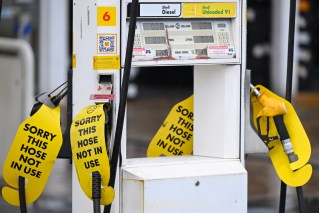
Australian bowser prices have dipped below $2.10 a litre and are under $3 for diesel for the first time since February across major cities.
However it may take time for consumers to feel the full impact of the Hormuz reopening even if it holds.
While recent falls in global oil prices are translating to cheaper fuel, markets are volatile, according to National Roads and Motorists Association spokesman Peter Khoury.
“Wholesale prices have been falling and they should continue to fall,” he told AAP.
“We are focusing on the wholesale prices in Australia because that’s the clearest indication of what going to happen at the bowser.
“It takes about seven to 10 days for those falls in oil prices to flow on in the Australian market.”
Reprieve aside, Khoury is urging motorists to remain cautious, saying it is still unclear whether the cheaper fuel will last.
“Trying to predict what’s going to happen in the Middle East is the quickest way to get made a fool of yourself,” he added.
“We’re really careful not to get too far ahead of ourselves but the trajectory has been in the right direction, it’s been positive and we really need that to continue.”
Energy Minister Chris Bowen says Australia has 46 days of petrol in reserve and 31 days’ worth of diesel.
The number of petrol stations without fuel is also dropping and there are about 120 without diesel across the nation.
Australasian Convenience and Petroleum Marketers Association’s Rowan Lee told AAP the issue facing consumers was fuel price rather than supply.
He said price pressures were expected to continue for at least the next six months.
“It’s just really uncharted territory and that is not underplaying it,” he said.
Energy Economics and Financial Analysis spokesman Kevin Morrison told ABC News it could take six weeks before Australia gets 80 per cent of the oil that’s been affected coming back online if peace holds.
“I don’t think we can expect cheaper oil prices in the foreseeable future,” he said.
French UN soldier killed
A French soldier has been killed and three others wounded while clearing a road in southern Lebanon in an attack that UNIFIL peacekeepers and French officials say was likely carried out by Hezbollah.
In calls with Lebanese President Joseph Aoun and Prime Minister Nawaf Salam, French President Emmanuel Macron condemned the “unacceptable attack,” his office said in a statement.
Three other members of the United Nations’ UNIFIL peacekeeping mission were injured, UNIFIL said, two of them seriously.
UNIFIL said initial assessments indicated the fire came from non-state actors, allegedly Hezbollah, and that an investigation had been launched into what it called “a deliberate attack”.
Macron also said the evidence so far pointed to the Iran-aligned armed group and urged Lebanese authorities to act against those responsible.
Hezbollah denied any involvement in the attack, expressing its “surprise at positions that rushed to make baseless accusations” against the group.
French armed forces minister Catherine Vautrin said the patrol was ambushed while on a mission to open a route to a UNIFIL post that had been isolated by fighting in the area.
The soldier was killed by direct small-arms fire, she said.
UNIFIL said the attack occurred in the southern Lebanese village of Ghandouriyeh.
Lebanon’s army condemned the shooting and said it had opened an investigation.
President Aoun offered condolences and ordered an immediate probe while Prime Minister Salam also condemned the attack.
UNIFIL was first deployed in 1978 and has remained through successive conflicts, including a 2024 war during which its positions came under repeated fire.
Separately, the Israeli military said on Saturday it had killed members of a “terrorist cell” that violated a US-brokered ceasefire and approached its soldiers in southern Lebanon.
It said it was authorised to take necessary self-defence measures against “threats,” adding that such actions are not restricted by the ceasefire.
Israel and Lebanon agreed a “cessation of hostilities” on Thursday for an initial period of 10 days to enable peace negotiations between the two countries, according to a text of the deal released by the US State Department.
The deal does not require Israel to withdraw from southern Lebanon, where Israeli troops have been destroying villages and infrastructure after ordering residents south of the Litani River to flee.
—AAP
Want to see more stories from The New Daily in your Google search results?
- Click here to set The New Daily as a preferred source.
- Tick the box next to "The New Daily". That's it.