PM tight-lipped on talks with China over flare incident
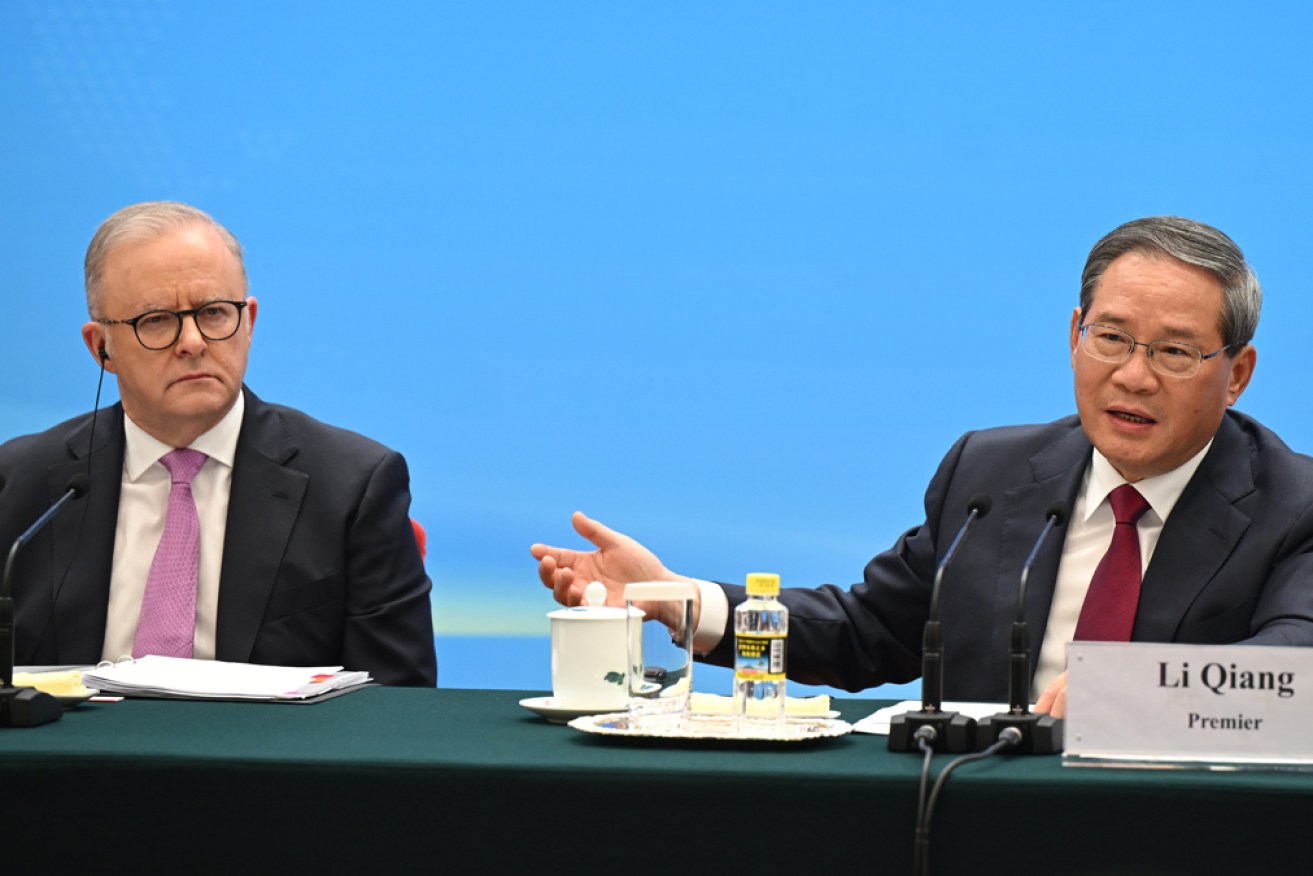
Anthony Albanese says Australia's relationship with China allows him to speak frankly with Li Qiang. Photo: AAP
Prime Minister Anthony Albanese has directly raised concerns with his Chinese counterpart after the nation’s military aircraft released flares close to an Australian defence jet.
But Albanese remained tight-lipped on what details were raised and how China’s Premier Li Qiang responded following a bilateral talk in Malaysia on Monday.
“He heard the message very directly. I’m not here to report on what people say when I have meetings,” Albanese said in Kuala Lumpur.
“I’m accountable for what I say and I made the position directly clear that this was an incident of concern for Australia.”
Australia lodged a diplomatic protest with Beijing after the Chinese military released the flare in “close proximity” to a RAAF plane in the South China Sea last week.
Asked how he could call Li a friend after the incident, Albanese said their close relationship allowed him to make clear his position.
“Friends are able to discuss issues frankly. I did that directly, that’s what we’re able to do,” Albanese said.
He arrived in Kuala Lumpur on Sunday night, shortly after US President Donald Trump, as the pair joined world leaders for the Association of South-East Asian Nations summit.
Albanese was welcomed by his Malaysian counterpart Anwar Ibrahim.
In a speech at the summit, Albanese outlined his government’s desire to expand its economic and business connections in the region.
He announced $175 million to invest in a global investment manager, owned by Australia’s industry superannuation funds.
The funds will be poured into sectors including renewable energy, telcos and logistics.
A $US50 million ($A77 million) investment in Australian public-private partnership infrastructure company Plenary to support healthcare, education and transport projects in the Philippines and Indonesia was also pledged.
“The markets and economies that we associated with our prosperity and our growth – the United Kingdom, Europe and the United States – were all on the other side of the world through the 1970s and into the 1980s,” Albanese said.
“This attitude began to change.
“We came to recognise the opportunity of proximity, the growth and transformation, the partnerships and potential right here in South-East Asia.”
South-East Asia was projected to become the world’s fourth largest economy by 2040, he said.
While in Malaysia, Albanese will meet several other leaders for talks. He said it was “terrific” to be one of the first international leaders to meet Japan’s newly-elected prime minister Sanae Takaichi.
On Wednesday, he will jet to South Korea for the Asia-Pacific Economic Cooperation summit, where a key meeting between Trump and Chinese president Xi Jinping is set for Thursday.
South-East Asian nations have been hit hard by tariffs imposed by the Trump administration and leaders are hoping for a reduction in those barriers.
-AAP
Want to see more stories from The New Daily in your Google search results?
- Click here to set The New Daily as a preferred source.
- Tick the box next to "The New Daily". That's it.