Ben Roberts-Smith allegedly threatened to sue his ex-wife over defamation case, court told

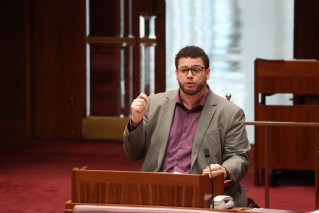
Ben Roberts-Smith is suing The Sydney Morning Herald, The Age and The Canberra Times newspapers. Photo: AAP
Decorated Australian soldier Ben Roberts-Smith allegedly threatened to sue his ex-wife if she breached a confidentiality agreement while speaking to lawyers acting in his defamation case, a court has heard.
Mr Roberts-Smith is suing three former Fairfax newspapers, The Sydney Morning Herald, The Age and The Canberra Times, as well as three journalists over a series of 2018 articles.
The Victoria Cross recipient claims the reports were defamatory and wrongly portrayed him as a criminal due to his alleged conduct while on deployment in Afghanistan, including the alleged murder of an unarmed civilian.
He claims the articles contained imputations including that he “broke the moral and legal rules of military engagement”, “disgraced his country”, bullied a fellow soldier and committed an act of domestic violence against a woman in a Canberra hotel.
Mr Roberts-Smith denies the specific events mentioned in the stories took place, while the media companies claim they are able to justify the imputations.
Ahead of a lengthy trial beginning in June, the Federal Court today heard lawyers acting for the media companies provided an outline of evidence set to be given by his ex-wife Emma Roberts to Mr Roberts-Smith’s legal team.
When more detail was requested, they sought an agreement that he would not rely on a confidentiality agreement but never received a response.

The court was presented with evidence set to be given by Ben Roberts-Smith’s ex-wife, Emma. Photo: AAP
Barrister Nicholas Owens SC, for the media companies, said Mr Roberts-Smith wrote to Ms Roberts with threats of an injunction, to sue her for damages and to overturn a property settlement.
Mr Roberts-Smith’s barrister, Bruce McClintock QC, later said he was “simply not in a position” to waive the confidentiality agreement, and also rejected the classification of the correspondence as a threat.
“It wasn’t a threat,” he said.
“It was simply a requirement that she obey an agreement she entered into in February this year, only two or three months ago.”
Mr McClintock said despite the case being “pretty awful already” he would need to cross-examine Ms Roberts to put to her that she is a liar.
He suggested his opponents should “re-think what they’re doing” because “sometimes you can pay too high a price to air a family’s dirty linen”.
Mr Owens insisted Ms Roberts’s evidence will be “carefully limited” so as to relate to matters directly relevant to the case, including allegations of witness intimidation and covert communication with witnesses by Mr Roberts-Smith.
The court also heard military witnesses who may give evidence risk consequences of “extraordinary gravity” including accusations of murder.
During arguments about the order in which evidence should flow, Mr McClintock said he wanted his client to be the first witness ahead of military witnesses.
But he said the position of those military witnesses must be considered due to the gravity of what is alleged against them, including the commission of murder and war crimes of the most serious kind.
Mr McClintock said the witnesses had a right to know the extent of the allegations before they were called.
He said the starkest examples were two people known by the pseudonyms ‘person 5’ and ‘person 11’.
“The consequences for those two men, person 5 and person 11, could be of extraordinary gravity,” he said.
“Indeed they could be of extraordinary gravity just by giving evidence in chief.
“In my submission, people in their positions should be entitled to hear and know the actual evidence against them before they’re called upon to respond.”
Mr Roberts-Smith is claiming damages, including aggravated damages, interest and costs, arguing the articles “brought [him] into public disrepute, odium, ridicule and contempt”.
The trial begins on June 7.
-ABC