Victoria announces landmark truth and justice royal commission as part of Aboriginal treaty talks
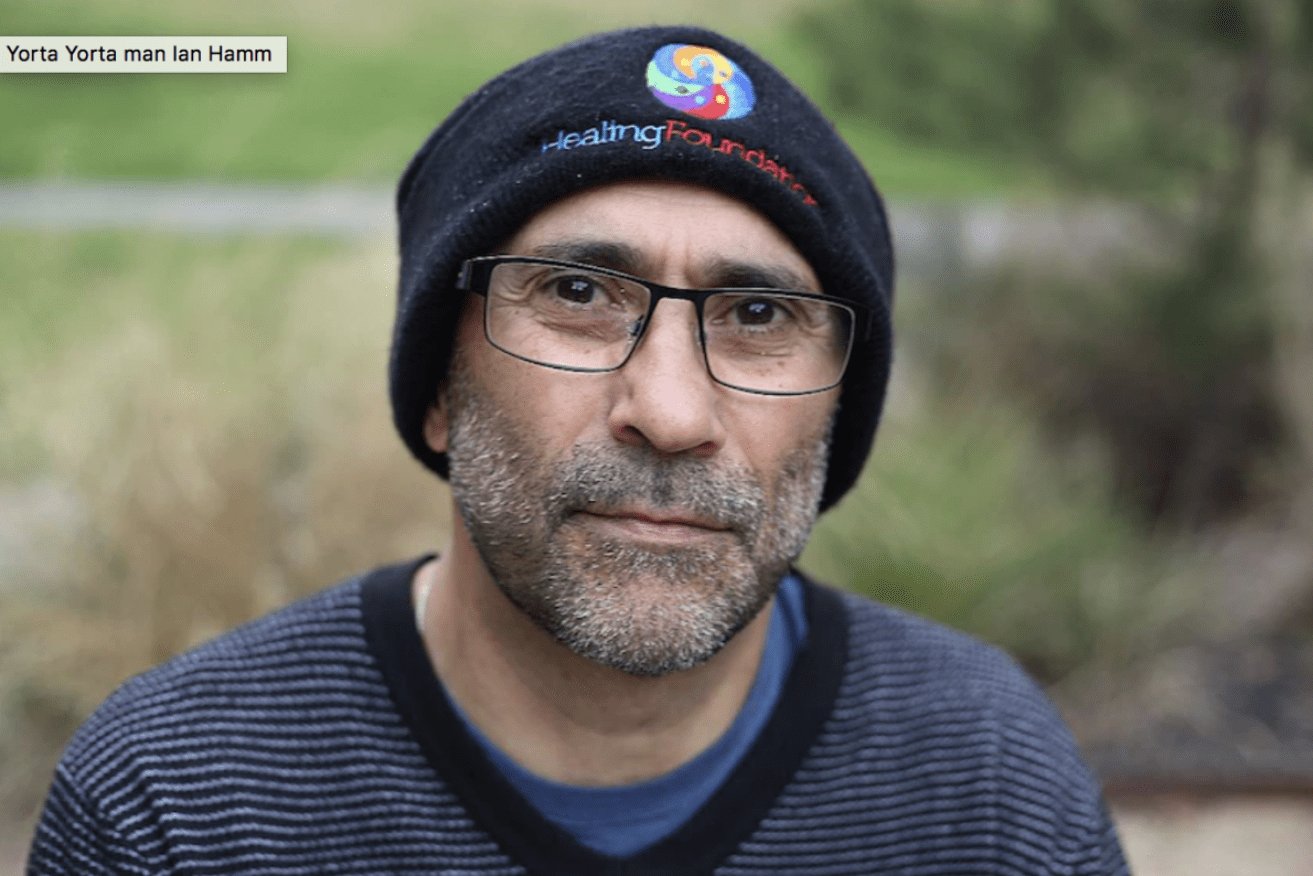
Yorta Yorta man Ian Hamm says the truth and justice royal commission offers a chance for all Victorians to embrace the state's ‘full story’. Photo: ABC: Joseph Dunston
Ian Hamm calls it “the transformation document”.
It is a single piece of paper that outlines the legal end of his life as Yorta Yorta baby Andrew James, and the start of his new life as the adopted son of a white family in Yarrawonga.
It is a document that took Mr Hamm, a member of the Stolen Generations, decades to find.
“At the top of the page I’m referred to as Andrew James … and at the bottom of the page, it says, ‘shall henceforth be known as Ian David Hamm’,” he said.
“I have a single piece of paper where I went from being one person to another person.”
Mr Hamm has forged a distinguished Victorian public sector career filled with landmark reforms for Aboriginal communities, including his involvement in the creation of the Traditional Owner Settlement Act.
But he said for him and the more than 800 members of the Stolen Generations or Stolen Children living in Victoria today, being torn from their Aboriginal identity at such a young age left a permanent mark.
“What you’re always trying to do is find your place in the world,” he said.
“Find out who you are, because there’s this thing about who you are, and there’s this thing about who you might otherwise have been.”

Mr Hamm’s only stories about his mother, Noelene, are those shared with him by those who knew her. Photo: ABC
The stories of Victoria’s Stolen Generations are expected to be just some of the material covered by a new truth and justice royal commission announced by the government on Tuesday.
It will be Australia’s first formal truth-telling process and a significant step in the Victorian government’s path to forge state-based treaties with its Aboriginal communities.
Five commissioners will be tasked with laying down an authoritative account of Victoria’s history of colonisation, and examine both historic and contemporary injustices.

First Peoples’ Assembly members Melissa Jones (left) and Aunty Geraldine Atkinson welcomed the announcement. Photo: ABC News/Joseph Dunstan
The majority of the commissioners will be Aboriginal, with at least one elder and one with legal expertise in the group.
The government had already committed to a truth and justice process, and on Tuesday announced that process would have the powers of a royal commission.
Deputy Premier James Merlino made the announcement at Coranderrk near Healesville, which was the site of one of Australia’s pivotal Aboriginal civil rights struggles.
Acting Victorian Premier James Merlino says the inquiry is ‘long-overdue’
“This is long overdue. It’s an acknowledgement that the pain in our past is present in the lives of people right now,” Mr Merlino said.
“It’s a recognition that without truth, without justice, you can’t have a treaty.
“You can’t take that incredibly powerful step forward until we go through this process.”
The holding of a truth and justice commission has been pushed for by the state’s First Peoples’ Assembly, which is laying the groundwork for the negotiation of state-based treaties in the future.
International transitional justice experts say truth-telling processes, which have been undertaken in South Africa, Canada and Mauritius, are often an important first step in addressing the legacies of colonisation.

Only later did Mr Hamm discover how his great-grandfather, Thomas James, taught a generation of Yorta Yorta civil rights campaigners. Photo: ABC
A chance to ‘fill in the gap’ on Victorian history
Mr Hamm is hopeful the commission will lay down the “good, the bad and the ugly” chapters of Victoria’s past for everyone to embrace and understand, including the difficulties faced.
Growing up in Yarrawonga, Mr Hamm and two of his sisters, who were also adopted from separate Aboriginal families, were the only Indigenous people in town.
They were aware they were different, but their only reference points to understanding their Aboriginality lay in what they were told or read in news coverage.
“And this was the ’60s and ’70s, so it wasn’t great,” he said, recalling how as the only Aboriginal footballer in his local league he would be subjected to a “shower of racism” every week.
The First Peoples’ Assembly is also keen for the truth-telling process to shine a light on the extraordinary acts of Aboriginal resilience and self-determination carried out in the face of colonisation.
Mr Hamm discovered his own links to that history as a young man, including the story of his non-Indigenous great-grandfather Thomas James, who married Yorta Yorta woman Ada Cooper.
A Mauritian migrant with Indian heritage, Mr James’s legendary tutelage at Cummeragunja equipped a generation of Yorta Yorta men and women with skills they used to take huge strides in Australia’s civil rights movement.
Mr Hamm said he felt much of Victoria’s history was a scattered group of anecdotes and was missing “the full story”.
“Hopefully this commission will be able to do that and it will fill in the gap in the story of Victoria that now exists,” he said.
“And really it will be about one part of the Victorian community telling the rest of the Victorian community, ‘this is part of our collective story’ and that will be a base, I hope, for where we go from here.”