Hong Kong police fire tear gas, make mass arrests as protests resume
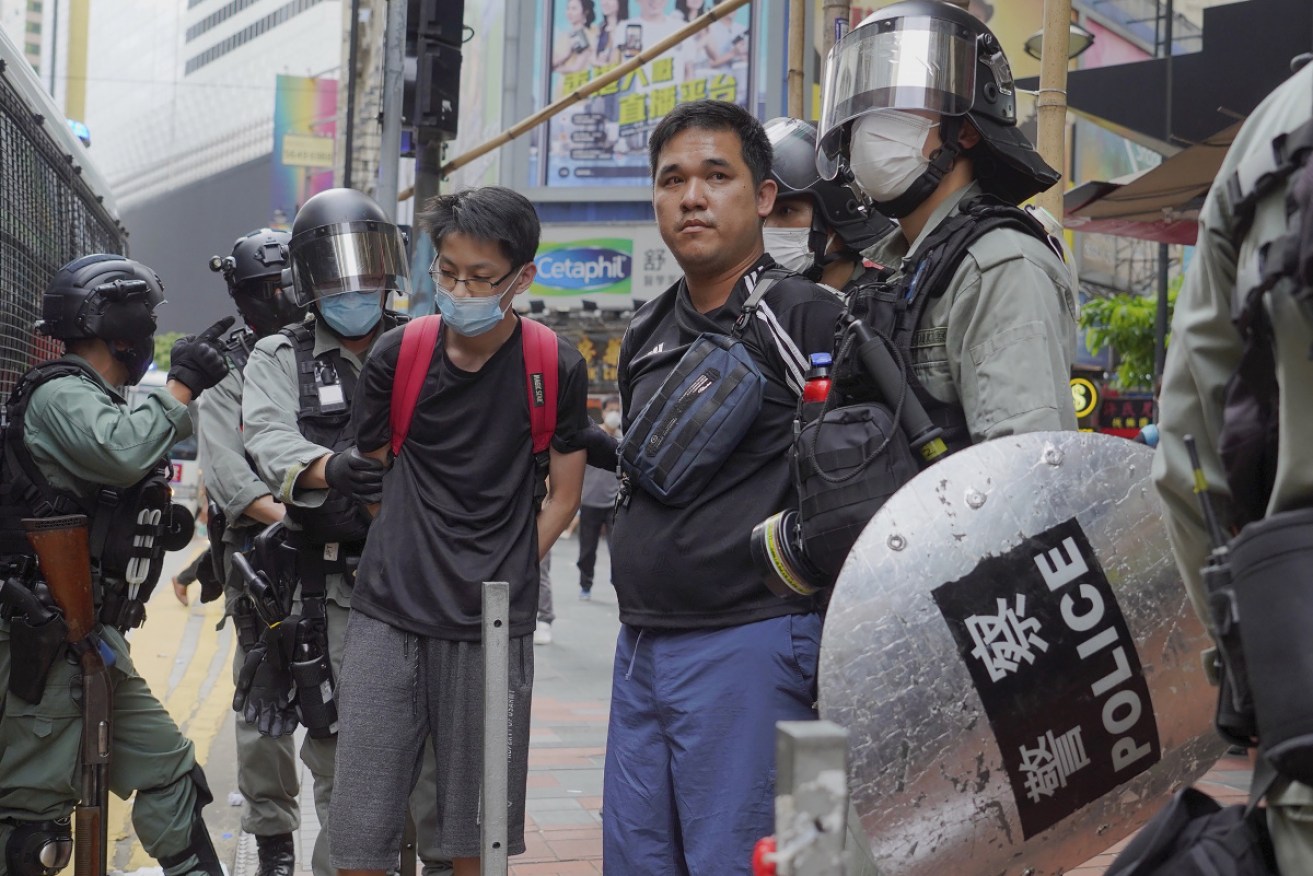
Riot police detain protesters during a demonstration against Beijing's national security legislation at Causeway Bay on Sunday. Photo: PA
Hong Kong police have fired tear gas and pepper spray to disperse thousands of people protesting against Beijing’s plan to directly impose national security laws on the city, the biggest flare-up in the city since COVID-19 lockdowns began.
Crowds thronged the bustling shopping district of Causeway Bay, where protesters chanted, “Revolution of our time. Liberate Hong Kong”, “Fight for freedom, Stand with Hong Kong” and “Hong Kong independence, the only way out”.
The protest on Sunday was the first since Beijing proposed national security laws on Thursday and pose a fresh challenge to Chinese President Xi Jinping as authorities struggle to tame public opposition to China’s tightening grip over the global financial hub.
The demonstrations come amid concerns over the fate of the “one country, two systems” formula that has governed Hong Kong since the former UK colony’s return to Chinese rule in 1997.
Causeway Bay: Police sweep into the Times Square area, arrest a young man and threaten the press with pepper spray. pic.twitter.com/DVaIS0Zvyu
— Hong Kong Free Press HKFP (@hkfp) May 24, 2020
The arrangement guarantees the city broad freedoms not seen on the mainland, including a free press and independent judiciary.
Sunday’s rally was initially organised against a controversial national anthem bill, due for a second reading in the city’s lawmaking body on Wednesday.
The proposed national security laws sparked calls for more people to take to the streets.
The city government sought on Sunday to reassure the public and foreign investors over the tough security laws that sent a chill through financial markets and drew a swift rebuke from foreign governments, international human rights groups and some business lobbies.
“These radical claims and illegal violence are extremely worrying,” Chief Secretary Matthew Cheung said in a blog post, referring to a backlash against the proposed laws as well as anti-government protests that roiled the city for months from June last year.
“We must face (this issue) squarely. If the situation is not effectively contained, it may be elevated to the level of endangering national security.”
According to a police statement on Facebook, the force has arrested at least 120 people in Causeway Bay and Wan Chai – most in connection with allegedly participating in an illegal assembly – as of 4:30 pm. Photo: United Social Press. pic.twitter.com/hZz4pSwB7H
— Hong Kong Free Press HKFP (@hkfp) May 24, 2020
Police conducted stop-and-search operations in Causeway Bay and warned people not to violate a ban on gatherings of more than eight, imposed to curb the spread of coronavirus.
They fired tear gas and pepper spray to disperse crowds amid chaotic scenes that evoked memories of sometimes violent anti-government protests that roiled the city last year, drawing as many as two million people. Some protesters tried to set up road blocks.
In a bold challenge to the mainland authorities, a small group of democracy activists protested outside Beijing’s main representative office in the city, chanting, “National security law is destroying two systems”.
Avery Ng of the League for Social Democrats pasted protest signs on a plaque outside the Liaison Office, despite warnings from police.
He described the proposed legislation as an “evil law” and appealed to Hong Kong people to come out and protest against it.
“It’s a moveable red line. In future they can arrest, lock up and silence anyone they want in the name of national security. We have to resist it,” Ng told Reuters.
More tear gas rounds are fired in Causeway Bay, near the Sogo. pic.twitter.com/UlNmUiJ5NL
— Hong Kong Free Press HKFP (@hkfp) May 24, 2020
A backlash intensified on Saturday as nearly 200 political figures from around the world said in a statement the proposed laws are a “comprehensive assault on the city’s autonomy, rule of law and fundamental freedoms”.
Last year’s anti-government protests plunged the city into its biggest political crisis in decades, battered the economy and posed the gravest popular challenge to President Xi Jinping since he came to power in 2012.
-AAP