AI is becoming the perfect partner. That may be the problem


AI can help smooth our path into relationships – but it's no substitute for interacting with a real person. Photo: Unsplash
Artificial intelligence did not suddenly arrive in our love lives with ChatGPT. Dating apps have used algorithms and machine learning for years to decide who appears in our feeds, recommend potential matches and shape the interactions that follow.
What has changed is the sophistication of the technology and how much of the process we are increasingly willing to hand over to it.
Tinder provides a fascinating example. Its latest AI-powered personalisation system, Chemistry, was initially developed in Australia and New Zealand and is now being expanded internationally. Rather than relying only on swiping behaviour, Chemistry uses questions and optional access to information from a user’s camera roll to develop a picture of their personality, interests and lifestyle, then uses that information to curate recommendations.
There is nothing inherently sinister about this. In many respects, it is exactly what we have always asked technology to do: Reduce uncertainty. But dating is fundamentally an exercise in uncertainty, and this is where things become interesting.
Australian data suggests our relationship with AI is already moving well beyond convenience. YouGov research conducted among a nationally representative sample of Australians in 2025 found 28 per cent had opened up or been emotionally vulnerable with an AI chatbot at least once.
By 2026, the relationship was becoming more personal. Another nationally representative YouGov study found 15 per cent of Australian adults had shared personal thoughts or feelings with a chatbot, 12 per cent had used one for emotional support during a difficult period and 11 per cent had disclosed something to a chatbot that they had never told anyone else. Eight per cent described having experienced a friendship with a chatbot and 4 per cent said they had experienced what they considered a romantic relationship.
Among younger Australians, the attraction becomes clearer. Forty-one per cent of gen Z respondents said chatbots could be easier to engage with because they don’t judge, argue or place demands on them.
It is tempting to dismiss this as another strange gen Z trend, but I think it tells us something much more fundamental about where intimacy is heading. In my own research into online dating, fear of rejection was a recurring theme. Technology provided a buffer between the individual and one of the most uncomfortable human experiences: Putting yourself in front of another person and discovering they don’t want you.
Why risk being rejected face-to-face when you can establish interest first?
Dating apps didn’t invent fear of rejection. However, they became remarkably effective at mediating it. We could swipe rather than approach, match before speaking, unmatch rather than explain, or ghost rather than endure the uncomfortable conversation that says: This isn’t working.
Over time, we have also become accustomed to relationships that can be exited with extraordinarily little friction. A person who once would have required a conversation can disappear from our lives through silence, blocking or an unmatch. The other person can effectively be removed from the screen.
AI is the logical extension of this trajectory because it doesn’t merely reduce the possibility of rejection. It offers companionship in which rejection may barely exist.
This is particularly seductive because human beings have always struggled to trust themselves. Our bodies and emotions are unruly things. We blush. We sweat. Our hearts race. We desire people we know are wrong for us. Someone can satisfy every criterion on our list and leave us completely cold, while someone entirely inappropriate can walk into a room and destabilise us.
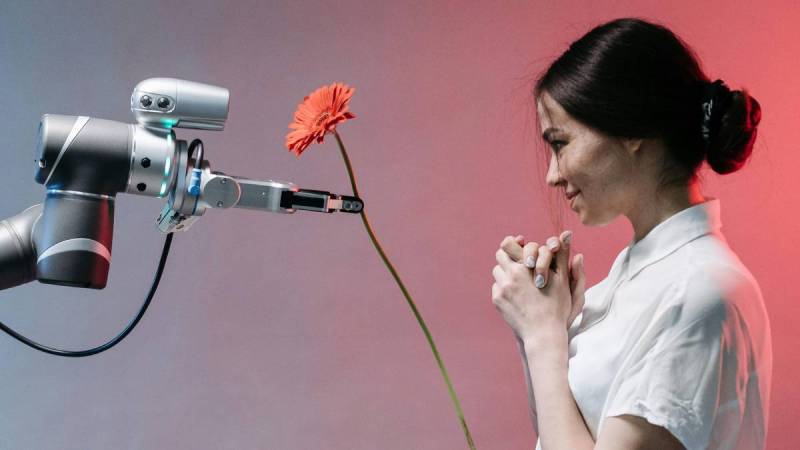
For younger Australians, in particular, technology provides a buffer from rejection.
There is something almost Cartesian about our growing reliance on technology: The enduring fantasy that the rational mind can discipline the unreliable body. Now our watches tell us whether we slept well. Algorithms tell us whom we should meet. Apps measure compatibility. AI interprets the ambiguous text message, identifies the supposed red flag and tells us what to say next.
We increasingly turn to technology to straighten out the messy evidence of our own bodies and emotions.
Then AI offers to straighten us out as well. It can choose the photograph, polish the biography, write the opening line, improve the response and make us appear smoother, funnier and more confident.
At what point do we optimise ourselves out of the picture?
Intimacy is not simply the experience of being understood or validated. Intimacy requires encountering another person whom we cannot entirely control.
Other people misunderstand us. They disagree. They have needs when we are exhausted. They have boundaries that inconvenience us. They become angry. They lose interest. They sometimes reject us. Relationships require negotiation, disappointment, rupture and repair.
These are not glitches in intimacy. They are part of its architecture.
The irony is that Australian gen Z daters appear to recognise this. Tinder’s own Australian research this year found more than three-quarters wanted a stronger sense of romantic “yearning”, while 81 per cent believed yearning was important to developing an early emotional connection.
Perhaps that is the real tension emerging in our relationships.
We want intimacy without rejection, connection without awkwardness and relationships without unnecessary friction. AI may become extraordinarily good at providing all three. But love has never worked like that. Love requires another person – strange, autonomous, inconvenient and impossible to completely optimise.
Dr Lisa Portolan is a casual academic at the University of Technology Sydney. Her PhD on dating apps and intimacy from Western Sydney University was published in 2024. It has also been released as a book: Love, intimacy and online dating (Routledge, 2023)
Want to see more stories from The New Daily in your Google search results?
- Click here to set The New Daily as a preferred source.
- Tick the box next to "The New Daily". That's it.


Taxable super matters to you, and your beneficiaries




Pork barrel rolls out again – it's time for a change